- Animals
- ›Arthropods
- ›Hexapods
- ›Insects
- ›Winged and Once-winged Insects
- ›Butterflies and Moths
- ›Butterflies
- ›Swallowtails and Parnassians
- ›Swallowtails
- ›Fluted Swallowtails
- ›Heraclides
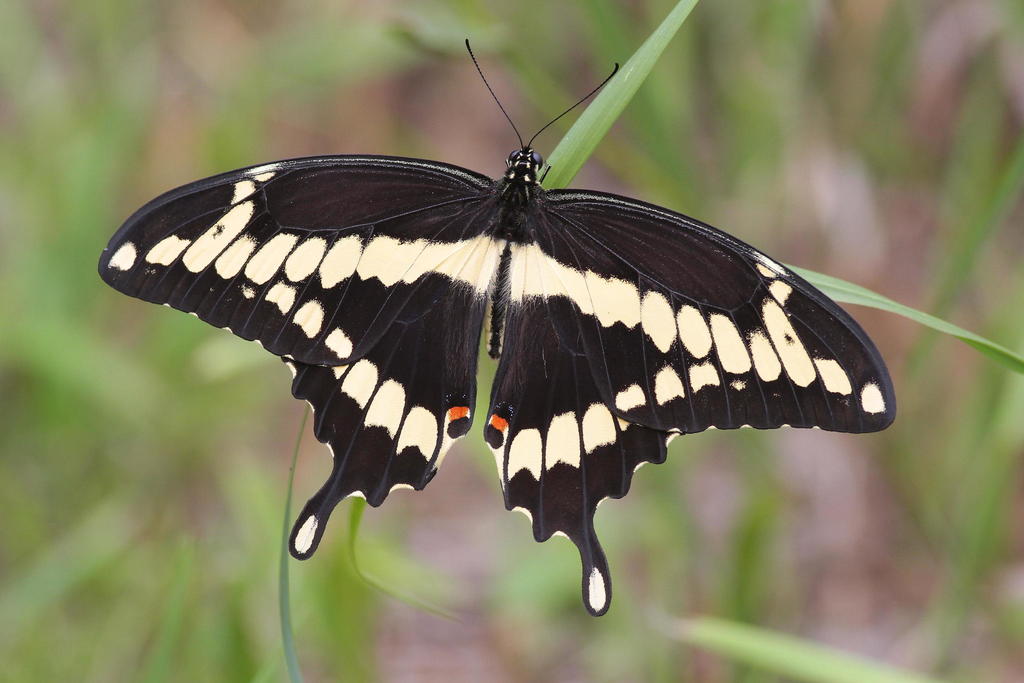
Eastern Giant Swallowtail
Heraclides cresphontes
The eastern giant swallowtail (Papilio cresphontes) is the largest butterfly in North America. It is abundant through many parts of eastern North America; populations from western North America and down into Panama are now (as of 2014) considered to belong to a different species, Papilio rumiko. Though it is often valued in gardens for its striking appearance, its larval stage can be a serious pest to citrus farms, which has earned its caterpillars the names orange dog or orange puppy. The eastern giant swallowtail caterpillars possess remarkable camouflage from predators by closely resembling bird droppings. They use this, along with their osmeteria, to defend against predators such as wasps, flies, and vertebrates.
From the article Papilio cresphontes on Wikipedia (CC BY-SA), quoted section by section
Description
One of the eastern giant swallowtail's most notable features is its size. Females have an average wingspan of 5.5 in (14 cm), and up to 6.9 in (18 cm), while males' average is 5.8 in (15 cm), and up to 7.4 in (19 cm). The wings are black with a horizontal yellow line across the forewings, and a diagonal yellow line across the hindwing. The underside of the wings is yellow with accents of black. A small patch of red on the ventral wing (within the small blue band) allows for distinction from the similar-looking Schaus' swallowtail. Seitz -"P. cresphontes Cr. (7a). Usually considered a slightly different variety of P. thoas. No cell-spot on the forewing; the fifth discal spot projecting further than the sixth. Claspers of the male separate above, the anal hook quite short, the lower part of the anal segment likewise quite different from that of P. thoas; harpe broad, rounded. A common species in eastern North America, occurring as far as Costa Rica in the south and southern Canada in the north; but the insect is a wanderer, which is found only now and then in the northern districts. In the United States it does not extend westward beyond the Mississippi plain, except in the Southern States. Its true home is the region adjoining the Gulf of Mexico. It occurs also on Cuba. Papilio cresphontes is a member of the Papilio thoas species group. '
Range & habitat
The eastern giant swallowtail is common across the United States, reaching as far north as southern New England and southern Canada. South of the United States, it is found in parts of Mexico and also found in Jamaica and Cuba. The species was historically considered to occur in the western United States and into South America, but now those populations are treated as a separate species, the western giant swallowtail (Papilio rumiko), based largely on DNA evidence.
Wikipedia: “Geographic range”
What it does
In specific local subpopulations (studied in Wisconsin, Ohio, and Florida), it was found that eastern giant swallowtail caterpillars do better on their local host plant than on other giant swallowtail host plants. The local host caused the larva to develop faster than other plants that were also edible to the larva. However, this feeding specialization hypothesis has not been tested in the species as a whole beyond these three regions.
Wikipedia: “Feeding specialization”
Listen
Looking for field recordings…
Where it lives
Recorded sightings
—
geo-referenced records in GBIF, from museums, herbaria and field observers.
Drag the globe to turn it. Dots are where records exist, not a range map; darker means more records.
In the stacks
Searching the stacks…
Every page naming Heraclides cresphontes in the Biodiversity Heritage Library →
This page is assembled live from iNaturalist, GBIF, Wikipedia, the Source Library and the Internet Archive. It is not yet part of the hand-edited codex. iNaturalist taxon 85024.