- Plants
- ›Vascular Plants
- ›flowering plants
- ›Dicots
- ›pinks, cactuses, and allies
- ›cacti
- ›Opuntioideae
- ›Opuntieae
- ›Opuntia
- ›Opuntia engelmannii
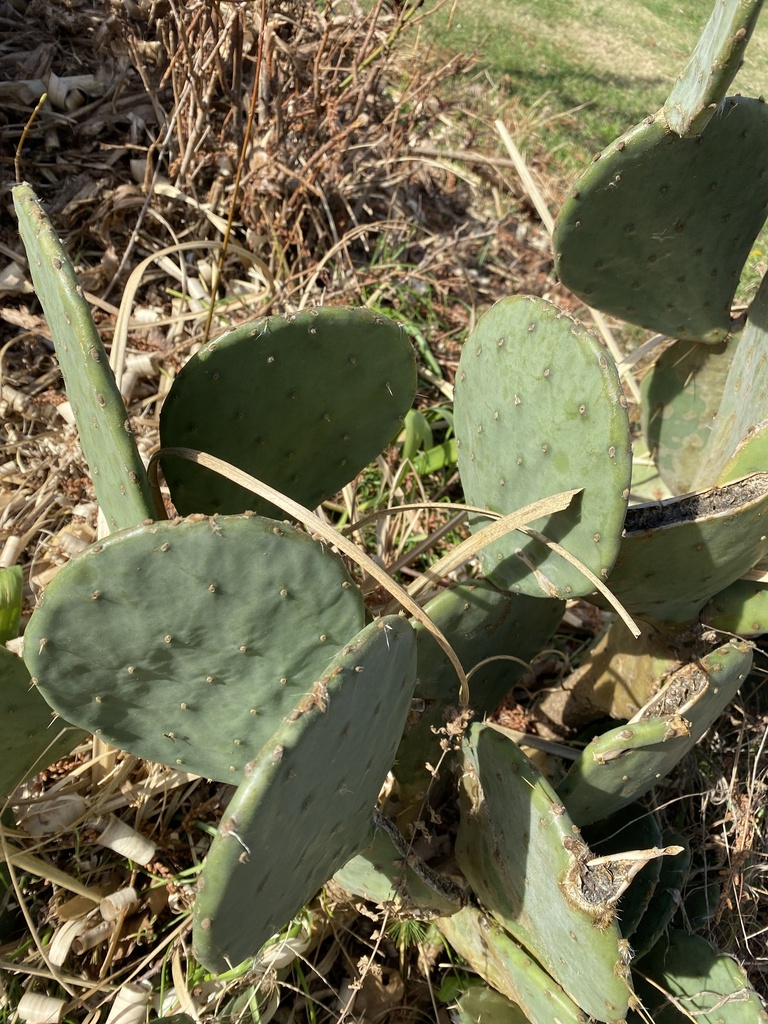
Carolina Prickly-pear Cactus
Opuntia tunoidea
Opuntia tunoidea, the Indian fig or eastern prickly pear, is a species of flowering cactus in the genus Opuntia, and occurs in most of the eastern United States. It is less often cultivated than the eastern prickly pear, despite being nearly, if not more cold hardy.
From the article Opuntia tunoidea on Wikipedia (CC BY-SA), quoted section by section
Description
Opuntia tunoidea is an erect succulent that can grow to as much as 2 meters (6.6 ft) in height. Its branches are widely spaced with an open structure. The large flat pads are spoon-shaped, tear-drop shaped, oval, or elliptic and are generally 10 to 30 centimeters (3.9–11.8 in) long. They are bright green in color and covered in natural waxes. The pads are covered in spines that emerge from areole, raised areas, that are evenly spaced and more numerous along the edges of the pads than on the flat faces. The spines are often in groups of two to four, but can also be solitary or in larger numbers. They are a dull yellow color when dry and 1–3 cm (0.5–1 in) long, and can be straight or curved. The flowers are bright yellow and 6.5–8 cm (2.5–3 in) across. The outermost set of sepals is kidney-shaped. The fruit is 4.5–6 cm (2–2.5 in) long and purple.
Where it lives
Recorded sightings
—
geo-referenced records in GBIF, from museums, herbaria and field observers.
Drag the globe to turn it. Dots are where records exist, not a range map; darker means more records.
In the stacks
Searching the stacks…
Every page naming Opuntia tunoidea in the Biodiversity Heritage Library →
This page is assembled live from iNaturalist, GBIF, Wikipedia, the Source Library and the Internet Archive. It is not yet part of the hand-edited codex. iNaturalist taxon 852610.