- Animals
- ›Arthropods
- ›Hexapods
- ›Insects
- ›Winged and Once-winged Insects
- ›Butterflies and Moths
- ›Butterflies
- ›Brush-footed Butterflies
- ›Satyrs, Morphos, and Allies
- ›Alpines, Arctics, Nymphs and Satyrs
- ›Satyrina
- ›Chazara
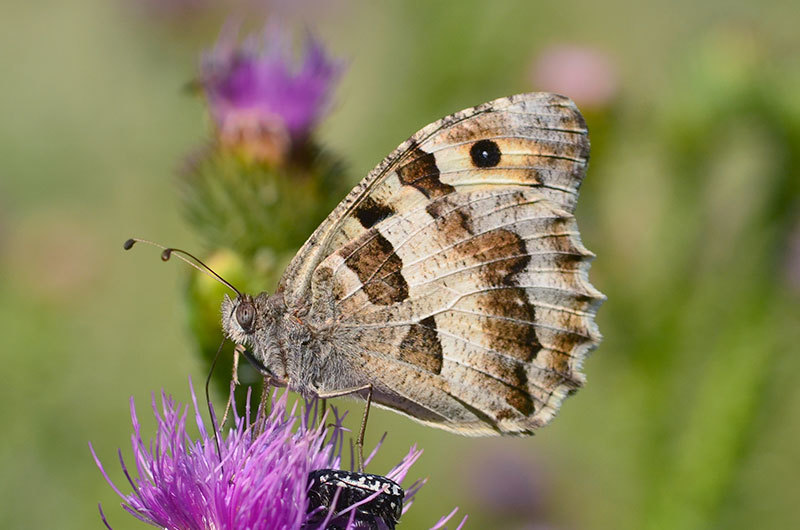
The Hermit
Chazara briseis
Chazara briseis, the hermit, is a butterfly species belonging to the family Nymphalidae. It can be found in North Africa, southern Europe, Asia Minor, the Caucasus, Kazakhstan, Central Asia through Afghanistan, and north-western China and Tuva. It is found on steppe and in other dry grassy places between 500 and 2,500 meters.
Their wingspan is 45–60 mm. The butterflies fly from July to September depending on the location.
From the article Chazara briseis on Wikipedia (CC BY-SA), quoted section by section
Description
S. briseis L. (= janthe Pall., daedale Bgstr.) (42b). Very variable in size and markings; recognizable by the flat triangular club of the antenna and the pale costal margin of the forewing. The dark wings are traversed by a band which is usually composed of narrow transverse spots, bearing a distinct apical ocellus and a second similar spot before and somewhat below the middle of the distal margin. Band of the hindwing sometimes shaded. On the underside the male has large dark angular spots at the base of both wings, the female having the hindwing beneath generally uniformly brownish or grey; North France, Germany, Austria, Hungary, and the adjacent districts of Russia. — meridionalis Stgr. (42b) is the South-European form, which is especially common on the Mediterranean coasts of Europe. The white spots composing the band of the forewing are broader than in specimens from Central Europe. — magna Stgr. is the from East Europe, which flies also in some districts of Asia Minor; in size like meridionalis, but the band somewhat broader and purer white, especially on the hindwing. — ab. pirata Esp. (42 f) has the size of the previous, but the band is ochreous; occurs among white-banded specimens in South and East Europe, and Anterior Asia, being especially large in the last country. — major Oberth. …
Wikipedia: “Description in Seitz”
Listen
Looking for field recordings…
Where it lives
Recorded sightings
—
geo-referenced records in GBIF, from museums, herbaria and field observers.
Drag the globe to turn it. Dots are where records exist, not a range map; darker means more records.
In the stacks
Searching the stacks…
Every page naming Chazara briseis in the Biodiversity Heritage Library →
This page is assembled live from iNaturalist, GBIF, Wikipedia, the Source Library and the Internet Archive. It is not yet part of the hand-edited codex. iNaturalist taxon 85460.