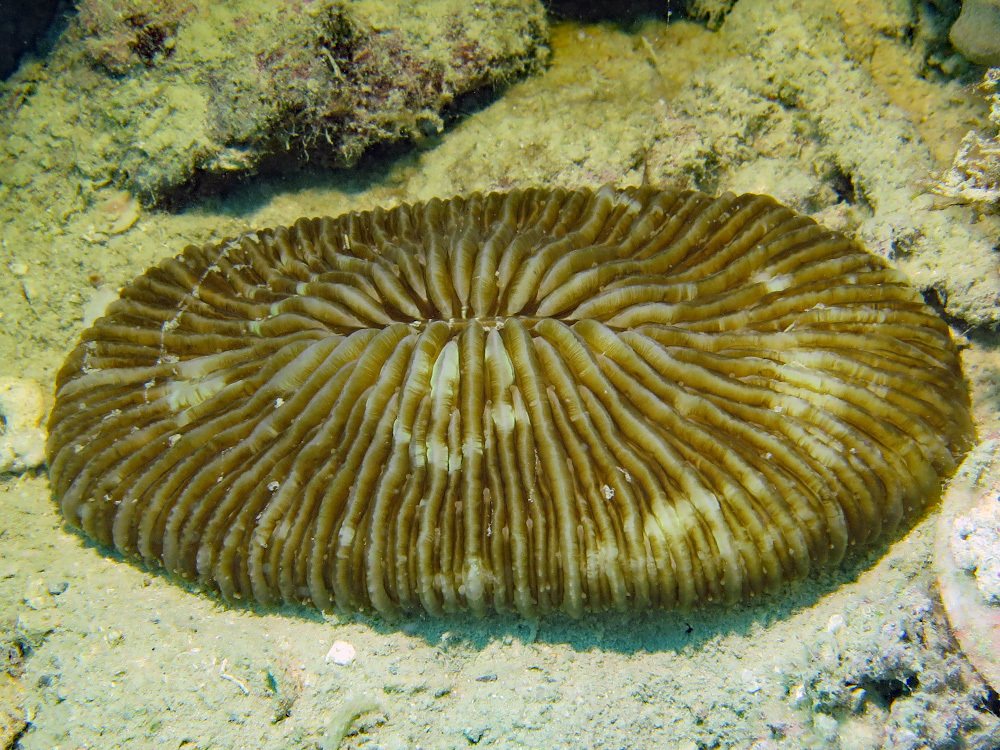
Elongate Mushroom Coral
Pleuractis paumotensis
Pleuractis paumotensis, commonly called plate coral, is a species of stony coral with a single large polyp. Plate coral are commonly kept in marine aquaria.
From the article Pleuractis paumotensis on Wikipedia (CC BY-SA), quoted section by section
Description
Pleuractis paumotensis is a solitary, non-colonial coral that is free living and not attached to the seabed. It is an elongated oval in shape and can grow to a very large size. The polyp can be up to 25 centimetres (9.8 in) long and is embedded in a cup shaped hollow known as a corallite, surrounded by calcareous material. Lining this are narrow ribs known as septa. Outside the corallite wall the ribs continue, now known as costae, bearing rows of tiny spines. The colour is usually brown. The polyp has a central, slit-like mouth and a small number of short, tapering tentacles.
Range & habitat
Pleuractis paumotensis occurs in the Indian Ocean on upper reef slopes especially where there is considerable movement of the water as a result of wave action. It is usually found on sand or beds of coral fragments. It is often associated with other species of Fungia.
== References ==
Wikipedia: “Distribution and habitat”
Where it lives
Recorded sightings
—
geo-referenced records in GBIF, from museums, herbaria and field observers.
Drag the globe to turn it. Dots are where records exist, not a range map; darker means more records.
In the stacks
Searching the stacks…
Every page naming Pleuractis paumotensis in the Biodiversity Heritage Library →
This page is assembled live from iNaturalist, GBIF, Wikipedia, the Source Library and the Internet Archive. It is not yet part of the hand-edited codex. iNaturalist taxon 856017.