- Fungi Including Lichens
- ›Ascomycete Fungi
- ›Sac Fungi and Lichens
- ›Sordariomycetes
- ›Hypocreomycetidae
- ›Hypocreales
- ›Cordycipitaceae
- ›Beauveria
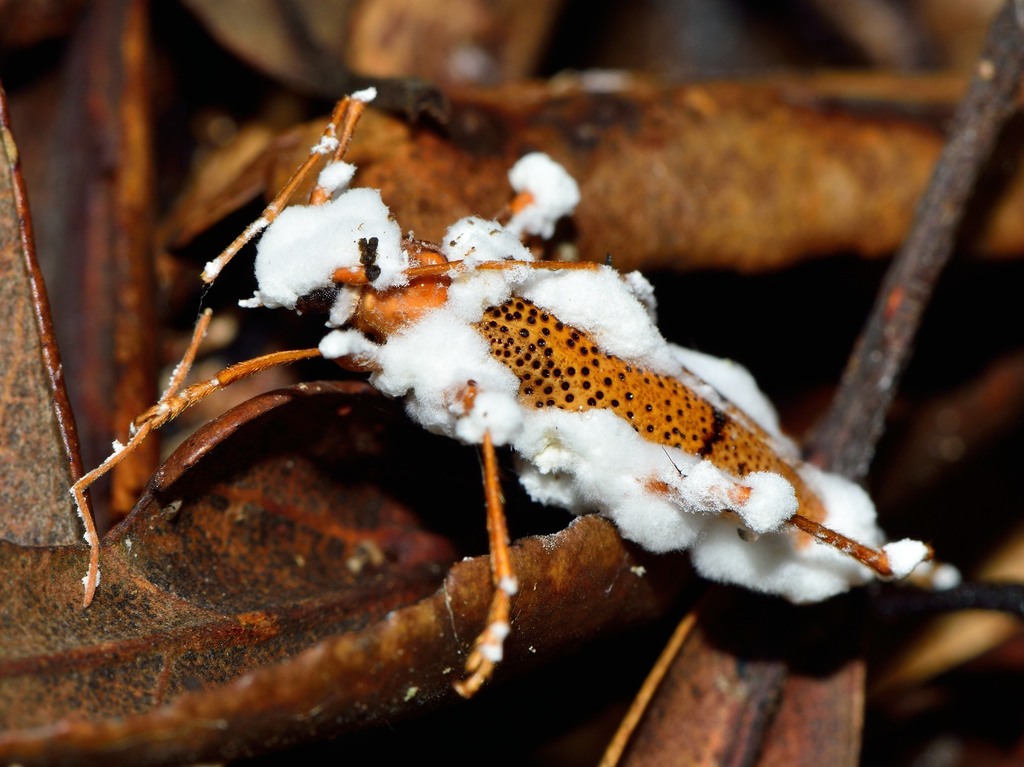
Icing sugar fungus
Beauveria bassiana
Beauveria bassiana is a fungus that grows naturally in soils throughout the world and acts as a parasite on various arthropod species, causing white muscardine disease; it thus belongs to the group of entomopathogenic fungi. It is used as a biological insecticide to control a number of pests, including termites, thrips, whiteflies, aphids, and various beetles. Its use in the control of bed bugs and malaria-transmitting mosquitos is under investigation.
From the article Beauveria bassiana on Wikipedia (CC BY-SA), quoted section by section
Description
B. bassiana is a white mold when grown on culture, producing white spore balls made up of many conidia that are single-celled, haploid, and hydrophobic. The short, ovoid conidiogenous cells that produce the conidia have a narrow apical extension called a rachis, which elongates into a long zig-zag extension.
What it does
The insect disease caused by the fungus is a muscardine, which has been called white muscardine disease. When the microscopic spores of the fungus come into contact with the body of an insect host, they germinate, penetrate the cuticle, and grow inside, killing the insect within a matter of days. Afterwards, a white mold emerges from the cadaver and produces new spores. A typical isolate of B. bassiana can attack a broad range of insects; various isolates differ in their host range. B. bassiana parasitizing the Colorado potato beetle has been reported to be, in turn, the host of a mycoparasitic fungus Syspastospora parasitica. This organism also attacks related insect-pathogenic species of the Clavicipitaceae. A fungus attributed to be B. bassiana was observed to cause infections in a captive American alligator and B. bassiana was implicated in causing a pulmonary disease in captive tortoises. The reptiles were in captivity and under temperature stress which may explain their susceptibility to the fungus. When a tortoise was kept at 22 °C and injected with 0.5 mL of 106 spores of B. …
Wikipedia: “Ecology”
At the table
B. bassiana can be used as a biological insecticide to control a number of pests such as termites, whiteflies, and many other insects. Its use in the control of malaria-transmitting mosquitos is under investigation. As an insecticide, the spores are sprayed on affected crops as an emulsified suspension or wettable powder or applied to mosquito nets as a mosquito control agent.
As a species, B. bassiana parasitizes a very wide range of arthropod hosts. However, different strains vary in their host ranges, some having rather narrow ranges, like strain Bba 5653 that is very virulent to the larvae of the diamondback moth and kills only few other types of caterpillars. Some strains do have a wide host range, so should be considered nonselective biological insecticides. These should not be applied to flowers visited by pollinating insects. Known targets of the species include: Preliminary research has shown the fungus is 100% effective in eliminating bed bugs exposed to cotton fabric sprayed with fungus spores. It is also effective against bed bug colonies due to B. bassiana carried by infected bugs back to their harborages. The tested strain of B. bassiana caused rapid mortality (3–5 days) after short-term exposure. In a 2017 follow-up study, pyrethroid-resistant bed bugs had >94% mortality after treatment with a commercial preparation of B. bassiana.
Wikipedia: “Uses”
Toxicity
The fungus rarely infects humans or other animals, so it is generally considered safe as an insecticide. However, at least one case of human infection by B. bassiana has been reported in a person with a suppressed immune system. Additionally, the spores may exacerbate breathing difficulties.
Where it lives
Recorded sightings
—
geo-referenced records in GBIF, from museums, herbaria and field observers.
Drag the globe to turn it. Dots are where records exist, not a range map; darker means more records.
In the stacks
Searching the stacks…
Every page naming Beauveria bassiana in the Biodiversity Heritage Library →
This page is assembled live from iNaturalist, GBIF, Wikipedia, the Source Library and the Internet Archive. It is not yet part of the hand-edited codex. iNaturalist taxon 862160.