- Plants
- ›Vascular Plants
- ›flowering plants
- ›monocots
- ›Agaves, Orchids, Irises, and Allies
- ›Orchids
- ›Orchidoid Orchids
- ›Diurideae
- ›Prasophyllinae
- ›Microtis
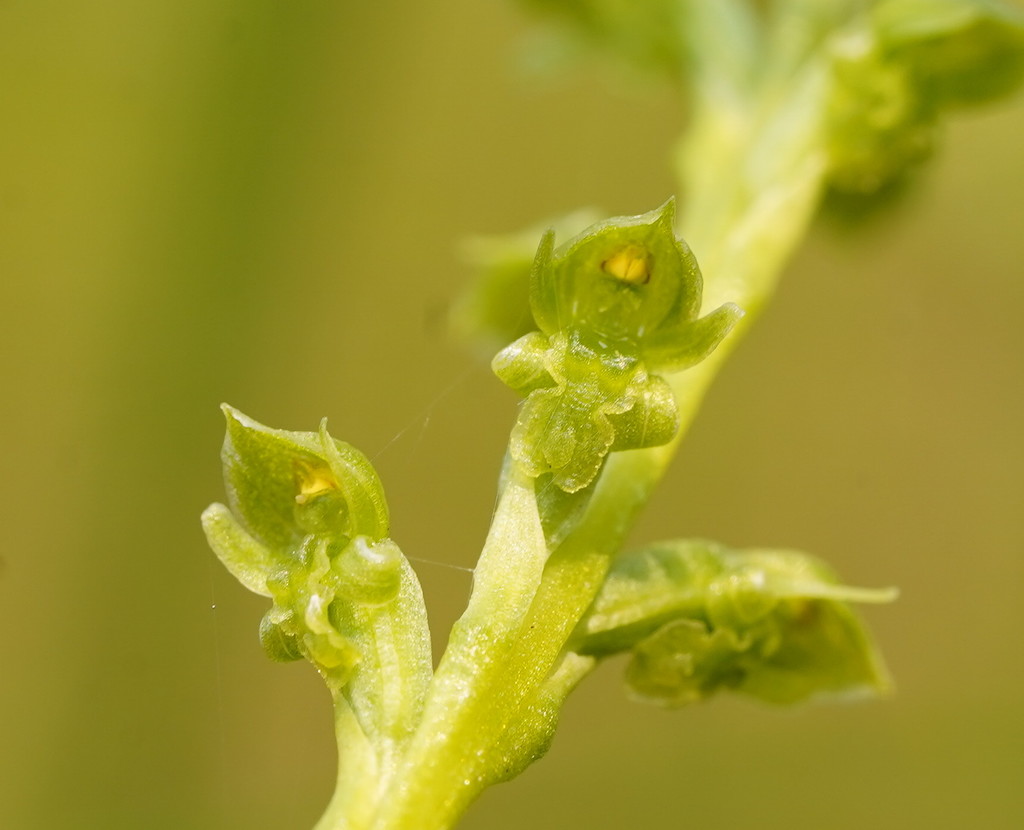
sweet onion-orchid
Microtis oblonga
Microtis oblonga, commonly known as the sweet onion orchid, is a species of orchid endemic to south-eastern Australia. It has a single hollow, onion-like leaf and up to fifty scented, bright green flowers. It is considered by some Australian authorities to be synonymous with Microtis rara.
From the article Microtis oblonga on Wikipedia (CC BY-SA), quoted section by section
Description
Microtis oblonga is a terrestrial, perennial, deciduous, herb with an underground tuber and a single erect, smooth, tubular leaf 200–600 mm (8–20 in) long and 6–8 mm (0.2–0.3 in) wide. Between ten and fifty bright green, sweetly scented flowers are arranged along a flowering stem 400–900 mm (20–40 in) tall. The flowers are 5–6 mm (0.20–0.24 in) long and 2–3 mm (0.08–0.1 in) wide. The dorsal sepal is more or less erect, about 3 mm (0.1 in) long and wide. The lateral sepals are 3 mm (0.1 in) long, about 1 mm (0.04 in) wide with their tips rolled under. The petals are 2–2.5 mm (0.08–0.1 in) long, about 1 mm (0.04 in) wide and usually curve forwards. The labellum is oblong, 3–3.5 mm (0.12–0.14 in) long, 1.5–2 mm (0.06–0.08 in) wide with irregular edges and turns downward towards the ovary. There is a raised, dark green callus in the centre of the labellum. Flowering occurs from October to February.
Range & habitat
The sweet onion orchid grows between grasses and shrubs in open forest from Gympie in Queensland south through New South Wales, Victoria and Tasmania and west to south-eastern South Australia.
Wikipedia: “Distribution and habitat”
Where it lives
Recorded sightings
—
geo-referenced records in GBIF, from museums, herbaria and field observers.
Drag the globe to turn it. Dots are where records exist, not a range map; darker means more records.
In the stacks
Searching the stacks…
Every page naming Microtis oblonga in the Biodiversity Heritage Library →
This page is assembled live from iNaturalist, GBIF, Wikipedia, the Source Library and the Internet Archive. It is not yet part of the hand-edited codex. iNaturalist taxon 876566.