- Animals
- ›Arthropods
- ›Hexapods
- ›Insects
- ›Winged and Once-winged Insects
- ›Flies
- ›Brachyceran Flies
- ›Cyclorrhaphan Flies
- ›Schizophoran Flies
- ›Acalyptrate Flies
- ›Diopsoidea
- ›Stalk-eyed Flies
- ›Diopsinae
- ›Cyrtodiopsis
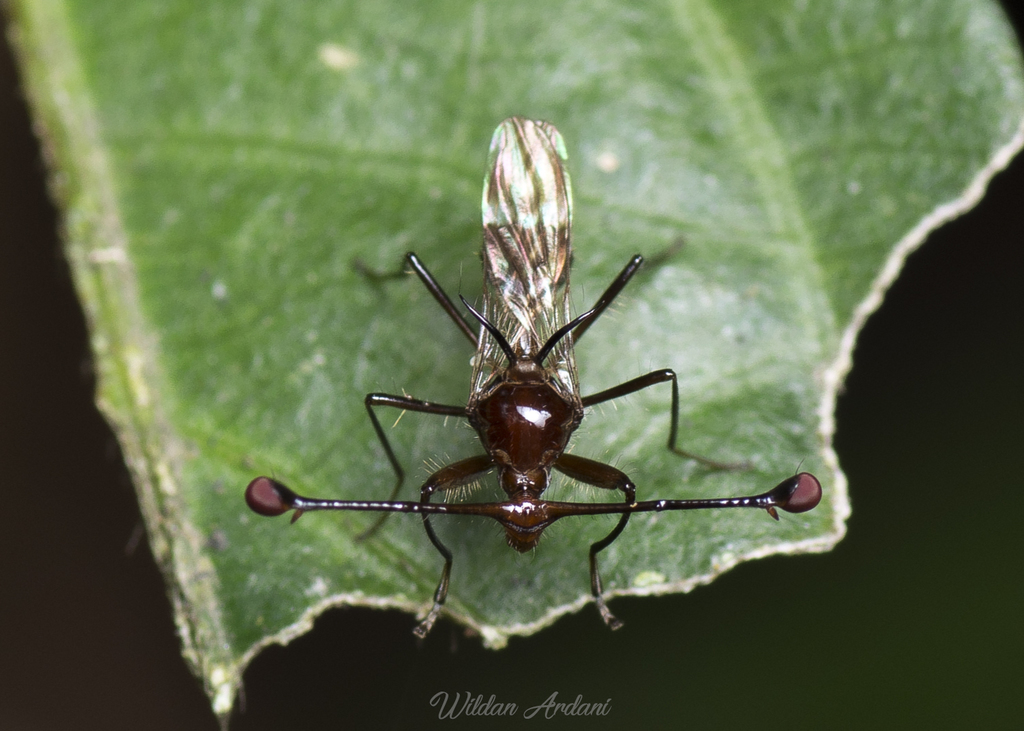
Cyrtodiopsis dalmanni
Teleopsis dalmanni, synonym Cyrtodiopsis dalmanni, also known as the Malaysian stalk-eyed fly, is a species of fly in the family Diopsidae. T. dalmanni flies possess lateral elongations on their head capsules called eyestalks. These eyestalks play an important role in mate selection and as a result physical characteristic of the fly has been the subject of several studies on sexual selection, natural selection, and mating behavior.
From the article Teleopsis dalmanni on Wikipedia (CC BY-SA), quoted section by section
Range & habitat
Teleopsis dalmanni is found in Malaysia as well as other parts of Southeast Asia. Flies used in studies are usually collected in Malaysia.
Wikipedia: “Distribution”
What it does
As with other Dipterans, T. dalmanni flies undergo a larval phase before transitioning into adults. There is little information available on the systematics and behavior of the larval stage in T. dalmanni. As holometabolous insects, the flies have dividing cells restricted to the gut and gonads. Due to this, the adult size is fixed by the nutrition received in the larval phase. Following the larval stage, further nutrition is required for the development of internal reproductive structures to reach sexual maturity. Breeding experiments typically assign three to six weeks for these flies to reach sexual maturity, but a value for wild fly populations has not been determined with confidence. Sexual maturity can be indicated by accessory gland growth, maturing of sperm bundles, and sperm motility. Accessory gland growth was found to have the largest effect on sexual maturity, but it is not the sole effect.
Wikipedia: “Life cycle”
At the table
Adult flies exhibit solitary foraging behavior, feeding on rotting vegetative matter in the daytime.
Wikipedia: “Food resources”
Listen
Looking for field recordings…
Where it lives
Recorded sightings
—
geo-referenced records in GBIF, from museums, herbaria and field observers.
Drag the globe to turn it. Dots are where records exist, not a range map; darker means more records.
In the stacks
Searching the stacks…
Every page naming Cyrtodiopsis dalmanni in the Biodiversity Heritage Library →
This page is assembled live from iNaturalist, GBIF, Wikipedia, the Source Library and the Internet Archive. It is not yet part of the hand-edited codex. iNaturalist taxon 876843.