- Plants
- ›Vascular Plants
- ›flowering plants
- ›Dicots
- ›nightshades, bindweeds, gooseweeds, and allies
- ›nightshade family
- ›nightshades and allies
- ›boxthorns and allies
- ›Lycium
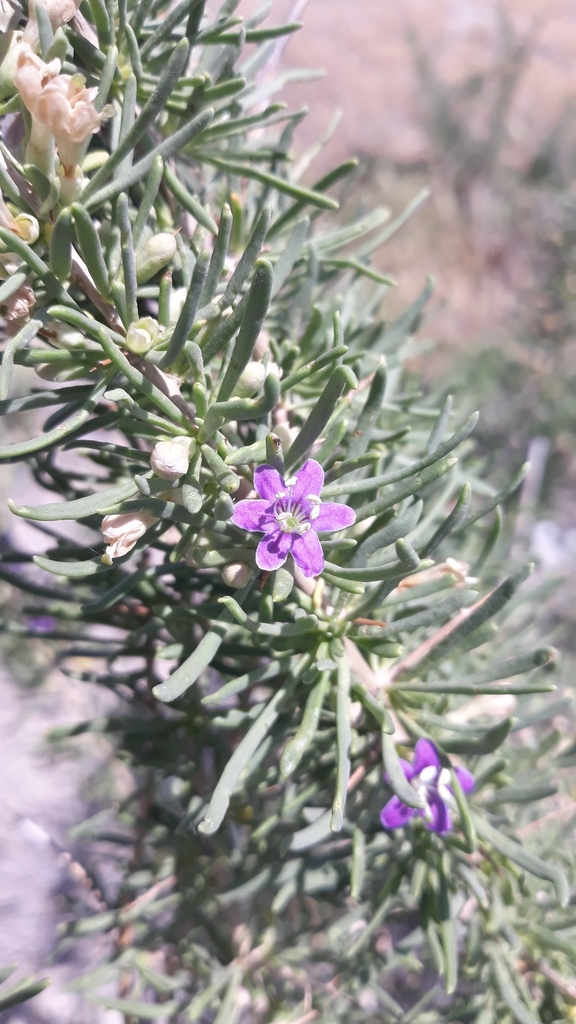
Russian box thorn
Lycium ruthenicum
Lycium ruthenicum (Chinese: 黑果枸杞; pinyin: hei guo gou qi), is a flowering plant commonly known as Russian box thorn in the West. is a species of flowering plant in the nightshade family which can be found in Central Asia, southern part of Russia, throughout Northwest China, and Pakistan. Also commonly known as black fruit wolfberry, goji nero, siyah goji, kaokee, თეთრეკალა, (Tibetan name) “next to Mary”, is a species of flowering plant in the nightshade family
From the article Lycium ruthenicum on Wikipedia (CC BY-SA), quoted section by section
Description
The species is either 1.8 centimetres (0.71 in), 20–50 centimetres (7.9–19.7 in), 20–150 centimetres (7.9–59.1 in), or 180 centimetres (71 in) tall. The leaves are either 5–30 millimetres (0.20–1.18 in), 0.6–2.5 centimetres (0.24–0.98 in), or 6–25 millimetres (0.24–0.98 in) by 1–1.5 millimetres (0.039–0.059 in). It have 2-4 sepals each one of which is bell-shaped and 3–4 millimetres (0.12–0.16 in) long. Pedicels are either 5–10 millimetres (0.20–0.39 in) long or can be as long as it sepals. The calyx is 2.5–3.5 millimetres (0.098–0.138 in) long but can be companulate and exceed 4–5 millimetres (0.16–0.20 in). Corolla's tube is 5–7 millimetres (0.20–0.28 in) long with stamens have 5–8 millimetres (0.20–0.31 in) long berries (which can sometimes grow up to 9 millimetres (0.35 in)) which are also broad and globose. The fruits' seeds are brown coloured and are 1.5–2 millimetres (0.059–0.079 in) long. The flowering time is June to August but can sometimes bloom in May too. Fruits mature from August to October.
Range & habitat
In India, it grows in Nubra Valley where it is used by native people to cure blindness in camels. In Central Asia and Northwest China the species grows on elevation of 400–3,000 metres (1,300–9,800 ft) in saline deserts, sands and roadsides.
Wikipedia: “Distribution and uses”
Where it lives
Recorded sightings
—
geo-referenced records in GBIF, from museums, herbaria and field observers.
Drag the globe to turn it. Dots are where records exist, not a range map; darker means more records.
In the stacks
Searching the stacks…
Every page naming Lycium ruthenicum in the Biodiversity Heritage Library →
This page is assembled live from iNaturalist, GBIF, Wikipedia, the Source Library and the Internet Archive. It is not yet part of the hand-edited codex. iNaturalist taxon 883534.