 NL·0388
Herbarium of the Nature Library
- Name
- Rupicola peruvianus
- Family
- Cotingidae
- Native to
- Eastern and western slopes of the Andes from Venezuela and Colombia through Ecuador and Peru to Bolivia, mainly 500–2,400 m
- Habitat
- Montane cloud forest, Forested ravines
On eBird ↗
Andean Cock-of-the-rock
Live sightings near you, the range map, bar charts of when it is seen, and Macaulay Library photos and recordings.
Andean cock-of-the-rock
Rupicola peruvianus
Also calledGallito de las rocas (Spanish) · Tunki (Quechua) · Galo-da-serra-andino (Portuguese)
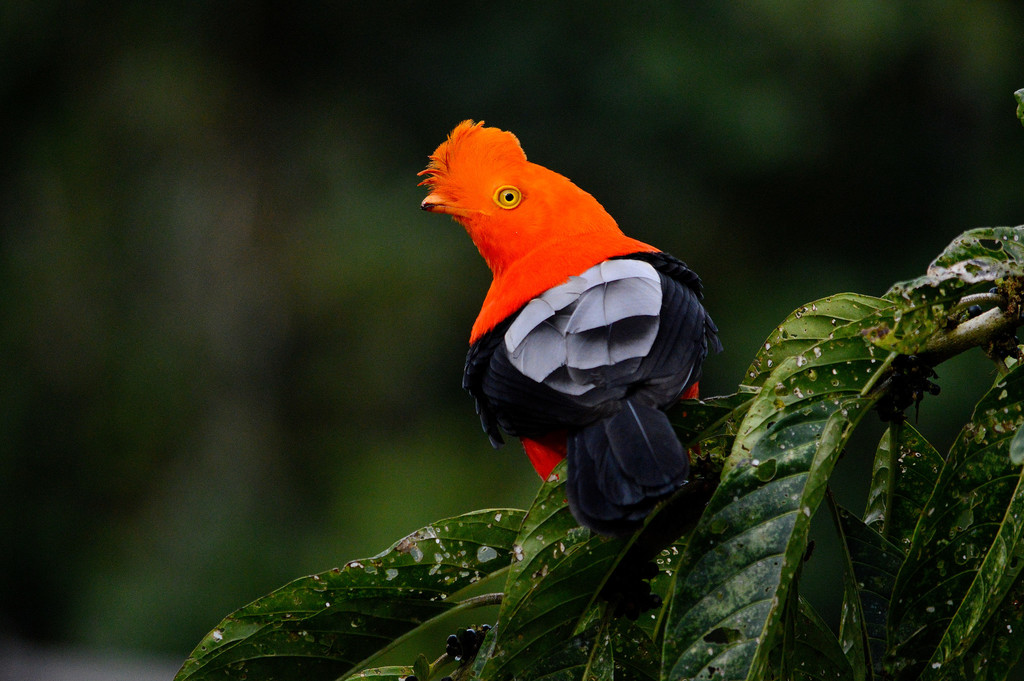
A blazing orange-red cotinga of Andean cloud forest ravines whose males gather at dawn leks, bowing, bobbing and squealing to attract drab females. It is Peru's national bird.
The Andean cock-of-the-rock, also known as tunki (Quechua), is a large passerine bird of the cotinga family native to Andean cloud forests in South America. It is the national bird of Peru. It has four subspecies and its closest relative is the Guianan cock-of-the-rock. Wikipedia
What it can do
- iMales display at communal leks, each defending a small court and performing in front of visiting females
- iiFemales build mud-and-plant cup nests glued to rock faces in humid gorges
- iiiImportant seed disperser for fruiting cloud-forest trees
- ivTakes small vertebrates such as frogs and lizards as well as fruit
In the field
Field marks
- aMale: brilliant scarlet or orange body with a disc-shaped crest that hides the bill
- bBlack wings and tail, with pale silvery-grey tertials
- cFemale: dark brownish-orange with a smaller crest
- dPlump, pigeon-sized shape
- Voice
- At leks, loud nasal squawks, grunts and pig-like squeals; otherwise mostly silent.
- Not to be confused with
- Guianan Cock-of-the-rock (Guiana Shield east of the Andes) is orange with a fringed crest and white wing patches; their ranges do not overlap. No other Andean bird has the crest-covered bill.
- Where to see it
- Lek sites along Peru's Manu Road (Cock-of-the-rock Lodge), near Mindo in Ecuador, and in Colombia's Río Claro and cloud forests.
- When
- Resident year-round; leks most active at dawn and late afternoon
Listen
Looking for field recordings…
Life & habits
- Diet
- Mainly fruit; insects, frogs and small lizards
- Habitat
- Humid montane forest near rocky streams and ravines
- Size
- 30–32 cm; about 220–300 g
Females raise the young alone; males spend much of the breeding season at the lek.
Where it lives
Recorded sightings
—
geo-referenced records in GBIF, from museums, herbaria and field observers.
Native range
Eastern and western slopes of the Andes from Venezuela and Colombia through Ecuador and Peru to Bolivia, mainly 500–2,400 m
Drag the globe to turn it. Dots are where records exist, not a range map; darker means more records.
In the stacks
Searching the stacks…
Every page naming Rupicola peruvianus in the Biodiversity Heritage Library →
Marginalia
Known in Quechua as tunki, it was named Peru's national bird and features in Andean folk dances and textiles.
Curiosity
The genus name Rupicola means 'rock-dweller', from the female's habit of nesting on cliff faces.
Kinship




Photographs: iNaturalist contributors under the licences shown. Records: GBIF.org. Historical plates: Source Library (CC BY-SA 4.0; originals public domain). Summary text: Nature Library editors and Wikipedia (CC BY-SA). Medicinal and edibility notes are historical and educational, not advice. iNaturalist taxon 8877.