- Animals
- ›Arthropods
- ›Hexapods
- ›Insects
- ›Winged and Once-winged Insects
- ›Butterflies and Moths
- ›Clearwing moths
- ›Clearwing Moths
- ›Sesiinae
- ›Synanthedonini
- ›Pyropteron
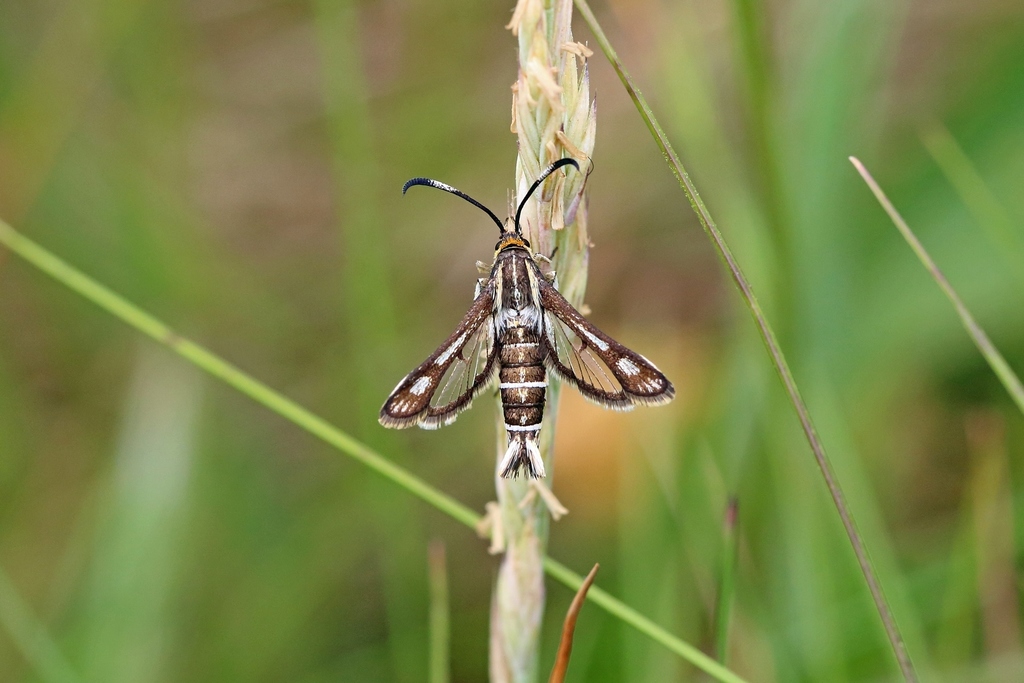
Thrift Clearwing
Pyropteron muscaeformis
Pyropteron muscaeforme, the thrift clearwing, is a moth of the family Sesiidae that lives in most of Europe.
From the article Pyropteron muscaeforme on Wikipedia (CC BY-SA), quoted section by section
What it does
A small member of its genus, the wingspan is 15–18 mm. It is further distinguished by narrow clear (transparent) spaces on the blackish, or bronzy, forewings. There are three whitish bands on the body, and traces of a whitish line along the middle of the back. Adults can be found on the flowers of the host plant, as well as on thyme (Thymus vulgaris). Males are attracted to pheromone lures. It is found on exposed rocky areas where its larval food plant occurs and overwinters as a larva.
Ovum Eggs are ovoid, are black with white retriculations and are laid on thrift (Armeria maritima). They can only be seen under magnification, as they are only c. 0.7 mm on the longest axis.
Larva Larvae are 11-15 mm long. They have a yellowish-white body, reddish-brown head and the prothorax is pale brown. They feed from August to May on the roots and stem in a silk-lined tunnel. In late summer and autumn, piles of reddish-frass can be seen extruding from infected stems. Plants with larvae are often on the edge of large patches of thrift. Larvae of Lobesia littoralis feed in the flowers, shoots and leaves in the spring and seeds in the autumn.
Pupa The pupa is slender and tapering, 12–14 mm long and is light reddish-brown with darker brown eyes, thorax and wings. It does not pupate in a cocoon.
Subspecies. …
Wikipedia: “Ecology”
Listen
Looking for field recordings…
Where it lives
Recorded sightings
—
geo-referenced records in GBIF, from museums, herbaria and field observers.
Drag the globe to turn it. Dots are where records exist, not a range map; darker means more records.
In the stacks
Searching the stacks…
Every page naming Pyropteron muscaeformis in the Biodiversity Heritage Library →
This page is assembled live from iNaturalist, GBIF, Wikipedia, the Source Library and the Internet Archive. It is not yet part of the hand-edited codex. iNaturalist taxon 890655.