- Animals
- ›Arthropods
- ›Hexapods
- ›Insects
- ›Winged and Once-winged Insects
- ›Butterflies and Moths
- ›Geometrid and Swallowtail Moths
- ›Geometer Moths
- ›Carpet Moths
- ›Arctesthes
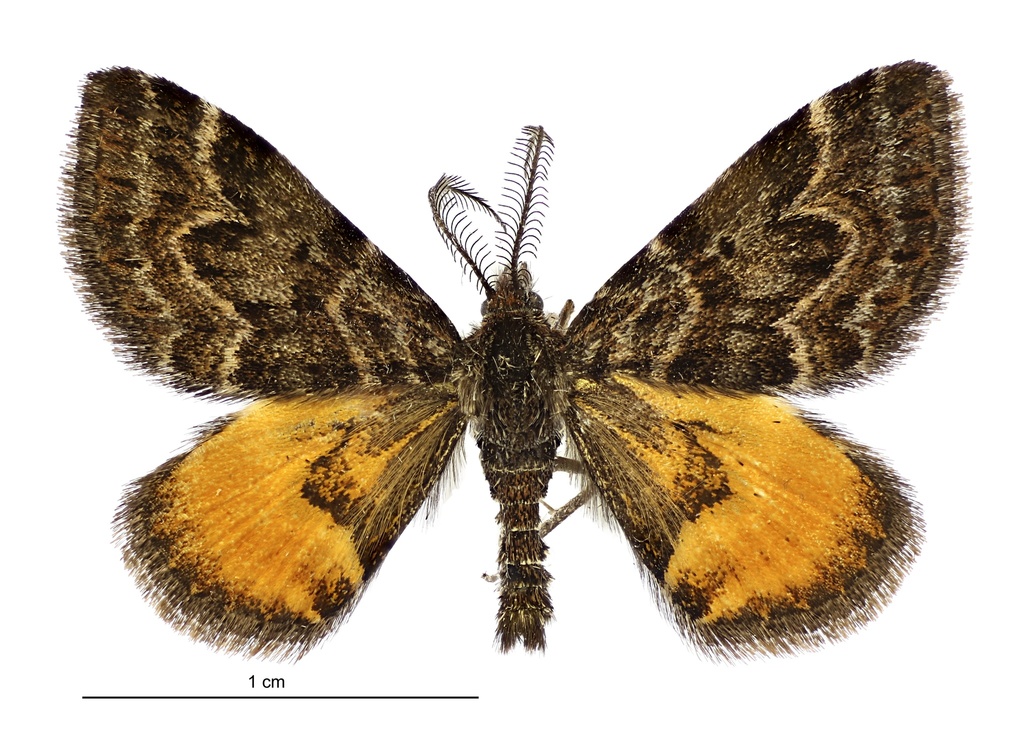
Arctesthes avatar
Arctesthes avatar, commonly known as the avatar moth or the Denniston triangle moth, is a moth of the family Geometridae and is endemic to New Zealand. It has been found in short-lived wetlands at elevations between 640 and 1000 metres, but only in the areas of the Denniston Plateau and the nearby Mount Rochfort in the Buller District of the West Coast Region of the South Island. The species was discovered by Brian Patrick in 2012, during a bio-blitz on the Denniston Plateau organised by Forest & Bird as part of a campaign against the planned development of an open-cast coal mine by Bathurst Resources. The name of the new species was proposed in 2012, following a competition run by Forest & Bird and judged by Patrick and his son. It was first described by Brian H. Patrick, Hamish J. H. Patrick and Robert J. B. Hoare in 2019. A. avatar has Nationally Critical conservation status under the New Zealand Threat Classification System.
From the article Arctesthes avatar on Wikipedia (CC BY-SA), quoted section by section
Description
The larvae have been described as being brown on the upper side and a paler shade on the underside of the caterpillar. The adult male of this species was described as follows:
Adult male: Wingspan 20–22 mm. Very similar to A. titanica, with the following differences. Forewing with antemedian and postmedian lines slightly better defined than in titanica; postmedian line with indentation above median evagination and level with discal spot tending to be more pronounced than in titanica. Hindwing with dark antemedian line reaching much further across wing than in titanica (about half way to costa), and then diverting basad to join small variably distinct discal dot; terminal line present as dark brown fascia, with weakly scalloped inner margin; black dashes along termen absent. Forewing underside with postmedian line more distinct than in titanica and almost complete, reaching to near dorsum. …
Range & habitat
This species inhabits short-lived wetlands on the Denniston Plateau and Mount Rochfort in the West Coast at altitudes of between 640 and 1000 m. Larvae of sister species in this genus feed on various species of native herbaceous plants. It has been hypothesised that the sole host of the larvae of this species is Liparophyllum gunnii, as females have been observed laying eggs on the underside of the leaves of this plant. An attempt was made to rear this species in captivity, with the larvae being feed on wilting leaves, stems and roots of this plant, but this was unsuccessful.
Wikipedia: “Habitat and hosts”
What it does
This species is a day flying moth. Adults have been observed on the wing in February and March.
Wikipedia: “Behaviour”
Listen
Looking for field recordings…
Where it lives
Recorded sightings
—
geo-referenced records in GBIF, from museums, herbaria and field observers.
Drag the globe to turn it. Dots are where records exist, not a range map; darker means more records.
In the stacks
Searching the stacks…
Every page naming Arctesthes avatar in the Biodiversity Heritage Library →
This page is assembled live from iNaturalist, GBIF, Wikipedia, the Source Library and the Internet Archive. It is not yet part of the hand-edited codex. iNaturalist taxon 895345.