- Fungi Including Lichens
- ›Ascomycete Fungi
- ›Sac Fungi and Lichens
- ›Common Lichens
- ›Shield Lichens, Sunburst Lichens, Rosette Lichens, and Allies
- ›shield lichens, rim lichens, and allies
- ›shield lichens and allies
- ›typical shield lichens
- ›Parmelia
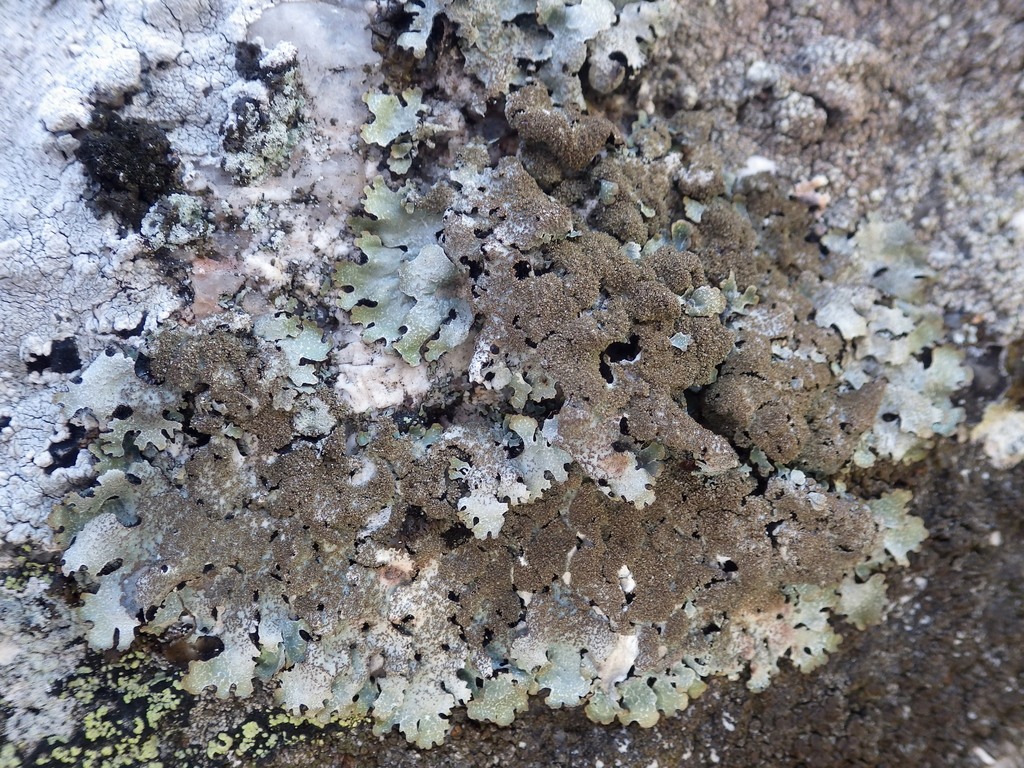
Parmelia serrana
Parmelia serrana is a species of foliose lichen in the family Parmeliaceae. It is native to Mediterranean regions, particularly in mountainous areas. It is a member of a complex of similar species centred around the common and widespread Parmelia saxatilis. It can be distinguished from these close relatives by the combination of long, sparsely branched lobes, numerous orbicular soralia, small pseudocyphellae, and sparse, mostly simple rhizines.
From the article Parmelia serrana on Wikipedia (CC BY-SA), quoted section by section
Description
Parmelia serrana features a crustose, epilithic thallus that is closely adpressed to the substrate and forms orbicular patches up to 15 cm in diameter. The thallus consists of overlapping (imbricate) lobes, which are typically 2.5–6 mm wide, apically rounded to sublinear, and show a pale greenish grey to whitish grey colour. The surface is shiny and may become reticulately cracked as it ages. Pseudocyphellae (tiny pores for gas exchange) are numerous and mainly linear to irregularly shaped, scattered across the lamina. Over time, the pseudocyphellae become sorediate, forming orbicular to linear soralia with eroded centres as they age. Isidia are densely packed on older parts of the thallus, cylindrical in shape, and simple to branched. The lower surface has sparse to moderately abundant, simple to sparsely branched rhizines, which measure 1–1.5 mm long. Apothecia (fruiting bodies) are fairly common, subpedicellate, with a disc that is initially concave, expanding to 1–4 mm in diameter. Ascospores are broadly ellipsoid, measuring 17–18 by 12–13 μm. Chemical spot tests on the thallus reveal a cortex that reacts K+ (yellow); the medulla shows a K+ (yellow then red) reaction, C−, PD+ (red-orange). Known chemical constituents include atranorin, chloroatranorin, salazinic acid, consalazinic acid, and trace amounts of protocetraric acid.
Range & habitat
Parmelia serrana grows on deciduous and coniferous trees, and less frequently on mossy rocks. It is particularly prevalent on Pinus sylvestris and various species of Quercus (oak). The species is widespread in the Sierra del Guadarrama and other mountain ranges within its native Mediterranean and submediterranean zones, from approximately 300 to 1700 metres in elevation. In terms of its geographic spread, Parmelia serrana is found in Africa (notably the Canary Islands) and across Europe. While it is prevalent in Mediterranean mountains, its full distribution in Europe remains partially understood, with occurrences noted at lower altitudes in more temperate, somewhat continental regions like Austria. The species is well-adapted to the Iberian Peninsula and the Canary Islands and is successful in colonising a range of habitats within these regions.
== References ==
Wikipedia: “Habitat and distribution”
Where it lives
Recorded sightings
—
geo-referenced records in GBIF, from museums, herbaria and field observers.
Drag the globe to turn it. Dots are where records exist, not a range map; darker means more records.
In the stacks
Searching the stacks…
Every page naming Parmelia serrana in the Biodiversity Heritage Library →
This page is assembled live from iNaturalist, GBIF, Wikipedia, the Source Library and the Internet Archive. It is not yet part of the hand-edited codex. iNaturalist taxon 922689.