- Plants
- ›Vascular Plants
- ›flowering plants
- ›monocots
- ›grasses, sedges, cattails, and allies
- ›grasses
- ›bamboos, canes, and allies
- ›Bambuseae
- ›Bambusinae
- ›Dendrocalamus
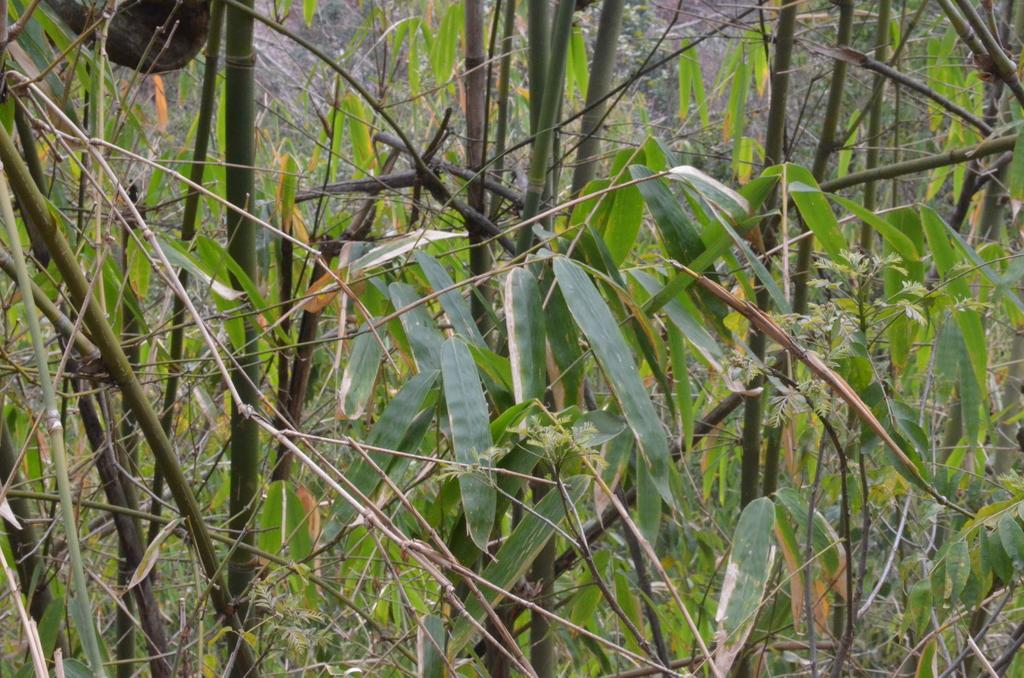
Dendrocalamus hamiltonii
Dendrocalamus hamiltonii, or Hamilton's bamboo, is a species of bamboo, 12–15 cm in diameter and growing up to 15–18 m in height, found in South Asian countries such as, India, Sri Lanka, Bhutan, Nepal, Pakistan, and far eastern China.
From the article Dendrocalamus hamiltonii on Wikipedia (CC BY-SA), quoted section by section
Description
Culms are dull green covered with whitish-brown hairs, which become dull brownish-green when dry. Whitish bands occur below and above the nodes. Culms are noticeably zig-zag. Branching occurs from the base to top. Aerial roots are present in all nodes. Internode length is 30–40 cm, and diameter is 5–15 cm. Culm walls are 0.5–1.5 cm thick. Nodes of some culms are bent. Culm sheaths are green when young and turn yellowish brown when mature, and are long and gradually tapering upwards from a flattened base. The sheath proper is 18–45 cm in length and 15–28 cm wide. Blade length is 8–20 cm. Auricles are absent. Upper surfaces of the sheaths are covered with patches of blackish-brown hairs. Lower surfaces of the sheaths are not hairy. Sheaths fall off early.
Wikipedia: “Appearance”
Where it lives
Recorded sightings
—
geo-referenced records in GBIF, from museums, herbaria and field observers.
Drag the globe to turn it. Dots are where records exist, not a range map; darker means more records.
In the stacks
Searching the stacks…
Every page naming Dendrocalamus hamiltonii in the Biodiversity Heritage Library →
This page is assembled live from iNaturalist, GBIF, Wikipedia, the Source Library and the Internet Archive. It is not yet part of the hand-edited codex. iNaturalist taxon 929048.