- Animals
- ›Arthropods
- ›Hexapods
- ›Insects
- ›Winged and Once-winged Insects
- ›Butterflies and Moths
- ›Butterflies
- ›Gossamer-winged Butterflies
- ›Hairstreaks
- ›Luciini
- ›Acrodipsas
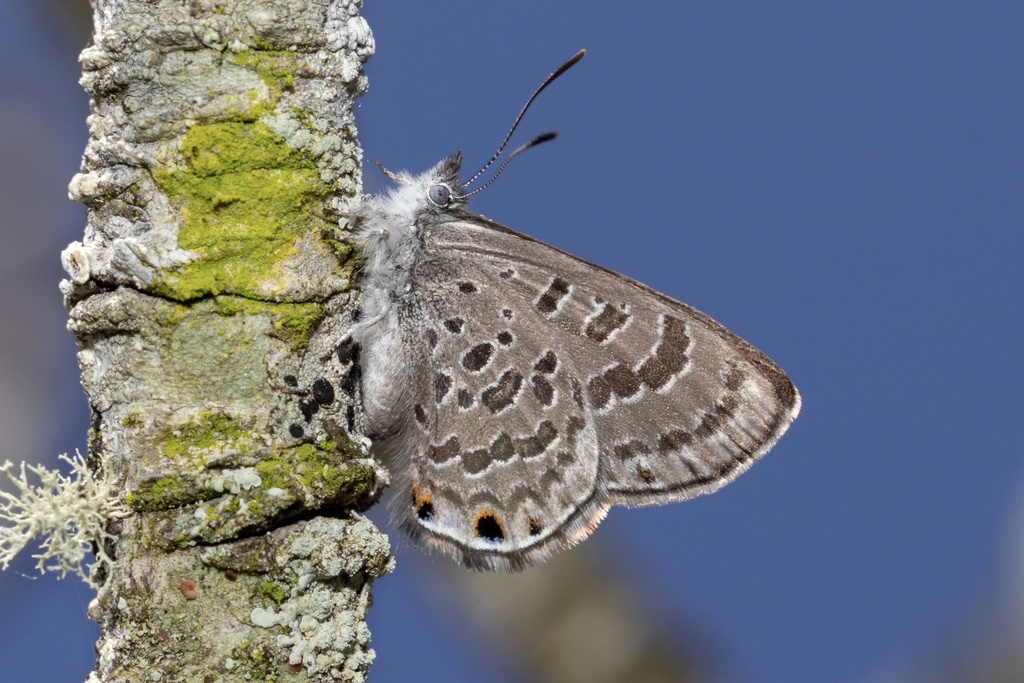
Illidge's Ant-blue
Acrodipsas illidgei
Illidge's ant-blue butterfly (Acrodipsas illidgei), is an endangered species of butterfly endemic to Australia. This species can be found at six confirmed sites: Mary River Heads, Beaver Rock and Maaroom in the Fraser Coast Region (Queensland); Redland Bay and Point Halloran in the City of Redland (Queensland), and Brunswick Heads (New South Wales).
From the article Illidge's ant blue on Wikipedia (CC BY-SA), quoted section by section
Description
The eggs of the Illidge's ant-blue butterfly are white and have an average diameter of 0.7 mm. In its caterpillar stage it is white. The pupa of the butterfly is approximately 1 cm lengthwise and is brown. As adults they are brown and the females of the species contain blue coloured regions on the surface of their wings that change shades depending on the angle from which the surface is being viewed. The ventral side of both genders of the butterfly are fawn in colour and contain small dark spots. The wingspan of the butterfly is approximately 2 cm.
Wikipedia: “Characteristics”
What it does
The life cycle of the Illidge's ant-blue butterfly, from when the eggs are laid to when the butterfly finally emerges, is highly complex. It is also one of the best illustrations of the symbiotic relationship between organisms within mangrove systems. The eggs are laid by the females of the species in stubs on grey mangrove trees where there is a presence of Crematogaster ant colonies. The larvae are transported to the ants' nests by the ants where they feed on excretions from the larvae, while a larva on the other hand feeds on developing ants (perhaps its regurgitations). There have been no recorded natural enemies of the Illidge's ant-blue, except for the exposed immature stage as an egg to hunting spiders. The largest cause of mortality of the larvae has been the host ants turning hostile towards it. Fluffy scales cover the body of an emerging butterfly so as to protect it from such hostile attacks.
Wikipedia: “Ecology”
Listen
Looking for field recordings…
Where it lives
Recorded sightings
—
geo-referenced records in GBIF, from museums, herbaria and field observers.
Drag the globe to turn it. Dots are where records exist, not a range map; darker means more records.
In the stacks
Searching the stacks…
Every page naming Acrodipsas illidgei in the Biodiversity Heritage Library →
This page is assembled live from iNaturalist, GBIF, Wikipedia, the Source Library and the Internet Archive. It is not yet part of the hand-edited codex. iNaturalist taxon 93206.