 NL·0240
Herbarium of the Nature Library
- Name
- Acropora cervicornis
- Family
- Acroporidae
- Native to
- Caribbean Sea, the Bahamas, Florida Keys and southern Gulf of Mexico
- Habitat
- Coral reef, Back reef, Fore reef
Staghorn coral
Acropora cervicornis
Also calledCoral cuerno de ciervo (Spanish) · Corail corne de cerf (French) · Hertshoornkoraal (Dutch)
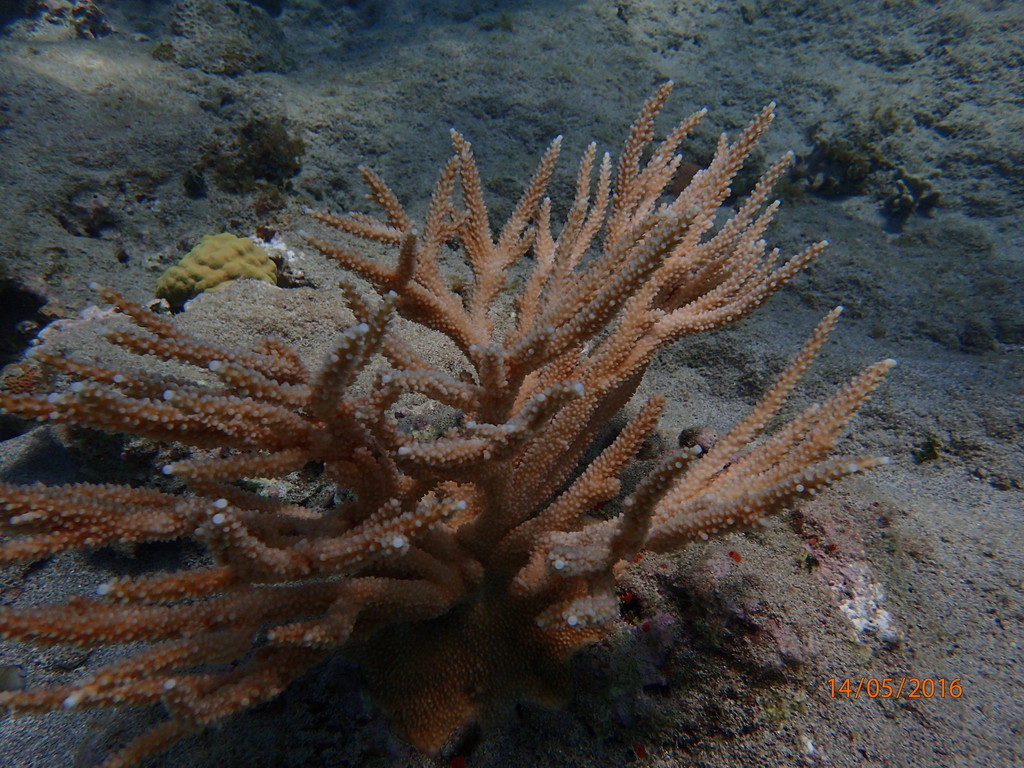
A fast-growing, antler-branched reef-building coral that once formed dense thickets across Caribbean reefs. Since the 1980s disease and bleaching have killed most of it, and it is now a focus of coral nursery restoration.
The staghorn coral is a branching, stony coral, within the Order Scleractinia. It is characterized by thick, upright branches which can grow in excess of 2 meters (6.5 ft) in height and resemble the antlers of a stag, hence the name, Staghorn. It grows within various areas of a reef but is most commonly found within shallow fore and back reefs, as well as patch reefs, where water depths rarely exceed 20 meters (65 ft). Staghorn corals can exhibit very fast growth, adding up to 5 cm in new skeleton for every 1 cm of existing skeleton each year, making them one of the fastest growing fringe coral species in the Western Atlantic. Due to this fast growth, Acropora cervicornis, serve as one of the most important reef building corals, functioning as marine nurseries for juvenile fish, buffer zones for erosion and storms, and center points of biodiversity in the Western Atlantic. Wikipedia
What it can do
- iGrows 10–20 cm a year in branch length, among the fastest of Atlantic corals
- iiLays down a limestone skeleton that builds reef framework
- iiiHosts photosynthetic algae (Symbiodiniaceae) in its tissues, which supply most of its energy
- ivRegrows into new colonies from broken branches, the basis of coral 'gardening'
- vReleases egg-sperm bundles in mass spawning nights after the summer full moon
In the field
Field marks
- aBranching coral like deer antlers
- bGolden-brown colour
- cBranches round in cross-section
- dGrows in thickets
- Not to be confused with
- Elkhorn coral (A. palmata) has broad, flattened branches. Fused staghorn (A. prolifera) is a hybrid with thicker, fused branches.
- Where to see it
- Coral Restoration Foundation sites in the Florida Keys and Bonaire
- When
- Resident
Life & habits
- Diet
- Mainly sugars from symbiotic algae; also captures plankton with tiny polyp tentacles
- Habitat
- Shallow, clear fore-reef and back-reef zones, typically 5–20 m
- Size
- Branches 1–3 cm thick; thickets can cover large areas
- Lifespan
- Colonies can persist indefinitely by fragmenting
Its thickets shelter juvenile fish, lobsters and other reef life.
Where it lives
Recorded sightings
—
geo-referenced records in GBIF, from museums, herbaria and field observers.
Native range
Caribbean Sea, the Bahamas, Florida Keys and southern Gulf of Mexico
Drag the globe to turn it. Dots are where records exist, not a range map; darker means more records.
In the old herbals & bestiaries
No plate in the Source Library names this exact species, so these show its closest relatives as the old naturalists drew them: same genus, or the same kind of animal. Click a plate to read the page it came from, with translation.

Georg Eberhard Rumphius — D'Amboinsche rariteitkamer (1705)
Relative · Georg Eberhard Rumphius · 1705 · p.291

The Natural History of Carolina Florida and Bahama Islands Vol. 2
Relative · Mark Catesby · 1743 · p.118

The Natural History of Carolina, Florida and the Bahama Islands, Vol. 1
Relative · Mark Catesby · 1777 · p.239

Garden of Health
Relative · Jacob Meydenbach · 1491 · p.721

Description of Less Known and Rare Plants
Relative · Fabio Colonna · 1616 · p.581

Musaeum metallicum
Relative · Ulisse Aldrovandi · 1648 · p.857

The Ambonese Herbal, Vol. 4
Relative · Georg Eberhard Rumphius · 1743 · p.334

The natural history of Carolina, Florida, and the Bahama Islands : containing two hundred a...
Relative · Catesby, Mark, bioloog, kunstenaar · 1743 · p.48

The Natural History of Carolina Florida and Bahama Islands Vol. 2
Relative · Mark Catesby · 1743 · p.70

Mark Catesby — Piscium, serpentum, insectorum (pt. 1) (1750)
Relative · Mark Catesby · 1750 · p.109
In the stacks
Searching the stacks…
Every page naming Acropora cervicornis in the Biodiversity Heritage Library →
Marginalia
In 2006 staghorn and elkhorn corals became the first corals listed under the US Endangered Species Act. Restoration groups in Florida and the Caribbean have since grown and planted tens of thousands of nursery fragments.
Curiosity
White-band disease in the 1980s killed an estimated 80–98% of Caribbean staghorn and elkhorn coral.
Kinship




Photographs: iNaturalist contributors under the licences shown. Records: GBIF.org. Historical plates: Source Library (CC BY-SA 4.0; originals public domain). Summary text: Nature Library editors and Wikipedia (CC BY-SA). Medicinal and edibility notes are historical and educational, not advice. iNaturalist taxon 93234.