- Animals
- ›Arthropods
- ›Chelicerates
- ›Arachnids
- ›Spiders
- ›Typical Spiders
- ›Entelegyne Spiders
- ›RTA Clade Spiders
- ›Oval calamistrum clade spiders
- ›Wolf Spiders and Allies
- ›Wolf Spiders
- ›Adelocosa
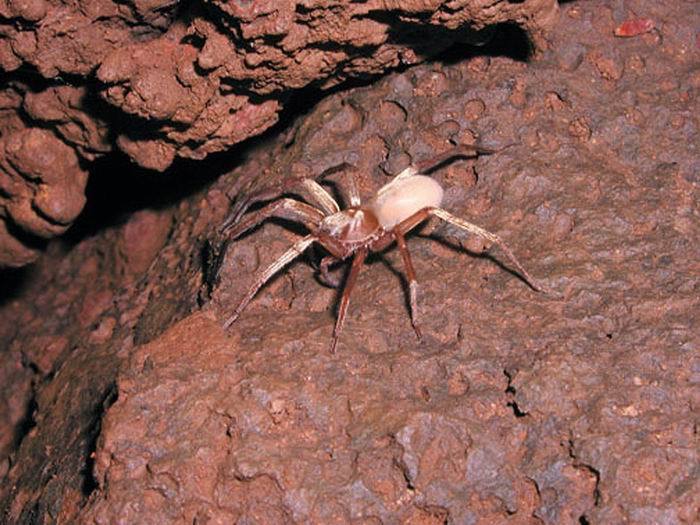
Kaua'i Cave Wolf Spider
Adelocosa anops
The Kauaʻi cave wolf spider (Adelocosa anops), also known to local residents as the blind spider, is a species of wolf spider. It is monotypic within the genus Adelocosa.
The Kauaʻi cave wolf spider is only known to occur in a few caves in a lava flow with an area of 10.5 km2 (4.1 sq mi) in the Kōloa–Poʻipū region of Kauaʻi, Hawaiian Islands, and only six populations are known to exist. While their nearest surface-dwelling relatives have large eyes, this species has completely lost its eyes. They reach a body length around 20 mm (0.8 in), and are reddish brown and completely harmless to people. Unlike most wolf spiders, it produces only 15 to 30 eggs per clutch. The female carries the egg sac in her mouthparts until the spiderlings hatch.
From the article Kauaʻi cave wolf spider on Wikipedia (CC BY-SA), quoted section by section
Description
Adult Kauaʻi cave wolf spiders typically measure between 12.7 and 19.0 millimeters (0.5-0.75 inches) in length. The Kauaʻi cave wolf spider is the only wolf spider to completely lack eyes. It has a reddish brown to orange carapace with a pale abdomen and bright orange legs. Each leg has four pairs of short black spines and a thin coating of pale, silky hairs. The chelicera has three large teeth used for biting prey.
Range & habitat
The Kauaʻi cave wolf spider is an obligate cave-dweller. It lives in large cave passages, small mesocaverns, and cracks that are inaccessible to humans. Since they can die of desiccation in low humidity, the Kauaʻi cave wolf spider requires a high humidity habitat. Because of this, they prefer to inhabit the dark and stagnant air zones of caves. These zones are characterized by high humidity, low air movement, and low temperature fluctuations.
Wikipedia: “Habitat”
What it does
The Kauaʻi cave wolf spider is an opportunistic feeder, meaning it feeds on other cave inhabitants whenever possible. Its diet may include the Kaua'i cave amphipod, as well as introduced spiders and cockroaches.
Wikipedia: “Diet”
In human culture
Kauaʻi cave wolf spiders have a small clutch size compared to other wolf spiders. Kauaʻi cave wolf spiders only produce 15-30 eggs per clutch, where as other terrestrial wolf spiders may have 100 to 300. Female Kauaʻi cave wolf spiders carry their egg sacs on their backs until their spiderlings hatch in 30 to 50 days. Upon hatching, the large spiderlings are carried on the back of the mother for several days. Kauaʻi cave wolf spiders have an adapted row of comb-like teeth on their claws. These align with the branched hairs of their mother's back and allow the spiderlings to hold onto the mother securely for protection and transport. This species takes up to a year to reach sexual maturity. At that time, the spiderlings are old enough to hunt for themselves and disperse from the mother. Little is known about the mating strategies of Kauaʻi cave wolf spiders. Ecologists hypothesize that Kauaʻi cave wolf spider life history has been shaped by a behavior that allows other wolf spiders to fly through the air at short and long distances. Aerial dispersal is a behavior employed most often by young spiderlings, or instars, though it has never been observed in Kauaʻi cave wolf spiders. However, there are close relatives to this species that are able to aerially disperse that inhabit the islands next to Kauaʻi. …
Wikipedia: “Life history”
Where it lives
Recorded sightings
—
geo-referenced records in GBIF, from museums, herbaria and field observers.
Drag the globe to turn it. Dots are where records exist, not a range map; darker means more records.
In the stacks
Searching the stacks…
Every page naming Adelocosa anops in the Biodiversity Heritage Library →
This page is assembled live from iNaturalist, GBIF, Wikipedia, the Source Library and the Internet Archive. It is not yet part of the hand-edited codex. iNaturalist taxon 93412.