- Plants
- ›Vascular Plants
- ›flowering plants
- ›Dicots
- ›Nances, Willows, and Allies
- ›Leaf-flower Family
- ›Phyllanthoideae
- ›Bridelieae
- ›Cleistanthus
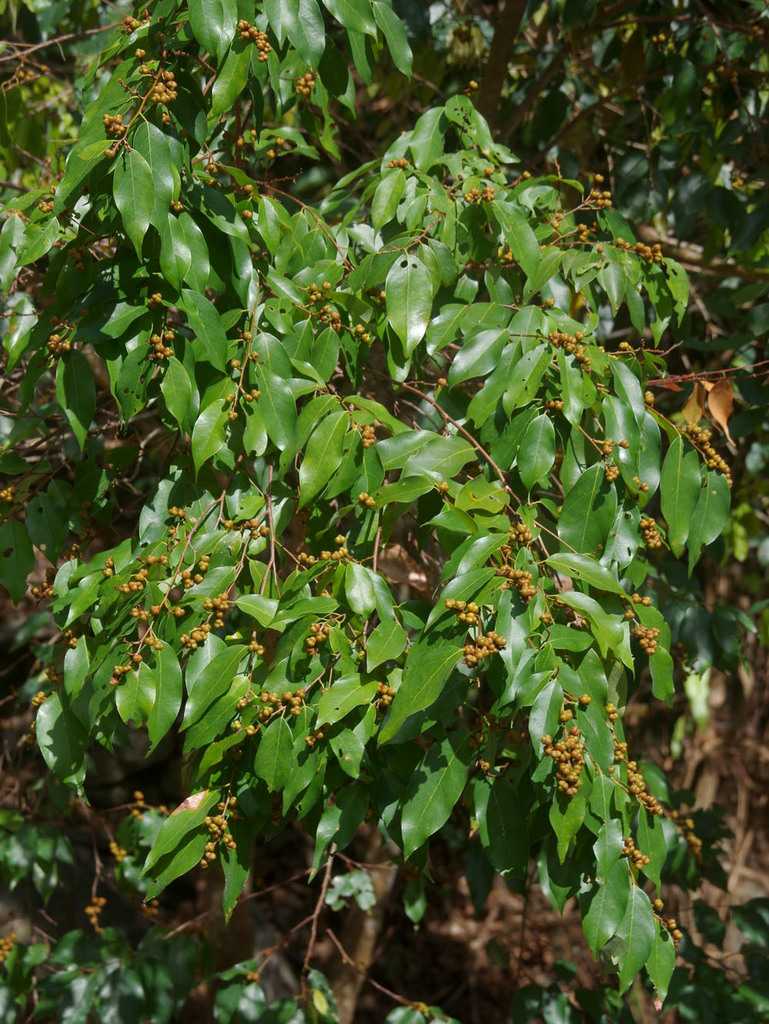
Cleistanthus apodus
Cleistanthus apodus, commonly known as the weeping Cleistanthus, is a tree in the family Phyllanthaceae native to New Guinea and northeast Queensland. It was first described in 1873 by the English botanist George Bentham in his seven-volume book Flora Australiensis.
From the article Cleistanthus apodus on Wikipedia (CC BY-SA), quoted section by section
Description
Cleistanthus apodus is a shrub or small tree growing up to about 12 m (39 ft) tall with a trunk usually less than 20 cm (7.9 in) diameter. The thin leaves are simple and arranged alternately on the twigs, on petioles (stems) about 9 mm (0.35 in) long. Stipules are minute, less than 1 mm (0.039 in) long, and the leaves are dark green and somewhat glossy above, slightly lighter green and dull below. They are ovate to lanceolate in shape, and measure up to 20 cm (7.9 in) long by 8 cm (3.1 in) wide. The inflorescence is a spike or fascicle produced in the leaf axils carrying very small 5-petaled flowers about 2 mm (0.079 in) diameter. The fruit is a green to brown stemless capsule up to 10 mm (0.39 in) long and 12 mm (0.47 in) diameter. It has 3 segments and contains about 6 seeds.
Phenology. This species has been observed flowering between August and October, and fruiting from September to February.
Range & habitat
This species occurs in northeast Queensland and New Guinea. In Queensland, the natural range is from the Torres Strait Islands south through Cape York Peninsula to the area near Ingham. There is also a single confirmed collection a little way south of Home Hill, approximately 190 km (120 mi) to the southeast of Ingham. It grows in well developed rainforest and semi-deciduous vine forest on a variety of soil types, particularly on the margins of rivers and streams.
Wikipedia: “Distribution and habitat”
In human culture
At the time of Bentham's publication describing this species, Cleistanthus was included in the family Euphorbiaceae, subfamily Phyllanthoideae. However in the release of the APG II system in 2003, Phyllanthoideae was removed from Euphorbiaceae and promoted to family status as Phyllanthaceae.
Wikipedia: “Taxonomic history”
Where it lives
Recorded sightings
—
geo-referenced records in GBIF, from museums, herbaria and field observers.
Drag the globe to turn it. Dots are where records exist, not a range map; darker means more records.
In the stacks
Searching the stacks…
Every page naming Cleistanthus apodus in the Biodiversity Heritage Library →
This page is assembled live from iNaturalist, GBIF, Wikipedia, the Source Library and the Internet Archive. It is not yet part of the hand-edited codex. iNaturalist taxon 949154.