- Plants
- ›Vascular Plants
- ›flowering plants
- ›monocots
- ›Agaves, Orchids, Irises, and Allies
- ›Orchids
- ›Orchidoid Orchids
- ›Diurideae
- ›Thelymitrinae
- ›Thelymitra
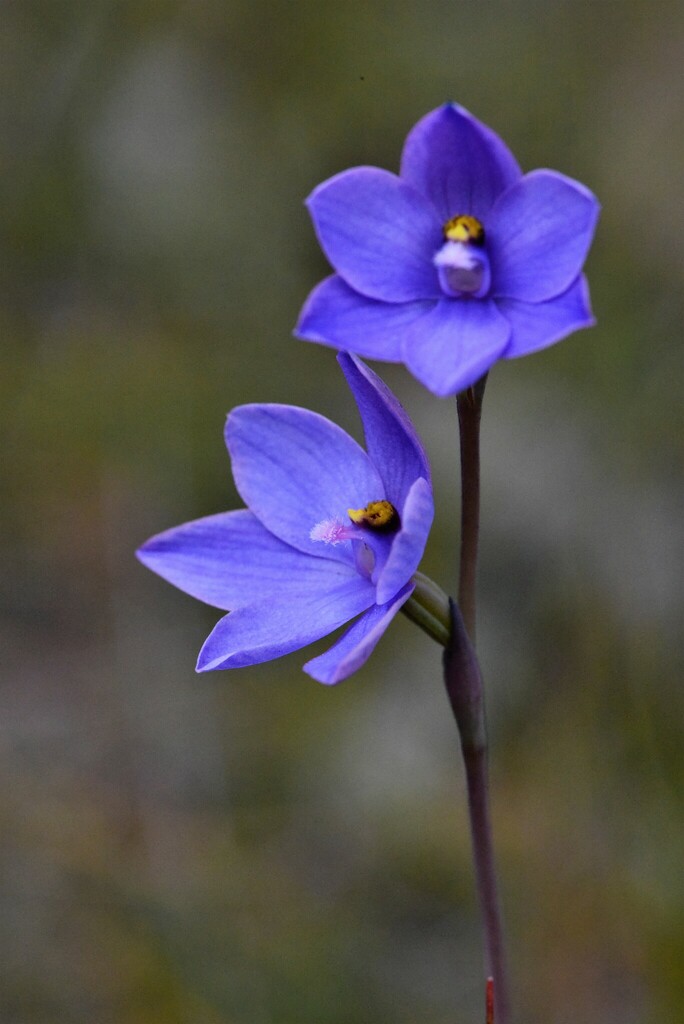
Wallum sun orchid
Thelymitra purpurata
Thelymitra purpurata, commonly called the wallum sun orchid, is a species of orchid that is endemic to eastern Australia. It has up to ten purplish flowers with long, finger-like glands on the top of the column and flowers earlier in the season than most other thelymitras.
From the article Thelymitra purpurata on Wikipedia (CC BY-SA), quoted section by section
Description
Thelymitra purpurata is a tuberous, perennial herb with a single ribbed, linear to lance-shaped leaf 100–250 mm (4–10 in) long and 2–4 mm (0.08–0.2 in) wide. Between two and ten bluish purple flowers without spots, 20–25 mm (0.8–1 in) wide are borne on a flowering stem 150–350 mm (6–10 in) tall. The sepals and petals are 12–17 mm (0.5–0.7 in) long and 5–8 mm (0.2–0.3 in) wide. The column is bluish to pinkish, 4.5–5.5 mm (0.18–0.22 in) long and 2.5–3 mm (0.098–0.12 in) wide. The lobe on the top of the anther is short, yellow with a dark blue band and with many finger-like calli. The side lobes have dense, mop-like tufts of white hairs. The flowers are insect-pollinated, open on sunny days and often have the petals and sepals turned backwards. Flowering occurs from July to September.
Range & habitat
Wallum sun orchid is common in heath in coastal Queensland south of Fraser Island to Myall Lakes in New South Wales.
Wikipedia: “Distribution and habitat”
Where it lives
Recorded sightings
—
geo-referenced records in GBIF, from museums, herbaria and field observers.
Drag the globe to turn it. Dots are where records exist, not a range map; darker means more records.
In the stacks
Searching the stacks…
Every page naming Thelymitra purpurata in the Biodiversity Heritage Library →
This page is assembled live from iNaturalist, GBIF, Wikipedia, the Source Library and the Internet Archive. It is not yet part of the hand-edited codex. iNaturalist taxon 956951.