- Animals
- ›Arthropods
- ›Hexapods
- ›Insects
- ›Winged and Once-winged Insects
- ›Butterflies and Moths
- ›Owlet Moths and Allies
- ›Cutworm Moths and Allies
- ›Cutworms and Dart Moths
- ›Wainscot Moths
- ›Ichneutica
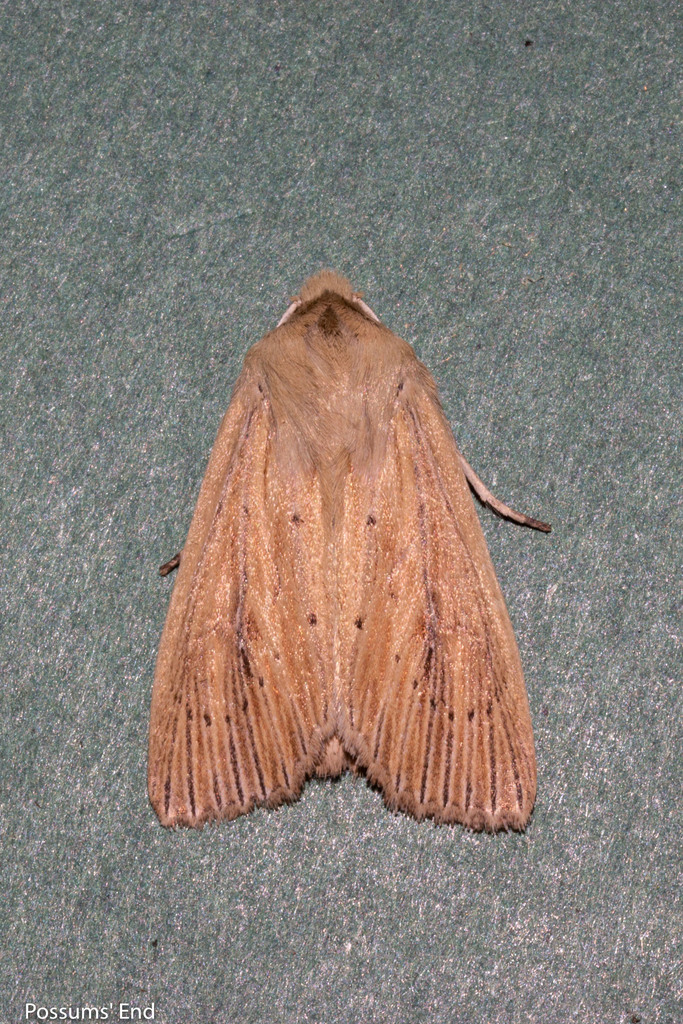
Ichneutica arotis
Ichneutica arotis is a moth of the family Noctuidae. It is endemic to New Zealand. This species is found throughout the North and South Islands but has yet to be recorded on Stewart Island. I. arotis is variable in appearance and have been described as having a "northern dark form", a "typical" form and a "swamp" form. Robert Hoare hypothesised that this species may be in the process of evolving into several distinct species. However, as these forms show no difference in antennae or genitalia so, as at 2019, they are not regarded as separate species. Larval hosts include species in the genera Cortaderia and Schoenus as well as Phormium tenax. The caterpillar feeds at night and rests in during the day amongst dead flax leaves. It pupates in a loose cocoon either hidden at the base of a stem of flax or on the ground. The adults of this species is on the wing from September to April. In the North Island there have also been records of adults being on the wing in June to August.
I. arotis can be confused with I. blenheimensis, I. theobroma, or I. epiastra, and the female of I. arotis can possibly be confused with the female of I. cornuta. I. blenheimensis can be distinguished as even when worn and pale it has blackish forewing fringes that I. arotis lack. I. theobroma might possibly be confused with the "northern dark" form of I. arotis but can be distinguished as I. theobroma has broader wings and doesn't have the pale markings on the forewing that the "northern dark" form of I. arotis has. I.
From the article Ichneutica arotis on Wikipedia (CC BY-SA), quoted section by section
Description
Hudson described the egg of this species as follows:
The egg, which is laid upright, is almost round, flattened beneath, white; with many prominent longitudinal ribs, a series of transverse striations connecting each rib. The micropyle and ring around it become brown as the egg develops. Hudson described the larva of this species as follows:
Length of the full grown larva is about 1 13/4 inches (45 mm). Cylindrical, moderately stout, tapering strongly at both extremities, but most posteriorly. General colour dull reddish-ochreous, with numerous darker, slightly wavy, longitudinal lines. Head ochreous, with fine blackish markings. A double, slender brownish-red dorsal line, with pale interspace, very conspicuous; a similar, but slightly fainter subdorsal line; lateral area darker through being crowded with numerous irregular brownish strigulae; a row of rather conspicuous black dots on lateral area just above spiracles; spiracles whitish, ringed with blackish, small and inconspicuous; no definite markings below spiracular line. Undersurface, legs and prolegs paler and duller, very slightly tinged with faint greenish-grey. Younger larvae have the general colouring paler. Meyrick originally described adults of this species as follows:
Male, female. — 39-42 mm. …
Range & habitat
It is endemic to New Zealand. This species is found throughout the North and South Islands but has yet to be recorded on Stewart Island.
Wikipedia: “Distribution”
What it does
This species is on the wing from September to April. In the North Island there have also been records of adults being on the wing in June to August. They are attracted to light and have been collected via a mercury vapour light trap.
Wikipedia: “Behaviour”
In human culture
This species has been reared in captivity on stems of species within the genus Cortaderia. Species in the Schoenus genus might also be larval host plants. Larvae have been confirmed to feed on Phormium tenax in the wild. The caterpillar feeds at night and rests in during the day amongst dead flax leaves. This species pupates in a loose cocoon either hidden at the base of a stem of flax or on the ground.
== References ==
Wikipedia: “Life history and host species”
Listen
Looking for field recordings…
Where it lives
Recorded sightings
—
geo-referenced records in GBIF, from museums, herbaria and field observers.
Drag the globe to turn it. Dots are where records exist, not a range map; darker means more records.
In the stacks
Searching the stacks…
Every page naming Ichneutica arotis in the Biodiversity Heritage Library →
This page is assembled live from iNaturalist, GBIF, Wikipedia, the Source Library and the Internet Archive. It is not yet part of the hand-edited codex. iNaturalist taxon 974629.