- Animals
- ›Arthropods
- ›Hexapods
- ›Insects
- ›Winged and Once-winged Insects
- ›Butterflies and Moths
- ›Owlet Moths and Allies
- ›Cutworm Moths and Allies
- ›Cutworms and Dart Moths
- ›Wainscot Moths
- ›Ichneutica
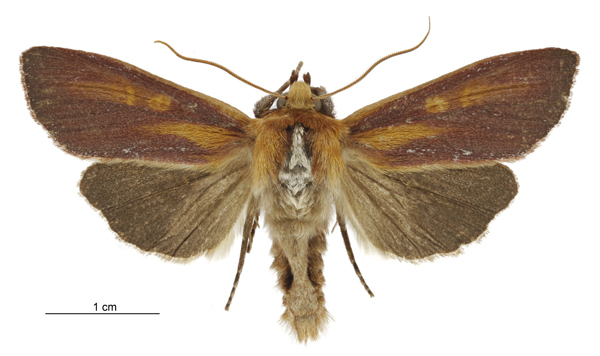
Orange Astelia Wainscot
Ichneutica purdii
Ichneutica purdii, the orange astelia wainscot, is a moth of the family Noctuidae. It is endemic to New Zealand. It can be found throughout the main islands of New Zealand. I. purdii is a relatively large, colourful moth, unlikely to be confused with any other endemic moth species in New Zealand. The larvae of this moth feed at night on species of Astelia. During the day they shelter in the interior of the plant. When fully grown the larvae can reach a length of approximately 48mm. The larvae are ocherous in colour with a pink flush with line markings but when ready to pupate these markings fade and the larvae take on a light golden hue with a rosy tinge to its rear segments. The deep wine coloured pupa is enclosed in a slight cocoon, with this being constructed below the soil, amongst debris or alternatively within a hollow stick. The adult moths are on the wing from October to March. Although this moth is found throughout the main islands of New Zealand it is more frequent in the south of New Zealand at higher altitudes of up to 1200m.
From the article Ichneutica purdii on Wikipedia (CC BY-SA), quoted section by section
Description
The eggs of this species are spherical in shape though slightly flattened both above and below. Eggs can range in colour from light blue green, to pale brown with a dark central spot to black, again, with a darker spot in the centre. When hatched the larvae are approximately 3mm in length and are coloured off white. When fully grown the larvae are ocherous in colour with a pink flush with line markings but when ready to pupate these markings fade and the larvae take on a light golden hue with a rosy tinge to its rear segments. The larvae can reach a length of approximately 48mm. Pupa are deep wine coloured. Fereday first described the adult male holotype specimen of this species as follows:
Head and thorax dark pinkish-ochreous-yellow, darkest in front; abdomen paler and greyish at base. Primaries above dark pinkish cedar colour, a dash of ochreous-yellow occupying the areolet between the submedian nervure and the third median nervule, the dash being very bright at the base and fading towards the posterior angle; a dash of the same colour commencing broadly in the middle of the discoidal cell, extending along the areolet between the first discoidal and lower subcostal nervules, and narrowing towards and vanishing near the exterior margin; a similar dash extending along two-thirds of the costa from the base of the wing; cilia, basal half ochreous-yellow, exterior whitish-ochre …
Range & habitat
I. purdii is endemic to New Zealand and can be found throughout the North, South and Stewart Islands. It can be found at an altitude range of between sea level and 1200m although it is more commonly found in the south of the country and at the higher end of the altitude limit.
Wikipedia: “Geographic range”
What it does
When disturbed the larvae of this species drops and rolls into a ball. Adult moths are on the wing from October to March and are attracted to light. They have been collected via a mercury vapour light trap.
Wikipedia: “Behaviour”
In human culture
The eggs are laid in patches. Once hatched the larvae are nocturnal, spending the day sheltering in the middle of their host plant. The pupa is enclosed in a slight cocoon with this being constructed below the soil, amongst debris or alternatively within a hollow stick. The adult moths are on the wing from October to March. Hudson was of the opinion that the perfect adult was obtained in December until March.
== References ==
Wikipedia: “Life history”
Listen
Looking for field recordings…
Where it lives
Recorded sightings
—
geo-referenced records in GBIF, from museums, herbaria and field observers.
Drag the globe to turn it. Dots are where records exist, not a range map; darker means more records.
In the stacks
Searching the stacks…
Every page naming Ichneutica purdii in the Biodiversity Heritage Library →
This page is assembled live from iNaturalist, GBIF, Wikipedia, the Source Library and the Internet Archive. It is not yet part of the hand-edited codex. iNaturalist taxon 974633.