- Animals
- ›Arthropods
- ›Hexapods
- ›Insects
- ›Winged and Once-winged Insects
- ›Butterflies and Moths
- ›Owlet Moths and Allies
- ›Cutworm Moths and Allies
- ›Cutworms and Dart Moths
- ›Wainscot Moths
- ›Ichneutica
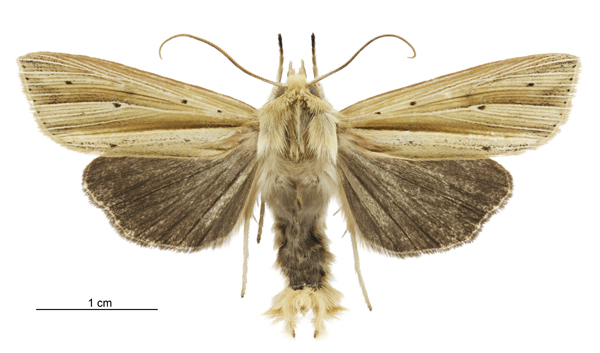
Dark Underwing Wainscot
Ichneutica sulcana
Ichneutica sulcana, the dark underwing wainscot, is a moth of the family Noctuidae. It is endemic to New Zealand and can be found throughout the North, South and Stewart Islands at a range of altitudes from the lowlands to the alpine zone. This species prefers to live in native grass, shrub and wetland habitats as well as in native forest. The larval host plants of this species are forest grasses and sedges and larvae have been reared on Microlaena avenacea and species within the genus Carex. The larva pupates in the soil. Adults are on the wing from December to May but have also been recorded in August and September in the northern parts of the North Island. They are attracted to sugar traps as well as to light. I. sulcana and I. supersulcana are very similar in appearance but can be distinguished as there are differences in the male abdomen and genitalia of the two species. Also these two species do not appear to share a range as I. supersulcana seems to prefer to live at higher altitudes than I. sulcana. I. sulcana might also be confused with I. semivittata but I. sulcana is a larger species with a much darker abdomen and hindwing, and has only 1 to 3 dots on the forewing postmedian line.
From the article Ichneutica sulcana on Wikipedia (CC BY-SA), quoted section by section
Description
Eggs of this species are hemispherical in shape and green in colour with a honeycomb on the surface.
George Hudson described the larva of this species as follows:
The full grown larva is about 1+3⁄4 inch in length, much attenuated posteriorly, pale reddish-ochreous, with numerous fine wavy darker lines; the subdorsal and lateral lines are straight and much more conspicuous; the spiracles are black, and there is a dark olive-green line down the midback.
George Hudson described the adults of I. sulcana as follows:
The expansion of the wings is from 1 1/2 to 1 3/4 inches. The fore-wings are light ochreous with the veins white; there is a shaded, brownish, longitudinal streak near the apex, another from the end of the cell to the termen, a stronger streak from the base of the wing to near the tornus, and another along the dorsum; there is a minute black dot near the base above the middle, a slightly larger dot at about one-third, a conspicuous dot between the origins of veins 3 and 4, and a very minute dot on vein 6. Hind-wings dark blackish-grey, cilia paler. The wingspan of the adult male of this species is between 35 and 46 mm and for the female is between 42 and 48 mm. Specimens from the northern North Island can be smaller and have more pronounced shading on the forewing. I. sulcana and I. …
Range & habitat
This species is endemic to New Zealand. I. sulcana are fairly common and are found throughout the North, South and Stewart Islands at a range of altitudes from the lowlands to the alpine zone. This species is said to be more common in the North Island.
Wikipedia: “Distribution”
What it does
Adults of this species are on the wing from December to May but have been recorded as on the wing in August and September in the northern parts of the North Island. Adults are attracted to light and have been collected via sugar traps as well as a mercury vapour light trap.
Wikipedia: “Behaviour”
Listen
Looking for field recordings…
Where it lives
Recorded sightings
—
geo-referenced records in GBIF, from museums, herbaria and field observers.
Drag the globe to turn it. Dots are where records exist, not a range map; darker means more records.
In the stacks
Searching the stacks…
Every page naming Ichneutica sulcana in the Biodiversity Heritage Library →
This page is assembled live from iNaturalist, GBIF, Wikipedia, the Source Library and the Internet Archive. It is not yet part of the hand-edited codex. iNaturalist taxon 974634.