- Animals
- ›Arthropods
- ›Hexapods
- ›Insects
- ›Winged and Once-winged Insects
- ›Butterflies and Moths
- ›Owlet Moths and Allies
- ›Cutworm Moths and Allies
- ›Cutworms and Dart Moths
- ›Wainscot Moths
- ›Ichneutica
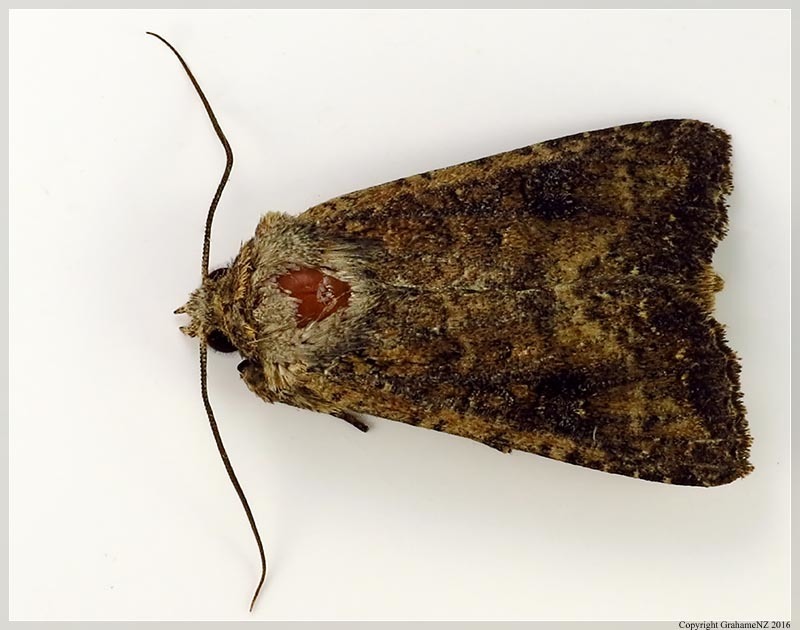
Ichneutica morosa
Ichneutica morosa is a moth of the family Noctuidae. It is endemic to New Zealand and is found in the southern parts of the North Island and throughout the South Island. I. morosa is common in the eastern parts of both those islands and also in Fiordland. I. morosa can be found from altitudes ranging from lowlands to the alpine zone. I. morosa is absent from the range of its closely related species I. mustulenta, that is from the northern North Island. The larvae of I. morosa are known to feed on Poa astonii and also on other Poa species including introduced species. As well as its standard form the adult moths have a grey colour morph with the head and thorax being a grey and mottled brown, and the forewing being a pale greyish ochreous to a deep brown, suffused with grey. I. morosa can be confused with I. mustulenta and I. lignana. Adults are on the wing from November to April.
From the article Ichneutica morosa on Wikipedia (CC BY-SA), quoted section by section
Description
Butler described the adults of the species as follows:
Allied to X. lignana, and referable to the X. rurea group, smoky-brown, primaries with the internal area and disc paler; ordinary spots greyish with black-edged white borders, the reniform extending over the base of the second median interspace and streaked with blackish, a line of which colour runs backwards from it along the median vein; a black-edged white spot close to the base of the interno-median area and three at equal distances on the costal margin; three white costal dots beyond the cell; ordinary lines obsolete; a discal series of black and white dots on the veins followed by a series of externally yellowish-edged ferruginous lunules between the veins; two dusky, somewhat triangular, patches on outer border, with black spots upon them at the extremities of the veins; fringe black spotted and traversed by a central black line; secondaries shining smoky-brown; fringe with a grey-edged yellow basal line; externally silvery-white; head and thorax brown, traversed by bisinuated darker lines; abdomen shining greyish-brown; anal segment blackish at the base, with lateral reddish-brown fringe; body below pinky-whitish, front of pectus pale purplish-brown; knees black, posterior tibiae striped at the end with black; venter with lateral black spots; primaries below shining grey, with cupreous reflections, border whitish; …
Range & habitat
It is endemic to New Zealand. This species is found in the southern parts of the North Island and throughout the South Island.
Wikipedia: “Distribution”
What it does
The adults of this species is on the wing from November to April. They are attracted to light and have been collected via a mercury vapour light trap.
Wikipedia: “Behaviour”
In human culture
The life history of this species is poorly documented as are the host species of its larvae. As at 2019 the larvae are undescribed but are known to feed on Poa astonii and also on other Poa species including introduced species. The adults are known to feed on blossoms at night and Hudson witnessed adults of this species feeding on white rata flowers.
== References ==
Wikipedia: “Life history and host species”
Listen
Looking for field recordings…
Where it lives
Recorded sightings
—
geo-referenced records in GBIF, from museums, herbaria and field observers.
Drag the globe to turn it. Dots are where records exist, not a range map; darker means more records.
In the stacks
Searching the stacks…
Every page naming Ichneutica morosa in the Biodiversity Heritage Library →
This page is assembled live from iNaturalist, GBIF, Wikipedia, the Source Library and the Internet Archive. It is not yet part of the hand-edited codex. iNaturalist taxon 974691.