- Animals
- ›Arthropods
- ›Hexapods
- ›Insects
- ›Winged and Once-winged Insects
- ›Butterflies and Moths
- ›Butterflies
- ›Gossamer-winged Butterflies
- ›Blues
- ›Typical Blues
- ›Leptotina
- ›Cyclyrius
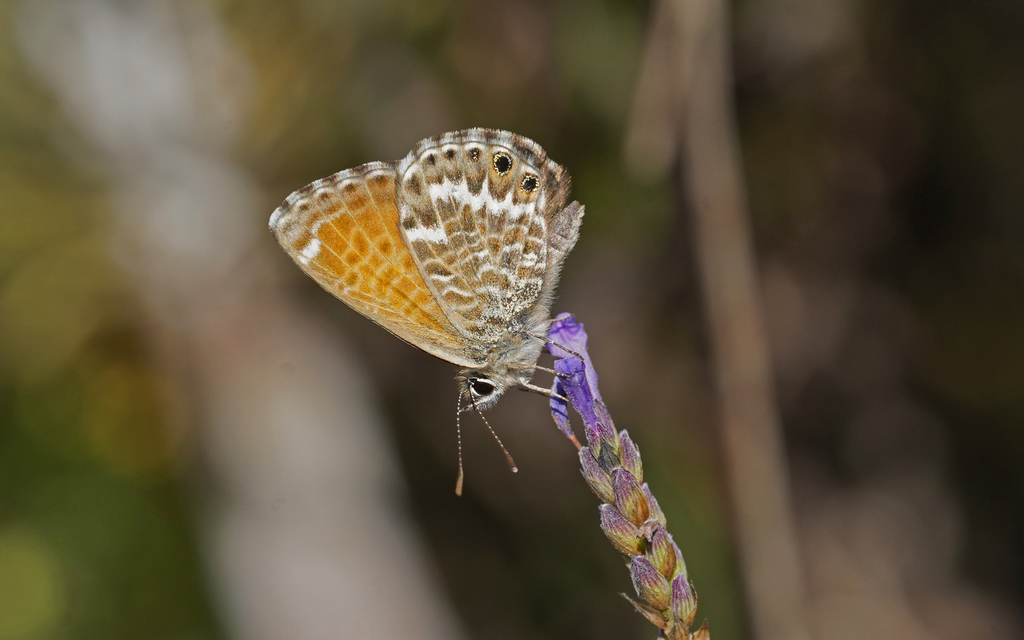
Canary Blue
Cyclyrius webbianus
Leptotes webbianus (formerly Cyclyrius webbianus), the Canary blue, is a butterfly in the family Lycaenidae. It is endemic to the Canary Islands.
The wingspan is 28–34 mm. Adults are on wing year round. The habitat consists of coastal areas. The species flies from March to August on heights of up to 3,000 metres (9,800 ft).
From the article Leptotes webbianus on Wikipedia (CC BY-SA), quoted section by section
Description
P. webbianus Brulle (— fortunata Stgr.) (77 k). Both sexes quite dark brown above with dull blue gloss. At once recognized by the variegated underside; disc of forewing beneath yellowish brown, with white spots before the apex; the hindwing dark grey-brown with light striation and an irregular white band; fringes spotted. — Only on the Canary Islands. Larva said to feed on the flowers of Cytisus canariensis and C. nubigenus. The butterflies fly at a considerable altitude on the Pic of Teneriffe, locally very plentiful, but also in the plains, where they are met with more singly. Simony still found them high up in a locality without vegetation where they were sitting on the blocks of lava. They are apparently on the wing throughout the year, being especially common in August, flying about the branches of Tamarisk and visiting the flowers of Adenocarpus viscosus. I obtained a specimen at Orotava in the immediate neighbourhood of the old dragon-tree, which was then still standing.
== References ==
Wikipedia: “Description from Seitz”
Listen
Looking for field recordings…
Where it lives
Recorded sightings
—
geo-referenced records in GBIF, from museums, herbaria and field observers.
Drag the globe to turn it. Dots are where records exist, not a range map; darker means more records.
In the stacks
Searching the stacks…
Every page naming Cyclyrius webbianus in the Biodiversity Heritage Library →
This page is assembled live from iNaturalist, GBIF, Wikipedia, the Source Library and the Internet Archive. It is not yet part of the hand-edited codex. iNaturalist taxon 98849.