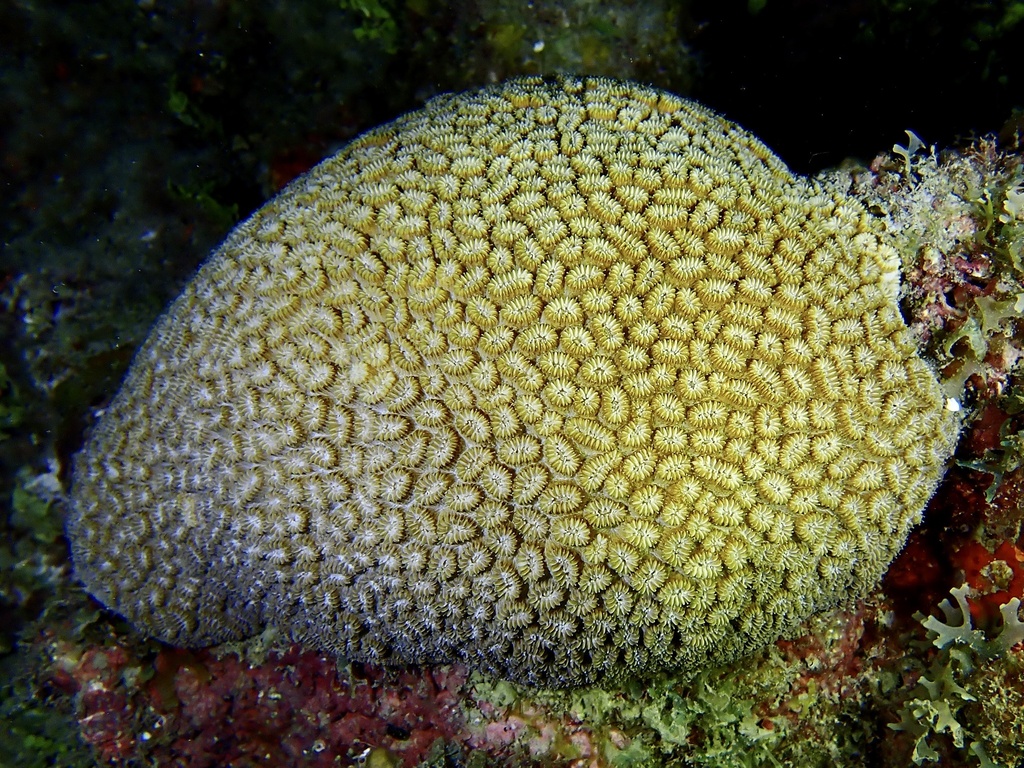
Elliptical Star Coral
Dichocoenia stokesii
Dichocoenia is a monotypic genus of stony coral in the family Meandrinidae. It is represented by a single species, Dichocoenia stokesii, which is commonly known as pineapple coral, elliptical star coral, or pancake star coral. It is mostly found in the Caribbean Sea and the western Atlantic Ocean. Dichocoenia stokesii has irregular calyces and its form can be either a massive, hemispherical hump or a flat, platform-like structure.
From the article Dichocoenia on Wikipedia (CC BY-SA), quoted section by section
Description
Dichocoenia stokesi is a massive colonial coral that forms rounded humps up to 40 centimetres (16 in) in diameter or thick plates. It is recognisable by the fact that many of the corallites, the stony cups from which the coral polyps protrude, can be oval, or elongated. They can be up to 5 centimetres (2.0 in) long and only 0.5 centimetres (0.20 in) wide. Others are circular or Y-shaped and all have raised rims. The columella, the central axial structure in the corallite, is fragile and spongy. The polyps are large and well-separated with a diameter of about 4 millimetres (0.16 in). The colour is variable and can be white, cream, orange, yellowish-brown, green, olive or brown and the septo-costae, the little ridges that surround the corallites, are white. Sometimes two individual corals grow side by side and intertwine, forming one hump, but in these circumstances they do not fuse and each retains its original colour.
Range & habitat
Dichocoenia stokesi is found in the western Atlantic Ocean and Caribbean Sea. Its range extends from Bermuda and southern Florida to the southern half of the Gulf of Mexico and along the coast of Central America to Venezuela. The fossil record shows that this species grew in the Caribbean region as long ago as the Oligocene Era (34 to 23 million years ago). It is a relatively uncommon species and tends to grow on fore reefs and back reefs but not on reef crests. It has a wide depth range of 2 to 72 metres (6 to 236 feet) but is commonest at 30 metres (98 ft) or less. The corallites are larger and more prominent in individuals growing at greater depths.
Wikipedia: “Distribution and habitat”
Where it lives
Recorded sightings
—
geo-referenced records in GBIF, from museums, herbaria and field observers.
Drag the globe to turn it. Dots are where records exist, not a range map; darker means more records.
In the stacks
Searching the stacks…
Every page naming Dichocoenia stokesii in the Biodiversity Heritage Library →
This page is assembled live from iNaturalist, GBIF, Wikipedia, the Source Library and the Internet Archive. It is not yet part of the hand-edited codex. iNaturalist taxon 99273.