- Animals
- ›Arthropods
- ›Hexapods
- ›Insects
- ›Winged and Once-winged Insects
- ›Stick Insects
- ›Verophasmatodea
- ›Areolatae
- ›Bacilloidea
- ›Heteropterygidae
- ›Obriminae
- ›Obrimini
- ›Tisamenus
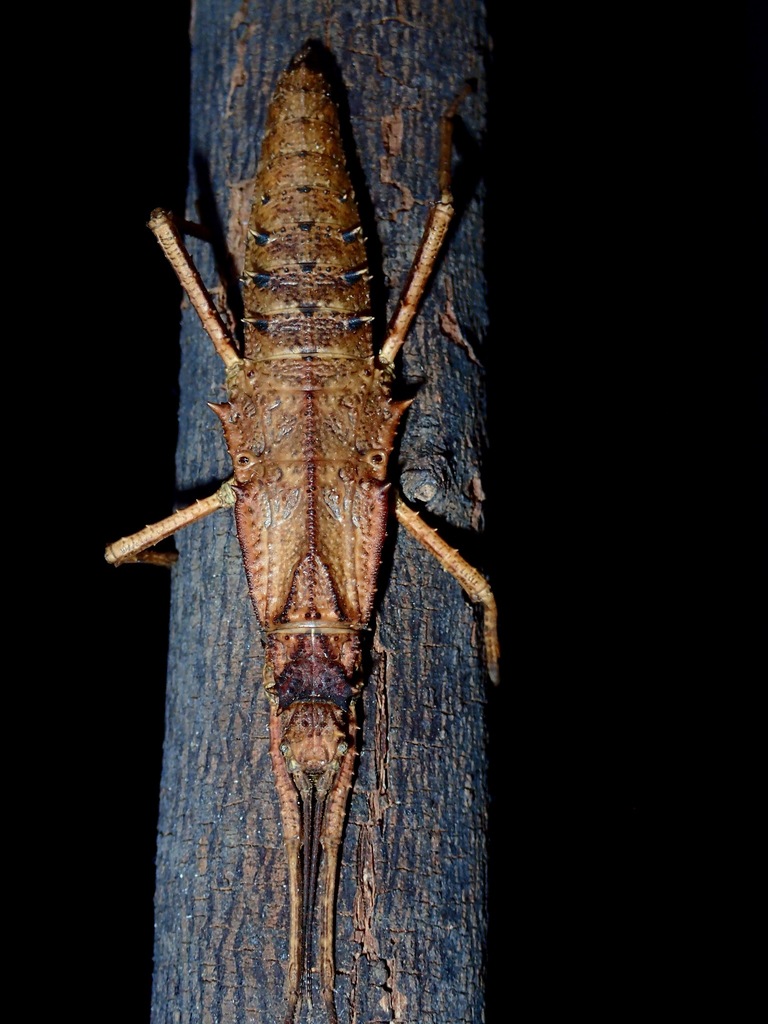
Tisamenus deplanatus
Tisamenus deplanatus is a stick insect species native to the north of the Philippine island of Luzon. A relatively rarely used common name for the species is flat stick insect, which in turn refers to the species name "deplanatus" what means something like "flattened".
From the article Tisamenus deplanatus on Wikipedia (CC BY-SA), quoted section by section
Description
Tisamenus deplanatus is a relatively unspined Tisamenus species. The males are 38 to 43 millimetres (1.5 to 1.7 in), the wider females about 56 to 67 millimetres (2.2 to 2.6 in) long. On the flat head there is a distinct pair of supra orbital spines, which either consist of three interconnected tubercles or of a larger pair of tubercles with surrounding tubercles. On the right and left of the pronotum there are two closely spaced spines. On the relatively short mesothorax, which widens in a strongly trapezoidal shape towards the rear, there is the triangle formed by raised edges, which is typical of Tisamenus species. The base of this triangle is attached to the front edge of the mesonotum and is strongly raised. On the triangle is a flat, central longitudinal ridge, which extends somewhat higher along the rest of the mesonotum and the entire metanotum, extending from the posterior tip. In females of Tisamenus deplanatus, the triangle is longer than wide, forming an isosceles triangle. On the triangle there is a flat, central longitudinal ridge, which extends in extension of the posterior tip somewhat higher over the rest of the mesonotum and the entire metanotum. This feature makes them easy to distinguish from females of the similar, somewhat broader Tisamenus cervicornis, in which this triangle is wider than long, forming a roughly equilateral triangle. …
Range & habitat
Only the islands of the Philippines are mentioned as the location of the female holotype. The previously known distribution area includes the north of the island of Luzon. The breeding stock, currently kept in Europe, comes from the Ilocos region, more precisely from the province of Ilocos Norte. The female examined by Rehn and Rehn in 1939 comes from Surigao on the island of Mindanao, but was assigned to Tisamenus cervicornis by Hennemann in 2025.
Wikipedia: “Distribution area”
Listen
Looking for field recordings…
Where it lives
Recorded sightings
—
geo-referenced records in GBIF, from museums, herbaria and field observers.
Drag the globe to turn it. Dots are where records exist, not a range map; darker means more records.
In the stacks
Searching the stacks…
Every page naming Tisamenus deplanatus in the Biodiversity Heritage Library →
This page is assembled live from iNaturalist, GBIF, Wikipedia, the Source Library and the Internet Archive. It is not yet part of the hand-edited codex. iNaturalist taxon 995936.