- Animals
- ›Arthropods
- ›Hexapods
- ›Insects
- ›Winged and Once-winged Insects
- ›Butterflies and Moths
- ›Owlet Moths and Allies
- ›Underwing, Tiger, Tussock, and Allied Moths
- ›Erebinae
- ›Thermesiini
- ›Ascalapha
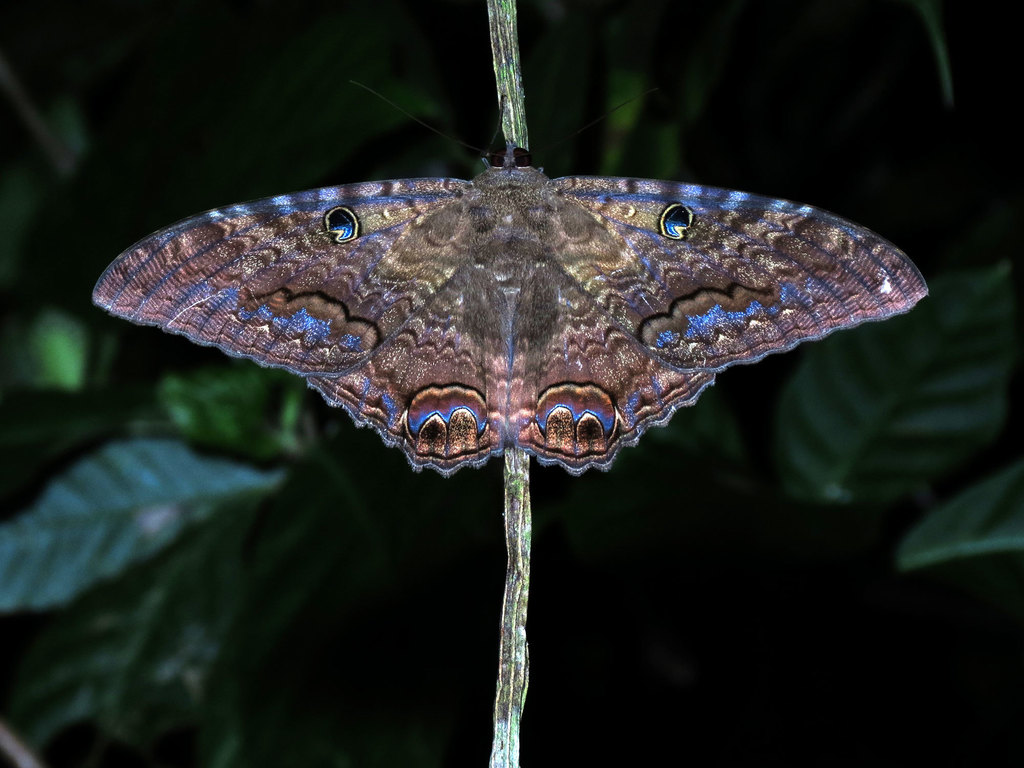
Black Witch
Ascalapha odorata
The erebid moth Ascalapha odorata, commonly known as the black witch, is a large bat-shaped, dark-colored nocturnal moth, normally ranging from the southern United States to Brazil. Ascalapha odorata is also migratory into Canada and most states of the United States. It is the largest noctuoid in the continental United States. In the folklore of many Central and South American cultures, it is associated with death or misfortune.
From the article Ascalapha odorata on Wikipedia (CC BY-SA), quoted section by section
Range & habitat
The black witch lives from the southern United States, Mexico and Central America to Brazil, and even Argentina. Also, the moth has apparently been introduced to Hawaii. The black witch flies north during late spring and summer. One was caught during an owl banding project at the Whitefish Point lighthouse on the shoreline of Lake Superior in July 2020.
Wikipedia: “Geographical range”
In human culture
The black witch is considered a harbinger of death in Mexican and Caribbean folklore. In many cultures, one of these moths flying into the house is considered bad luck: e.g., in Mexico, when there is sickness in a house and this moth enters, it is believed the sick person will die, though a variation on this theme (in the lower Rio Grande Valley, Texas) is that death only occurs if the moth flies in and visits all four corners of one's house (in Mesoamerica, from the pre-Hispanic era until the present time, moths have been associated with death and the number four). In some parts of Mexico, people joke that if one flies over someone's head, the person will lose his hair. In Jamaica, under the name duppy bat, the black witch is seen as the embodiment of a lost soul or a soul not at rest. In Jamaican English, the word duppy is associated with malevolent spirits returning to inflict harm upon the living and bat refers to anything other than a bird that flies. The word "duppy" (also: "duppie") is also used in other West Indian countries, generally meaning "ghost". In Brazil it is called "mariposa-bruxa", "mariposa-negra", "bruxa-negra", and "bruxa", and it is also believed that when a moth of this type enters the house it can bring some "bad omen", signaling the death of a resident. In the Ecuadorian highlands they are called Tandacuchi and in Peru Taparacuy or Taparaco. …
Wikipedia: “Folklore and mythology”
Listen
Looking for field recordings…
Where it lives
Recorded sightings
—
geo-referenced records in GBIF, from museums, herbaria and field observers.
Drag the globe to turn it. Dots are where records exist, not a range map; darker means more records.
In the stacks
Searching the stacks…
Every page naming Ascalapha odorata in the Biodiversity Heritage Library →
This page is assembled live from iNaturalist, GBIF, Wikipedia, the Source Library and the Internet Archive. It is not yet part of the hand-edited codex. iNaturalist taxon 61503.