- Animals
- ›Arthropods
- ›Hexapods
- ›Insects
- ›Winged and Once-winged Insects
- ›Butterflies and Moths
- ›Butterflies
- ›Whites, Yellows, and Sulphurs
- ›Whites
- ›Pierini
- ›Aporiina
- ›Belenois
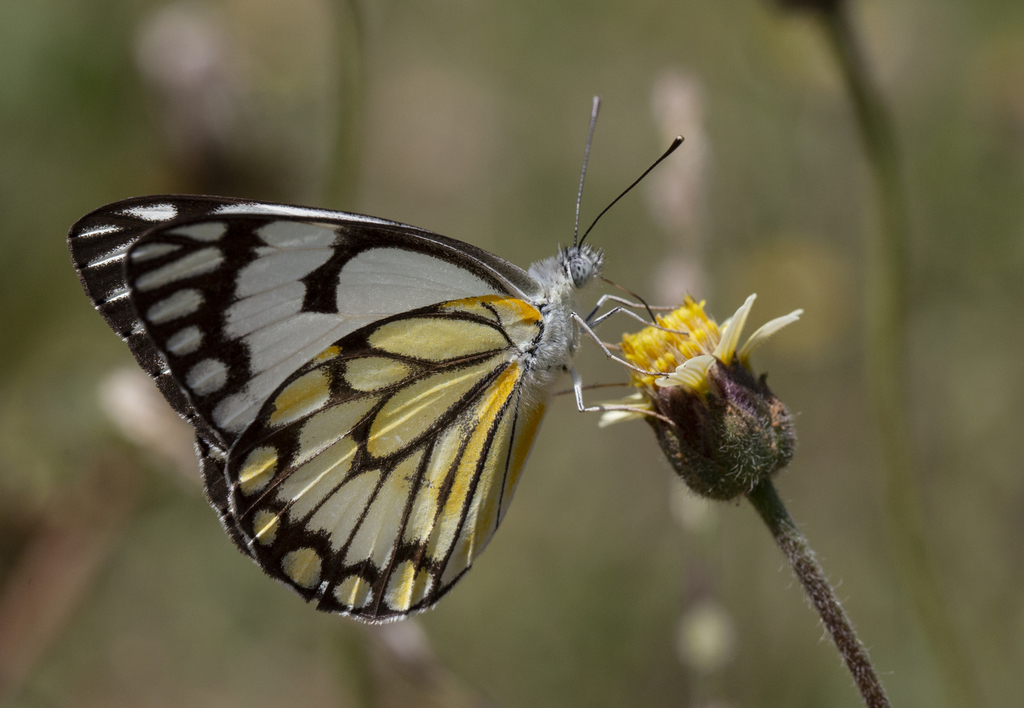
Pioneer White
Belenois aurota
Belenois aurota, the pioneer or pioneer white or caper white, is a small to medium-sized butterfly of the family Pieridae—that is, the yellows and whites—which is found in South Asia, West Asia and Africa. In Africa, it is also known as the brown-veined white, and is well known during summer and autumn when large numbers migrate north-east over the interior.
From the article Belenois aurota on Wikipedia (CC BY-SA), quoted section by section
Range & habitat
The species lives in Sri Lanka, the Himalayas from Kashmir to Sikkim at elevations below 6,000 feet (1,800 m), and through the plains to southern India. In the Nilgiris observed up to 8,000 feet (2,400 m) (George Hampson). To the west it spreads through Persia and Arabia to East Africa. The species occurs over the greater part of Sub-Saharan Africa.
Wikipedia: “Distribution”
What it does
Food plants of the larvae include Capparis zeylanica. In Africa, the host plants are almost exclusively from the family Capparaceae and in particular the genera Boscia, Maerua and Capparis. Eggs are laid in batches of 20 or so, while the newly hatched larvae are gregarious.
Larva. When hatched a line long, olive colour, with a distinct glossy jet-black head. After first moult. One fourth inch long; grass-green; dorsal line very distinct, dark green; lateral line very broad, plum-coloured and mottled, dentated into the ground-colour, on the last two segments on its upperside; a small white spot on either side of dorsal line on each segment; a yellow spot on each segment on the lateral line on either side; abdomen glossy green; ventral line distinct, rather interrupted, grass-green; all the legs green, hairy; head shiny black with a green triangular mark in front, covered with stiff whitish hairs; stigmata dark-coloured; sides greyish green, slightly wrinkled transversely; the portion of ground-colour between lateral and dorsal line slightly powdered with yellow; hair whitish grey; anal segment black and hairy; first segment rather swollen in front. After last moult length 1.25 inch long; cylindrical, broader towards the head, slightly tomentose on back, hairy on the sides; otherwise as after first moult. Food plant, the pea-leaved caper (Capparis pyrifolia).
Pupa. …
Wikipedia: “Life cycle”
Listen
Looking for field recordings…
Where it lives
Recorded sightings
—
geo-referenced records in GBIF, from museums, herbaria and field observers.
Drag the globe to turn it. Dots are where records exist, not a range map; darker means more records.
In the stacks
Searching the stacks…
Every page naming Belenois aurota in the Biodiversity Heritage Library →
This page is assembled live from iNaturalist, GBIF, Wikipedia, the Source Library and the Internet Archive. It is not yet part of the hand-edited codex. iNaturalist taxon 125577.