- Animals
- ›Arthropods
- ›Hexapods
- ›Insects
- ›Winged and Once-winged Insects
- ›Butterflies and Moths
- ›Butterflies
- ›Whites, Yellows, and Sulphurs
- ›Whites
- ›Pierini
- ›Pierina
- ›Pieris
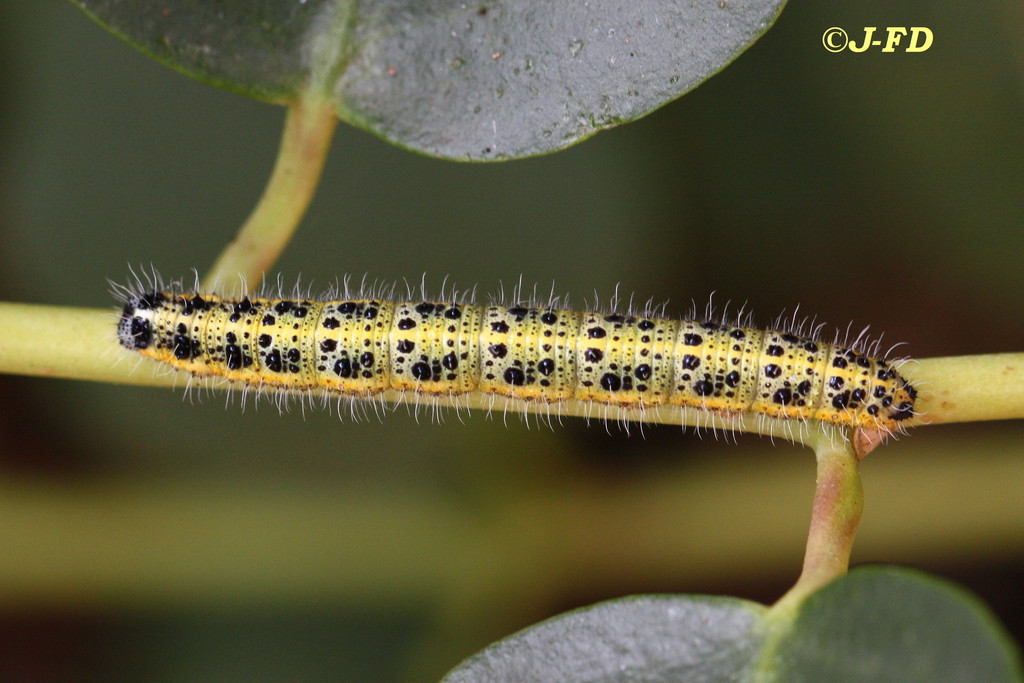
Large White
Pieris brassicae
Pieris brassicae, the large white, also called cabbage butterfly, cabbage white, cabbage moth (erroneously), or in India the large cabbage white, is a butterfly in the family Pieridae. It is a close relative of the small white, Pieris rapae.
The large white is common throughout Europe, North Africa and Asia.
From the article Pieris brassicae on Wikipedia (CC BY-SA), quoted section by section
Range & habitat
The large white is common throughout Europe, north Africa, and Asia to the Himalayas often in agricultural areas, meadows and parkland. It has managed to establish a population in South Africa and in 1995 it was predicted to spread to Australia and New Zealand. The large white is a strong flier and the British population has been reinforced in most years by migrations from the continent. Scattered reports of the large white from the north-eastern United States (New York, Rhode Island and Maine) over the past century are of a dubious nature and indicate either accidental transport or intentional release. Such introductions threaten to establish this agricultural pest in North America. In 2010 the butterfly was found in Nelson, New Zealand where it is known as the great white butterfly. It is classed as an unwanted pest due to the potential effect on crops. For a limited period in October 2013 the Department of Conservation offered a monetary reward for the capture of the butterfly. After two weeks, the public had captured 134 butterflies, netting $10 for each one handed in. As a result of this and other containment measures, such as over 263,000 searches in the upper South Island and the release of predatory wasps, the large white was officially declared to be eradicated from New Zealand as of December 2014.
Eggs. …
Wikipedia: “Distribution”
What it does
Males do not display considerable amounts of territorial behaviour. It has been suggested that this could be a reason why there is no observed significant sexual dimorphism between the male and female large white butterflies.
Wikipedia: “Territorial behaviour”
At the table
Large white butterflies have a preference for what types of food plant they usually eat. Studies have shown that the preference for certain plants is reliant upon the butterflies' previous experiences. The large white butterflies, then, are shown to rely on the species of food plants, the time of experience, and the choice-situation. Thus, the large white butterflies learn what types of foods they prefer, rather than relying on their sense organs or physiological changes. In contrast, this preference for adult food plant differs from the preference of female large whites using visual cues such as plant colour to determine the best host plants for oviposition. Plants with mustard-oil glucosides are important for this butterfly because it dictates their eating behaviours, and resultant survival rates, as specified in the section regarding oviposition. This is so beneficial for large whites because their large consumption of plants containing mustard oils is the specific reason they are so distasteful to predators, such as birds. Thus, caterpillars are protected from attack, despite them being brightly coloured; in fact, the bright colouration is to signal to predators that they taste bad. However, there is more benefit to this species' use of mustard oil glucosides. …
Wikipedia: “Diet and food selection”
Listen
Looking for field recordings…
Where it lives
Recorded sightings
—
geo-referenced records in GBIF, from museums, herbaria and field observers.
Drag the globe to turn it. Dots are where records exist, not a range map; darker means more records.
In the old herbals & bestiaries

The natural history of Carolina, Florida, and the Bahama Islands : containing two hundred a...
Catesby, Mark, bioloog, kunstenaar · 1743 · p.192

Mark Catesby — Piscium, serpentum, insectorum (pt. 1) (1750)
Mark Catesby · 1750 · p.133

Maria Sibylla Merian — Der rupsen begin, voedzel en wonderbaare verandering (1712)
Maria Sibylla Merian · 1717 · p.257

The natural history of Carolina, Florida, and the Bahama Islands : containing two hundred a...
Catesby, Mark, bioloog, kunstenaar · 1743 · p.401

Florentine Codex, Vol. 3 (Books 10-12)
Bernardino de Sahagún · 1577 · p.379

Introductory Book
Michael Scot · 1350 · p.307

The Natural History of Carolina Florida and Bahama Islands Vol. 2
Mark Catesby · 1743 · p.190

Christoph Jakob Trew — Uitgezochte planten (1771)
Christoph Jakob Trew · 1771 · p.120

Notable Commentaries on the History of Plants
Leonhart Fuchs · 1549 · p.655

Jan Moninckx; Maria Moninckx — Moninckx Atlas, vol. 1 (1686)
Jan Moninckx; Maria Moninckx · 1687 · p.15

A voyage to the islands Madera Barbados Jamaica Vol. 1
Hans Sloane · 1707 · p.630

Mark Catesby — Piscium, serpentum, insectorum (pt. 2) (1777)
Mark Catesby · 1777 · p.27
In the stacks
Searching the stacks…
Every page naming Pieris brassicae in the Biodiversity Heritage Library →
This page is assembled live from iNaturalist, GBIF, Wikipedia, the Source Library and the Internet Archive. It is not yet part of the hand-edited codex. iNaturalist taxon 55401.