- Animals
- ›Arthropods
- ›Chelicerates
- ›Arachnids
- ›Mites and Ticks
- ›Parasitiformes
- ›Mesostigs
- ›Monogynaspida
- ›Gamasina
- ›Dermanyssiae
- ›Dermanyssoidea
- ›Laelapidae
- ›Varroinae
- ›Varroa
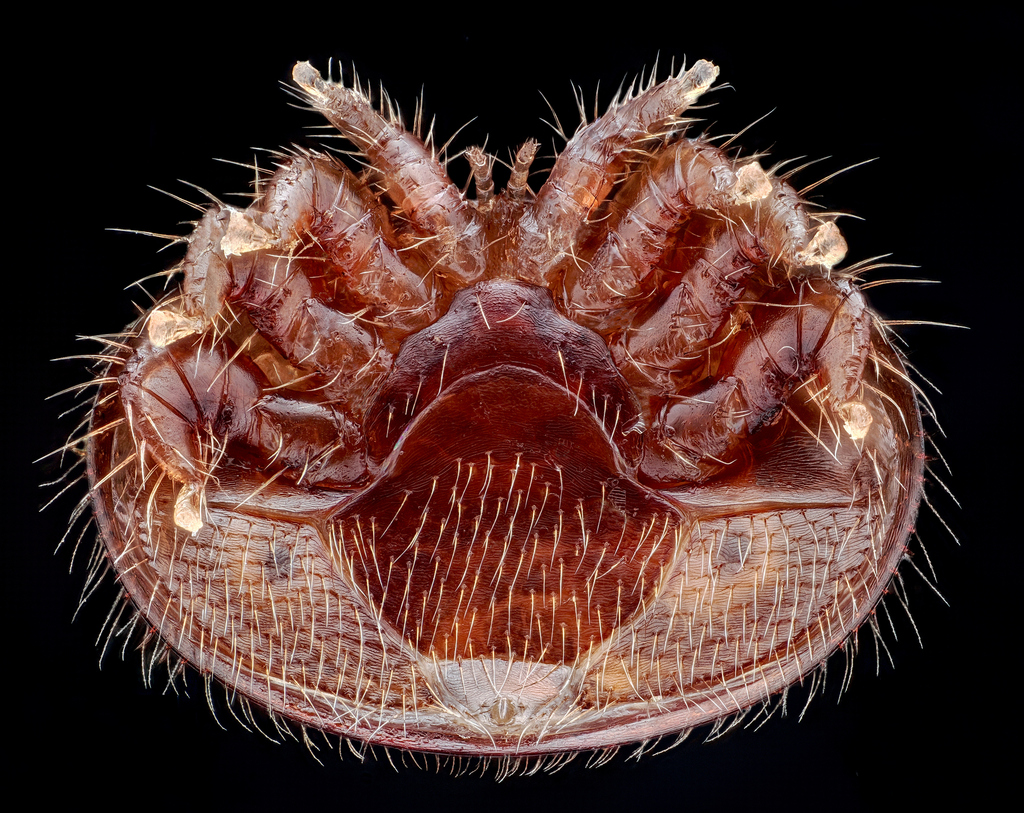
Varroa Mite
Varroa destructor
Varroa destructor, the Varroa mite, is an external parasitic mite that attacks and feeds on honey bees and is one of the most damaging honey bee pests in the world. A significant mite infestation leads to the death of a honey bee colony, usually in the late autumn through early spring. Without management for Varroa mite, honey bee colonies typically collapse within 2 to 3 years in temperate climates. These mites can infest Apis mellifera, the western honey bee, and Apis cerana, the Asian honey bee. Since it is very similar physically to the closely related Varroa jacobsoni, these species were thought to be one prior to 2000, but they were found to be two separate species by DNA analysis.
Parasitism of bees by mites in the genus Varroa is called varroosis. The Varroa mite can reproduce only in a honey bee colony. It attaches to the body of the bee and weakens the bee. The species is a vector for at least five debilitating bee viruses, including RNA viruses such as the deformed wing virus (DWV). The Varroa mite is the parasite with possibly the most pronounced economic impact on the beekeeping industry and is one of multiple stress factors contributing to the higher levels of bee losses around the world. Varroa mite has also been implicated as one of the multiple causes of colony collapse disorder.
From the article Varroa destructor on Wikipedia (CC BY-SA), quoted section by section
Description
The adult female mite is reddish-brown in color, while the male is white. Varroa mites are flat, having a button shape. They are 1–1.8 mm long and 1.5–2 mm wide, and have eight legs. Varroa mites lack eyes. These mites have curved bodies that allow them to fit between the abdominal segments of adult bees. Host bee species can help differentiate mite species in the genus Varroa; both V. destructor and Varroa jacobsoni parasitize Apis cerana, the Asian honey bee, but the closely related mite species originally described as V. jacobsoni by Anthonie Cornelis Oudemans in 1904 does not attack Apis mellifera, the western honey bee, unlike V. destructor. Until 2000, V. destructor was thought to be V. jacobsoni and resulted in some mislabeling in the scientific literature. The two species cannot be easily distinguished with physical traits and have 99.7% similar genomes, so DNA analysis is required instead. Because the more virulent and damaging species V. destructor could not be distinguished at the time, most pre-2000 research on western honey bees that refers to V. jacobsoni was actually research on V. destructor. Other Varroa species V. underwoodi and V. rindereri can also parasitize honey bee species and can be distinguished from V. destructor and V. …
Wikipedia: “Description and taxonomy”
Range & habitat
Varroa mites originally occurred only in Asia on the Asian honey bee, but this species has been introduced to many other countries on several continents, resulting in disastrous infestations of European honey bees. Introduction data prior to 2000 is unclear because of confusion with V. jacobsoni. By 2020, V. destructor was confirmed to be present throughout North America (excluding Greenland), South America, most of Europe and Asia, and portions of Africa. The species was not present in Australia as well as Oman, Congo, Democratic Republic of Congo, and Malawi. It was suspected to not be present in Sudan and Somalia. Mites were found in 2022 in New South Wales in Australia.
Wikipedia: “Range”
What it does
Female mites enter brood cells to lay eggs on the comb wall just before the cell is capped. Eggs are approximately 0.2 to 0.3 mm in diameter and cannot be seen without magnification. These eggs hatch into male and female protonymphs that are both transparent white. Immature mites can only feed on capped brood, so the life cycle cannot be completed during broodless periods. Protonymphs molt into deuteronymphs that more closely resemble the curved body of adults before they molt into adults. Development time from egg to adult is 6–7 days. Males will not leave brood cells and only mate with females present in the brood cell. Adult females can be found feeding both on brood and adult bees. After reaching the adult stage, females will leave the brood cell and enter a phoretic stage where mites attach to adult bees in order to disperse. Mites will feed on adult bees at this time and can be transmitted from bee to bee during this stage. Nurse bees are preferred hosts in order to be moved to new brood cells. Because the nurse bee spends more time around the drone brood (i.e., male bees) rather than the worker brood, many more drones are infected with the mites. These phoretic females can also be transmitted to other hives through bee contact or hive equipment transfer. …
Wikipedia: “Life cycle”
Where it lives
Recorded sightings
—
geo-referenced records in GBIF, from museums, herbaria and field observers.
Drag the globe to turn it. Dots are where records exist, not a range map; darker means more records.
In the stacks
Searching the stacks…
Every page naming Varroa destructor in the Biodiversity Heritage Library →
This page is assembled live from iNaturalist, GBIF, Wikipedia, the Source Library and the Internet Archive. It is not yet part of the hand-edited codex. iNaturalist taxon 194693.