 NL·0107
Herbarium of the Nature Library
- Name
- Musa acuminata
- Family
- Musaceae
- Native to
- Southeast Asia and Malesia to northern Australia; cultivated throughout the tropics
- Habitat
- Tropical rainforest, Tropical gardens and plantations, Forest gaps
Banana
Musa acuminata
Also calledKela (Hindi/Urdu) · Mawz (Arabic) · Xiāngjiāo (Chinese) · Pisang (Malay/Indonesian) · Ndizi (Swahili) · Plátano (Spanish) · Saging (Tagalog)
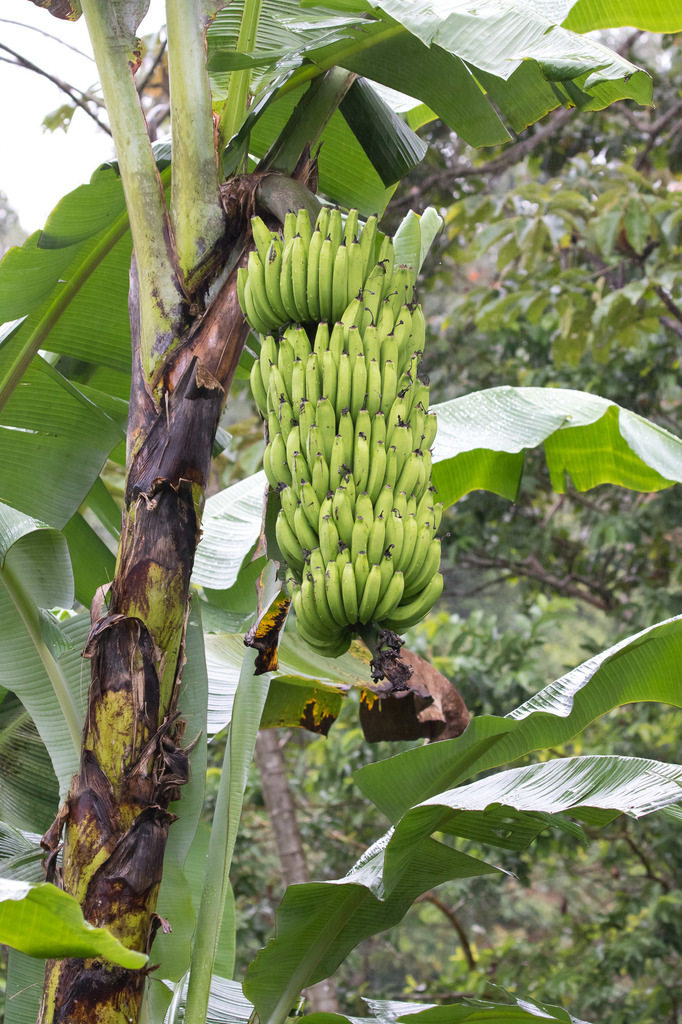
The banana plant is not a tree but the world's largest herb: its 'trunk' is a pseudostem of tightly rolled leaf sheaths. Wild Musa acuminata has fruit packed with hard seeds; the seedless sterile triploids we eat, like the 'Cavendish', are propagated only as clones.
Musa acuminata is a species of banana native to Southern Asia, its range comprising the Indian subcontinent and Southeast Asia. Many of the modern edible dessert bananas are derived from this species, although some are hybrids with Musa balbisiana. First cultivated by humans around 8000 BCE, it is one of the earlier examples of domesticated plants. Wikipedia
What it can do
- iPseudostem can grow to about 3–7 m in under a year, then dies after fruiting while suckers replace it
- iiCultivated triploids set fruit without pollination (parthenocarpy)
- iiiWild forms are pollinated at night by bats and by day by sunbirds
- ivFruit curves upward as it grows, turning toward light (negative geotropism)
At the table
Eatenfruit (ripe raw, or green cooked) · male flower bud (cooked) · inner pseudostem core (cooked) · leaves used as food wrappers and plates
Fruit, flower and stem core are all eaten. Wild seeded bananas have large hard seeds that must be spat out.
In the medicine cabinet
| Tradition | Use |
|---|---|
| Ayurveda | Unripe banana and banana-stem juice used for diarrhoea and urinary stones |
| Modern clinical nutrition | BRAT diet (bananas, rice, applesauce, toast) for recovery from gastroenteritis |
| Pacific Island medicine | Sap applied to wounds and burns |
Weight of evidence
Traditional. Long historical use; little or no modern clinical evidence.
Active compounds
resistant starch, potassium, dopamine (in peel), serotonin, pectin
Fruit & seed
Fruit
Berry (fleshy, many-seeded in wild forms)
Ripens: Year-round in the tropics
Elongated curved berry 10–30 cm, borne in 'hands' on a hanging bunch; green ripening to yellow, flesh cream and starchy-sweet. Cultivated forms show only tiny black specks where seeds aborted.
Seed
4–6 mm (wild)
In wild plants: hard, angular, black or dark-brown seeds about 4–6 mm, densely packed in the flesh. Cultivated dessert bananas show only rows of tiny brown-black specks of aborted ovules
- Dispersal
- Bats, birds and primates (wild); vegetatively by suckers (cultivated)
- Germination
- Wild seed: scarify and soak, sow warm (25–30 °C); erratic, 2 weeks to several months
How to grow it
Hardiness (USDA zones)
USDA 9b–12 (fruits reliably only in 10–12). Survives winters down to about -7 °C.
- Light
- Full sun; shelter from wind which shreds leaves
- Water
- High; constant moisture
- Soil
- Rich, deep, well-drained loam high in organic matter, pH 5.5–7
- Propagation
- Suckers (sword suckers with narrow leaves are best), corms, or tissue-cultured plantlets
- To harvest
- 9–15 months from planting to bunch; fruit ready ~3 months after flowering
- Climates
- Tropical, Humid subtropical
- 1Plant a sword sucker or tissue-culture plant in a hole enriched with compost, in a warm sheltered spot.
- 2Feed heavily (bananas are hungry for potassium and nitrogen) and water deeply; mulch with chopped old leaves.
- 3Keep one main stem plus one follower sucker per clump; cut away extra suckers.
- 4After the last hand forms, snap off the male bud; harvest the bunch when fruits are plump and the first one yellows.
- 5Cut down the spent pseudostem after harvest and chop it into mulch around the clump.
Can it grow where you are?
Where it lives
Recorded sightings
—
geo-referenced records in GBIF, from museums, herbaria and field observers.
Native range
Southeast Asia and Malesia to northern Australia; cultivated throughout the tropics
Drag the globe to turn it. Dots are where records exist, not a range map; darker means more records.
In the old herbals & bestiaries
Woodcuts and engravings matched from the Source Library’s scanned books by name. Plates marked “relative” show a close kin rather than this exact species. Click a plate to read the page it came from, with translation.

Itinerary: Voyage to the East or Portuguese Indies
Jan Huyghen van Linschoten · 1596 · p.161

Berthe Hoola van Nooten — Fleurs, fruits et feuillages choisis de la flore et de la pomone de Java (1863)
Berthe Hoola van Nooten · 1863 · p.139

Metamorphosis Insectorum Surinamensium
Maria Sibylla Merian · 1705 · p.45

Maria Sibylla Merian — Dissertatio de generatione et metamorphosibus insectorum Surinamensium (1719)
Maria Sibylla Merian · 1719 · p.53

Kircher: China Illustrata (1667)
Athanasius Kircher · 1667 · p.256

Sacred Physics
Scheuchzer, Johan Jacob · 1728 · p.454

The Embassy of the Dutch East India Company to the Tartar Cham
Johan Nieuhof · 1665 · p.447

Sacred Physics
Scheuchzer, Johan Jacob · 1728 · p.456

Garden of Malabar, Vol. 1
Hendrik van Rheede · 1683 · p.47

Mosaic History of the Hebrew Church
Goeree, Willem · 1700 · p.832
In the stacks
Searching the stacks…
Every page naming Musa acuminata in the Biodiversity Heritage Library →
Marginalia
Alexander the Great's soldiers reportedly saw sages resting under banana plants in the Indus valley, giving rise to Linnaeus's name Musa sapientum, 'fruit of the wise'. Bananas were among the first crops of New Guinea, where cultivation at Kuk Swamp dates back about 7,000 years.
Curiosity
Almost all export bananas are one clone, 'Cavendish', which replaced 'Gros Michel' after Panama disease wiped it out in the 1950s.
Kinship




Fact-checked: 1 correction made to this sheet. Photographs: iNaturalist contributors under the licences shown. Records: GBIF.org. Historical plates: Source Library (CC BY-SA 4.0; originals public domain). Summary text: Nature Library editors and Wikipedia (CC BY-SA). Medicinal and edibility notes are historical and educational, not advice. iNaturalist taxon 140907.