 NL·0142
Herbarium of the Nature Library
- Name
- Malus domestica
- Family
- Rosaceae
- Native to
- Domesticated from Malus sieversii of Central Asia (Tian Shan), with genes from M. sylvestris; cultivated throughout temperate regions worldwide
- Habitat
- Temperate forest, Orchards, Mountain woodland
Apple
Malus domestica
Also calledSeb (Hindi/Urdu) · Tuffāḥ (Arabic) · Sib (Persian) · Píngguǒ (Chinese) · Ringo (Japanese) · Manzana (Spanish) · Alma (Kazakh)
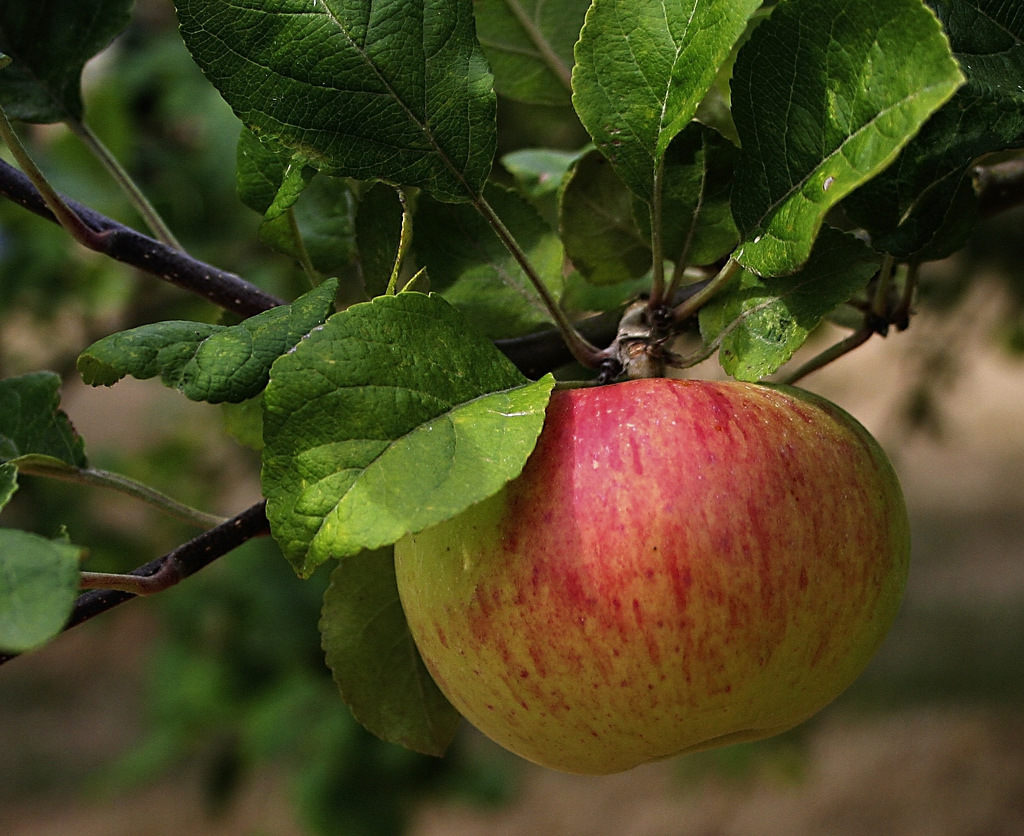
The domestic apple descends mainly from the wild apple forests of the Tian Shan mountains of Kazakhstan, carried west and east along the Silk Road. Apples do not come true from seed, so every named variety — from 'Gala' to 'Bramley' — is a clone propagated by grafting, some for centuries.
An apple is the round, edible fruit of an apple tree. Fruit trees of the orchard or domestic apple, the most widely grown in the genus, are cultivated worldwide. The tree originated in Central Asia, where its wild ancestor, Malus sieversii, is still found. Apples have been grown for thousands of years in Eurasia before they were introduced to the American continent by European colonists. Apples have cultural significance in many mythologies and religions. Wikipedia
What it can do
- iSelf-incompatible: most varieties need pollen from a different variety to set fruit
- iiSeeds are genetically shuffled, so almost every pip grows into a new, unique apple
- iiiRequires winter chilling (often 500–1,000 hours below 7 °C) to break dormancy and flower well
- ivFruit stores for months in cool conditions as cells slowly respire sugars
At the table
Eatenfruit (raw, cooked, juiced, fermented to cider) · flowers (in small amounts)
Flesh and skin are wholesome. Seeds contain amygdalin, which releases cyanide when chewed; a few swallowed whole are harmless, but large quantities of crushed seeds should be avoided.
In the medicine cabinet
| Tradition | Use |
|---|---|
| European folk medicine | Grated raw apple (rich in pectin) given for diarrhoea; stewed apple for convalescents |
| Unani | Apple preparations (e.g. murabba-e-seb) used as a heart and brain tonic |
Weight of evidence
Traditional. Long historical use; little or no modern clinical evidence.
Active compounds
pectin, quercetin, phloridzin, chlorogenic acid, malic acid
Fruit & seed


Fruit
Pome
Ripens: Late summer to late autumn (Northern Hemisphere)
Round to conical fruit 5–10 cm across, skin green, yellow or red, crisp white to cream flesh around a papery five-chambered core; the swollen fleshy part develops from the floral receptacle, not the ovary.

Seed
7–10 mm
Glossy dark-brown to almost black teardrop-shaped pips, flattened, about 7–10 mm long, typically 1–2 in each of the five core chambers
- Dispersal
- Animals (deer, bears, birds, horses) eat the fruit and pass the seeds
- Germination
- Needs 60–90 days of moist cold stratification at 1–5 °C; seedlings will not resemble the parent
Photographs from Wikimedia Commons under open licences; hover for the photographer, click for the file.
How to grow it
Hardiness (USDA zones)
USDA 3–8 (varies by cultivar; some low-chill types to 9–10). Survives winters down to about -40 °C.
- Light
- Full sun
- Water
- Moderate; regular water while fruit swells
- Soil
- Deep, well-drained loam, pH 6–7; avoid waterlogged ground
- Propagation
- Grafting or budding of named cultivars onto rootstocks (e.g. M9 dwarf, MM106 semi-vigorous); seed only for breeding or rootstocks
- To harvest
- 2–4 years on dwarfing rootstock; 5–8 years on vigorous stock
- Climates
- Temperate, Continental, Cool Mediterranean
- 1Buy a grafted tree of a variety suited to your chill hours, and plant a second compatible variety (or a crab apple) nearby for cross-pollination.
- 2Plant bare-root in winter with the graft union 5–10 cm above soil; stake dwarf rootstocks permanently.
- 3Water deeply weekly in the first two summers and mulch a 1 m circle to suppress grass.
- 4Prune in winter to an open-centre or central-leader shape, removing crossing, diseased and inward-growing wood; thin fruitlets to one per cluster in early summer.
- 5Pick when the fruit lifts and twists off easily and pips have turned brown.
Can it grow where you are?
Where it lives
Recorded sightings
—
geo-referenced records in GBIF, from museums, herbaria and field observers.
Native range
Domesticated from Malus sieversii of Central Asia (Tian Shan), with genes from M. sylvestris; cultivated throughout temperate regions worldwide
Drag the globe to turn it. Dots are where records exist, not a range map; darker means more records.
In the old herbals & bestiaries
Woodcuts and engravings matched from the Source Library’s scanned books by name. Plates marked “relative” show a close kin rather than this exact species. Click a plate to read the page it came from, with translation.

The natural history of Carolina, Florida, and the Bahama Islands : containing two hundred a...
Catesby, Mark, bioloog, kunstenaar · 1743 · p.201

The natural history of Carolina, Florida, and the Bahama Islands : containing two hundred a...
Catesby, Mark, bioloog, kunstenaar · 1743 · p.267

On the Names of Plants
Hieronymus Bock (Tragus) · 1552 · p.1114

Book of Herbs
Hieronymus Bock (Tragus) · 1546 · p.709

Book of Herbs
Hieronymus Bock (Tragus) · 1546 · p.826

Commentaries on the Six Books of Dioscorides
Pietro Andrea Mattioli · 1560 · p.269

Notable Commentaries on the History of Plants
Leonhart Fuchs · 1542 · p.406

Maria Sibylla Merian — Der rupsen begin, voedzel en wonderbaare verandering (1712)
Maria Sibylla Merian · 1717 · p.79

The Natural History of Carolina Florida and Bahama Islands Vol. 2
Mark Catesby · 1743 · p.265

Mark Catesby — Piscium, serpentum, insectorum (pt. 1) (1750)
Mark Catesby · 1750 · p.201
In the stacks
Searching the stacks…
Every page naming Malus domestica in the Biodiversity Heritage Library →
Marginalia
In Norse myth the goddess Iðunn kept apples that preserved the youth of the gods, and in Greek myth Eris's golden apple 'for the fairest' sparked the Trojan War. Johnny Appleseed (John Chapman) planted seedling nurseries across the American frontier in the early 1800s, mostly for cider.
Curiosity
An apple grown from a seed is almost never like its parent — the 'Granny Smith' itself arose as a chance seedling in Australia in 1868.
Kinship



Fact-checked: 1 correction made to this sheet. Photographs: iNaturalist contributors under the licences shown. Records: GBIF.org. Historical plates: Source Library (CC BY-SA 4.0; originals public domain). Summary text: Nature Library editors and Wikipedia (CC BY-SA). Medicinal and edibility notes are historical and educational, not advice. iNaturalist taxon 469472.