 NL·0144
Herbarium of the Nature Library
- Name
- Prunus armeniaca
- Family
- Rosaceae
- Native to
- Central Asia (Tian Shan, Dzungaria) and northern China; cultivated in Mediterranean and continental climates worldwide
- Habitat
- Mountain slopes, Steppe woodland, Orchards
Apricot
Prunus armeniaca
Also calledKhubani (Hindi/Urdu) · Mishmish (Arabic) · Zardālū (Persian) · Xìng (Chinese) · Kayısı (Turkish) · Albaricoque (Spanish) · Tsiran (Armenian)
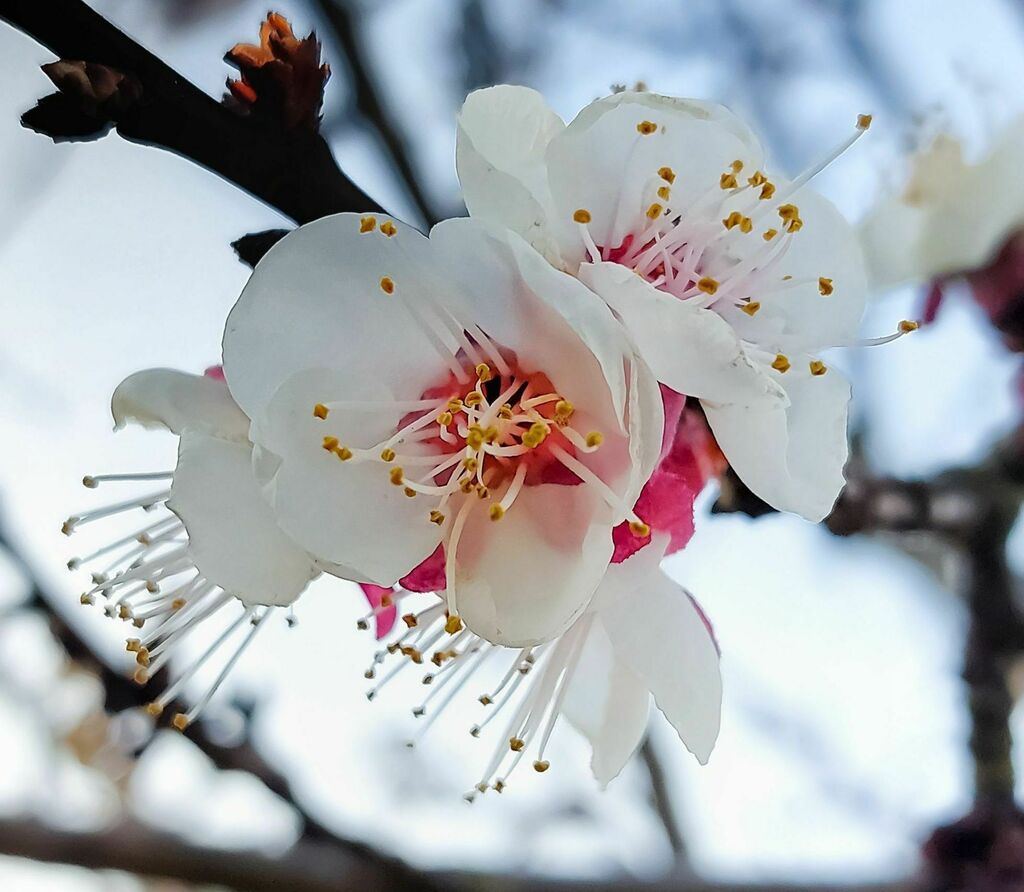
Named 'Armenian plum' by the Romans, the apricot actually originated in Central Asia and northern China. It is one of the first trees to bloom in spring, and in Hunza and Ladakh dried apricots and their kernel oil have long been winter staples.
Prunus armeniaca is the most commonly cultivated apricot species. The native range is somewhat uncertain due to its extensive prehistoric cultivation. Genetic studies indicate Central Asia is the center of origin. It is extensively cultivated in many countries and has escaped into the wild in many places. The specific epithet armeniaca refers to the country of Armenia. Wikipedia
What it can do
- iFlowers very early, before the leaves, so blossom is often lost to late frost
- iiMost cultivars are self-fertile
- iiiTolerates hot dry summers and very cold continental winters in Central Asian types
- ivKernels contain amygdalin, which releases cyanide
At the table
Eatenfruit (fresh, dried) · sweet kernels of selected varieties (in moderation) · kernel oil
Flesh is safe. Bitter apricot kernels are rich in amygdalin and have caused cyanide poisoning — a few bitter kernels can be dangerous to a child. Do not eat bitter kernels raw.
In the medicine cabinet
| Tradition | Use |
|---|---|
| Traditional Chinese Medicine | Bitter apricot kernel (kǔ xìng rén) in small, prescribed doses for cough and wheezing |
| Unani | Dried apricots as a mild laxative and nutritive |
Weight of evidence
Traditional. Long historical use; little or no modern clinical evidence.
Active compounds
amygdalin (kernel), β-carotene, chlorogenic acid, potassium
Fruit & seed

Fruit
Drupe
Ripens: Early to mid-summer
Round drupe 3–5 cm with a shallow groove, velvety yellow-orange skin often blushed red; sweet, slightly tart, firm orange flesh around a smooth flattened stone.


Seed
2–3 cm (stone)
Smooth, flattened oval stone 2–3 cm, light brown with a ridged edge; inside is a single almond-like kernel with a brown skin, sweet or bitter depending on variety
- Dispersal
- Mammals and humans
- Germination
- Cold-stratify the stone 60–90 days at 2–5 °C, sow in spring 3 cm deep; seedlings are variable but often fruit acceptably
Photographs from Wikimedia Commons under open licences; hover for the photographer, click for the file.
How to grow it
Hardiness (USDA zones)
USDA 5–8 (some Manchurian types to 4). Survives winters down to about -29 °C.
- Light
- Full sun
- Water
- Low–moderate
- Soil
- Deep, well-drained, slightly alkaline to neutral (pH 6.5–8)
- Propagation
- Budding onto apricot, peach or plum rootstock; seed
- To harvest
- 3–4 years
- Climates
- Continental, Mediterranean, Semi-arid
- 1Choose a late-flowering variety if your area has spring frosts, and plant in a sunny but not frost-pocketed site.
- 2Plant bare-root in winter; fan-train against a warm wall in cool climates.
- 3Water deeply in dry spells during fruit growth; avoid wet soil around the trunk.
- 4Prune in summer (after harvest) to reduce the risk of silver leaf and canker; thin fruit to 8–10 cm apart.
- 5Pick when fully coloured and slightly soft; halve and sun-dry or dehydrate for keeping.
Can it grow where you are?
Where it lives
Recorded sightings
—
geo-referenced records in GBIF, from museums, herbaria and field observers.
Native range
Central Asia (Tian Shan, Dzungaria) and northern China; cultivated in Mediterranean and continental climates worldwide
Drag the globe to turn it. Dots are where records exist, not a range map; darker means more records.
In the old herbals & bestiaries
Woodcuts and engravings matched from the Source Library’s scanned books by name. Plates marked “relative” show a close kin rather than this exact species. Click a plate to read the page it came from, with translation.

Commentaries on the Six Books of Dioscorides
Pietro Andrea Mattioli · 1560 · p.269

Commentaries on the Six Books of Dioscorides
Pietro Andrea Mattioli · 1560 · p.253

Ortus sanitatis
1491 · p.322

Commentaries on the Six Books of Pedanius Dioscorides on Medical Matter
Pietro Andrea Mattioli · 1565 · p.419

A New Herbal, or History of Plants
Rembert Dodoens (trans. Henry Lyte) · 1578 · p.734

Six Groups of the History of Plants
Rembert Dodoens · 1583 · p.806

Compendium of Materia Medica
李時珍 · 1596 · p.14

Collected Illustrations of the Three Realms: Herbs and Trees, Volume 5
王圻, 王思義 · 1609 · p.60

Illustrated Herbal Primer
Chen Jiamo (陳嘉謨) · 1628 · p.245

Maria Sibylla Merian — Der rupsen begin, voedzel en wonderbaare verandering (1712)
Maria Sibylla Merian · 1717 · p.341
In the stacks
Searching the stacks…
Every page naming Prunus armeniaca in the Biodiversity Heritage Library →
Marginalia
Apricots reached Greece and Rome via Armenia, hence 'armeniaca', and Arab gardeners spread them through Spain. The Hunza people of Pakistan's Karakoram are famed for their apricot orchards, drying the fruit on rooftops each summer.
Curiosity
The word 'apricot' comes from Latin praecoquum, 'early-ripening', via Arabic al-barqūq and Spanish albaricoque.
Kinship


Photographs: iNaturalist contributors under the licences shown. Records: GBIF.org. Historical plates: Source Library (CC BY-SA 4.0; originals public domain). Summary text: Nature Library editors and Wikipedia (CC BY-SA). Medicinal and edibility notes are historical and educational, not advice. iNaturalist taxon 135331.