- Plants
- ›Vascular Plants
- ›flowering plants
- ›Dicots
- ›Nances, Willows, and Allies
- ›willow family
- ›Salix
- ›Chamaetia
- ›Glaucae
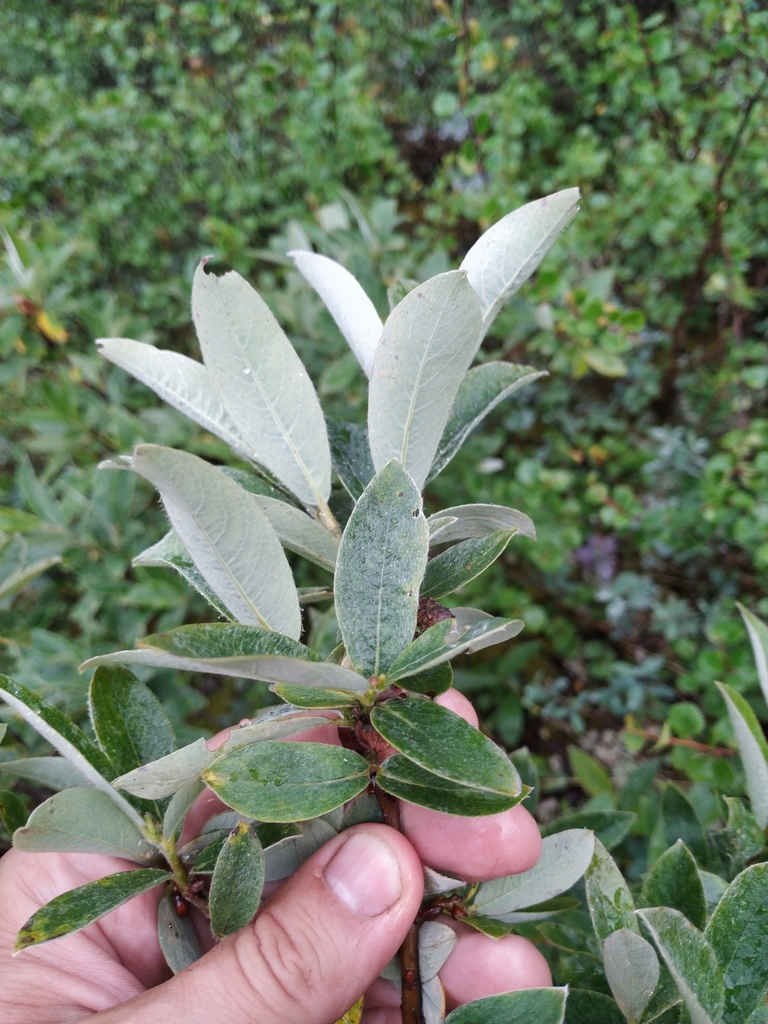
Grayleaf Willow
Salix glauca
Salix glauca is a species of flowering plant in the willow family known by the common names gray willow, gray-leaf willow, white willow, and glaucous willow. It is native to North America, where it occurs throughout much of Alaska, northern and western Canada, and the contiguous United States south through the Rocky Mountains to northern New Mexico. It can also be found in Greenland, northwestern Europe, and Siberia.
From the article Salix glauca on Wikipedia (CC BY-SA), quoted section by section
Description
This willow is usually a shrub growing up to 1.2 m (3.9 ft) tall, but in appropriate habitat it becomes a tree up to 6 m (20 ft) tall. The smooth gray bark becomes furrowed with age. The species is dioecious, with male and female reproductive parts occurring on separate individuals. This species has secondary sexual dimorphism, with male and female individuals different in function or morphology in aspects other than their reproductive structures. For example, female plants are more sensitive to drought conditions. The seed stays on the plant until fall, when it is dispersed. The seed is coated in downy fibers that help it disperse on the wind and on water. Unlike the seeds of many other willows, these do not germinate immediately on contact with the substrate, but overwinter under the snow and sprout in the spring. This provides cold stratification to the seeds, and allows them a few weeks more to develop than in summer-dispersing willows.
Range & habitat
In the northern part of its range, this plant codominates with other species of willow on floodplains and in shrubby riparian and tundra habitat. It may also grow scattered throughout coniferous forests and woodlands, dominated often by spruces. In the southern part of its range, it grows in alpine and subalpine climates. Like many other willows, it colonizes freshly cleared habitat, such as floodplains recently scoured by water and forests recently burned.
Wikipedia: “Distribution and habitat”
What it does
As with other willows, S. glauca is an important food source for a variety of animals, particularly wintering ungulates, providing them with a rich source of calcium and phosphorus. It is considered moderately important as moose browse, and during the winter it constitutes much of the diet for snowshoe hares.
Wikipedia: “Ecology”
Where it lives
Recorded sightings
—
geo-referenced records in GBIF, from museums, herbaria and field observers.
Drag the globe to turn it. Dots are where records exist, not a range map; darker means more records.
In the stacks
Searching the stacks…
Every page naming Salix glauca in the Biodiversity Heritage Library →
This page is assembled live from iNaturalist, GBIF, Wikipedia, the Source Library and the Internet Archive. It is not yet part of the hand-edited codex. iNaturalist taxon 168335.