 NL·0090
Herbarium of the Nature Library
- Name
- Punica granatum
- Family
- Lythraceae
- Native to
- Iran to northern India (Caucasus, Persia, Afghanistan, Himalayan foothills); cultivated across the Mediterranean and arid subtropics
- Habitat
- Semi-arid scrub, Mediterranean scrub, Dry river valleys
Pomegranate
Punica granatum
Also calledAnaar (Hindi/Urdu/Persian) · Rummān (Arabic) · Rimon (Hebrew) · Shíliu (Chinese) · Granada (Spanish) · Nar (Turkish) · Dāḍima (Sanskrit)
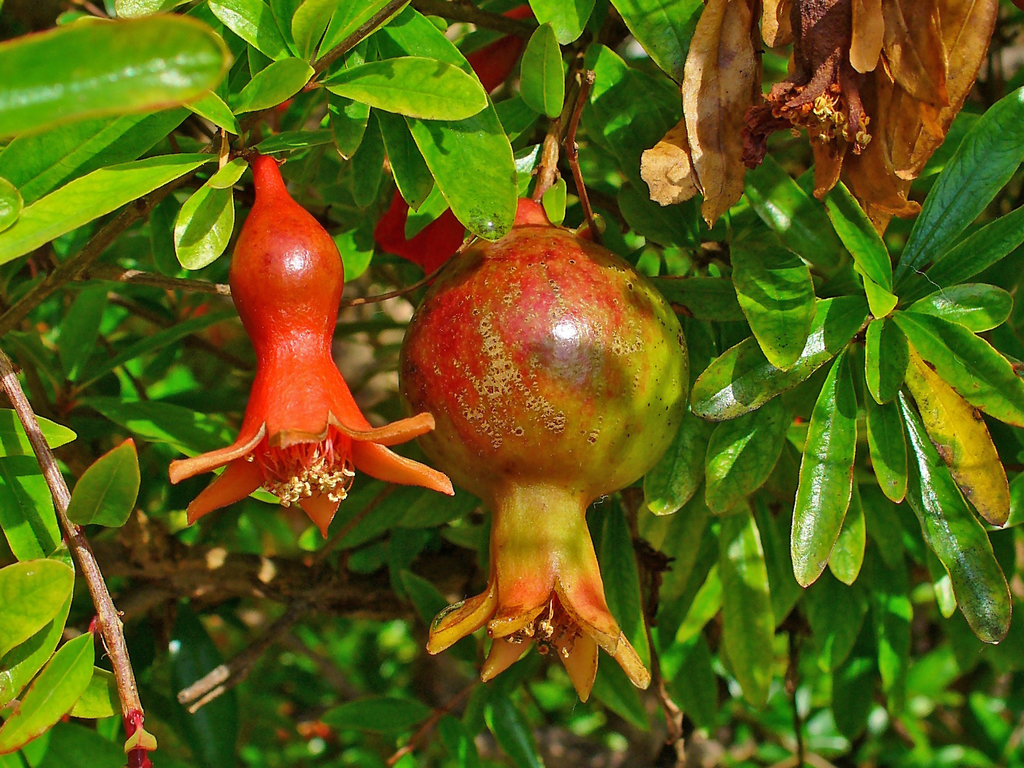
A thorny, drought-hardy shrub or small tree whose leathery fruit holds hundreds of jewel-like seeds. Cultivated from Iran to the Mediterranean since the Bronze Age, it has symbolised fertility, abundance and resurrection in nearly every culture that grew it.
The pomegranate is a fruit-bearing, deciduous shrub in the family Lythraceae, subfamily Punicoideae, that grows to between 1.5–5 metres (5–16 ft) tall. Rich in symbolic and mythological associations in many cultures, it originated in the region spanning the Caucasus and the Iranian plateau — including modern-day Iran, Turkmenistan, Afghanistan and Pakistan. Pomegranate was first domesticated by ancient Iranians in the Iranian plateau and nearby regions about 5,000 years ago. It is extensively cultivated for its fruit. Wikipedia
What it can do
- iTolerates drought, heat, alkaline and moderately saline soils
- iiFruit keeps for months on the shelf thanks to its tannin-rich leathery rind
- iiiBrilliant scarlet, trumpet-shaped flowers attract sunbirds and hummingbirds
- ivRind yields a yellow-brown dye used for Persian carpets and leather
At the table
Eatenseed arils (raw, juiced) · dried arils (anardana spice) · juice reduced to molasses
Arils and juice are eaten. Root and stem bark contain toxic alkaloids (pelletierines) and should not be consumed.
In the medicine cabinet
| Tradition | Use |
|---|---|
| Ayurveda | Rind decoction for diarrhoea and dysentery; fruit as a heart tonic |
| Unani / Persian | Sour and sweet pomegranate juices prescribed to balance hot and cold temperaments |
| Ancient Egyptian (Ebers Papyrus) | Root bark used to expel tapeworms |
Weight of evidence
Moderate. Some clinical trials with promising but limited or mixed results.
Active compounds
punicalagins, ellagic acid, anthocyanins, pelletierine (bark)
Fruit & seed


Fruit
Balausta (berry-like, many-chambered)
Ripens: Autumn
Round fruit 6–12 cm topped with a crown-like calyx; leathery red to yellow-pink rind enclosing white membranes and 200–1,400 juicy translucent arils, ruby to pale pink.


Seed
5–8 mm (seed); aril ~1 cm
Each seed is wrapped in a juicy, glassy red to pink aril; the seed itself is angular, cream to pale-yellow, woody, about 5–8 mm long
- Dispersal
- Birds and mammals
- Germination
- Clean off the aril, sow fresh 0.5 cm deep at 20–25 °C; sprouts in 2–6 weeks
Photographs from Wikimedia Commons under open licences; hover for the photographer, click for the file.
How to grow it
Hardiness (USDA zones)
USDA 7–11 (some Russian and Central Asian varieties to 6). Survives winters down to about -18 °C.
- Light
- Full sun
- Water
- Low–moderate; even watering at fruit set reduces splitting
- Soil
- Well-drained; tolerates poor, alkaline and loamy soils, pH 5.5–7.5
- Propagation
- Hardwood cuttings (25 cm, winter) root readily; seed for rootstock or novelty
- To harvest
- 2–3 years from cutting; fruit ripens 5–7 months after flowering
- Climates
- Mediterranean, Semi-arid, Subtropical
- 1Take 25 cm hardwood cuttings of a good variety (e.g. 'Wonderful', 'Bhagwa') in winter and root them in a pot or directly in the ground.
- 2Plant in the hottest, sunniest place, training to a single trunk or a few stems; remove suckers from the base.
- 3Water regularly in the first year, then deeply but infrequently; keep watering steady once fruit sets to avoid cracking.
- 4Prune lightly in late winter, as fruit forms on short spurs on 2–3-year-old wood.
- 5Harvest when the rind colours fully and the fruit sounds metallic when tapped; cut, don't pull.
Can it grow where you are?
Where it lives
Recorded sightings
—
geo-referenced records in GBIF, from museums, herbaria and field observers.
Native range
Iran to northern India (Caucasus, Persia, Afghanistan, Himalayan foothills); cultivated across the Mediterranean and arid subtropics
Drag the globe to turn it. Dots are where records exist, not a range map; darker means more records.
In the old herbals & bestiaries
Woodcuts and engravings matched from the Source Library’s scanned books by name. Plates marked “relative” show a close kin rather than this exact species. Click a plate to read the page it came from, with translation.

Garden of Health
1507 · p.163

Elements of Botany
Joseph Pitton de Tournefort · 1719 · p.158

Christoph Jakob Trew — Uitgezochte planten (1771)
Christoph Jakob Trew · 1771 · p.230

Christoph Jakob Trew — Uitgezochte planten (1771)
Christoph Jakob Trew · 1771 · p.232

Metamorphosis Insectorum Surinamensium
Maria Sibylla Merian · 1705 · p.156

Metamorphosis Insectorum Surinamensium
Maria Sibylla Merian · 1705 · p.36

Maria Sibylla Merian — Der rupsen begin, voedzel en wonderbaare verandering (1712)
Maria Sibylla Merian · 1717 · p.403

Maria Sibylla Merian — Dissertatio de generatione et metamorphosibus insectorum Surinamensium (1719)
Maria Sibylla Merian · 1719 · p.44

Maria Sibylla Merian — Dissertatio de generatione et metamorphosibus insectorum Surinamensium (1719)
Maria Sibylla Merian · 1719 · p.164

Ortus sanitatis
1491 · p.59
In the stacks
Searching the stacks…
Every page naming Punica granatum in the Biodiversity Heritage Library →
Marginalia
In Greek myth Persephone ate pomegranate seeds in the underworld, binding her there for part of each year and explaining the seasons. Pomegranates were embroidered on the hem of the Hebrew High Priest's robe and appear in the Qur'an as a fruit of paradise.
Curiosity
The city of Granada in Spain shares its name with the fruit, and the grenade was named after the pomegranate for its seed-like shrapnel.
Kinship



Photographs: iNaturalist contributors under the licences shown. Records: GBIF.org. Historical plates: Source Library (CC BY-SA 4.0; originals public domain). Summary text: Nature Library editors and Wikipedia (CC BY-SA). Medicinal and edibility notes are historical and educational, not advice. iNaturalist taxon 58300.