 NL·0135
Herbarium of the Nature Library
- Name
- Aconitum napellus
- Family
- Ranunculaceae
- Native to
- Mountains of western and central Europe
- Habitat
- Mountain meadows, Stream banks, Damp woodland edges
Monkshood (Aconite, Wolfsbane)
Aconitum napellus
Also calledBachnag / Vatsanabha (Hindi/Sanskrit, for Indian aconites) · Bish (Urdu, aconite) · Fùzǐ 附子 / Wūtóu 乌头 (Chinese, for related species) · Eisenhut (German) · Aconit napel (French) · Acónito (Spanish) · Queen of poisons (English)
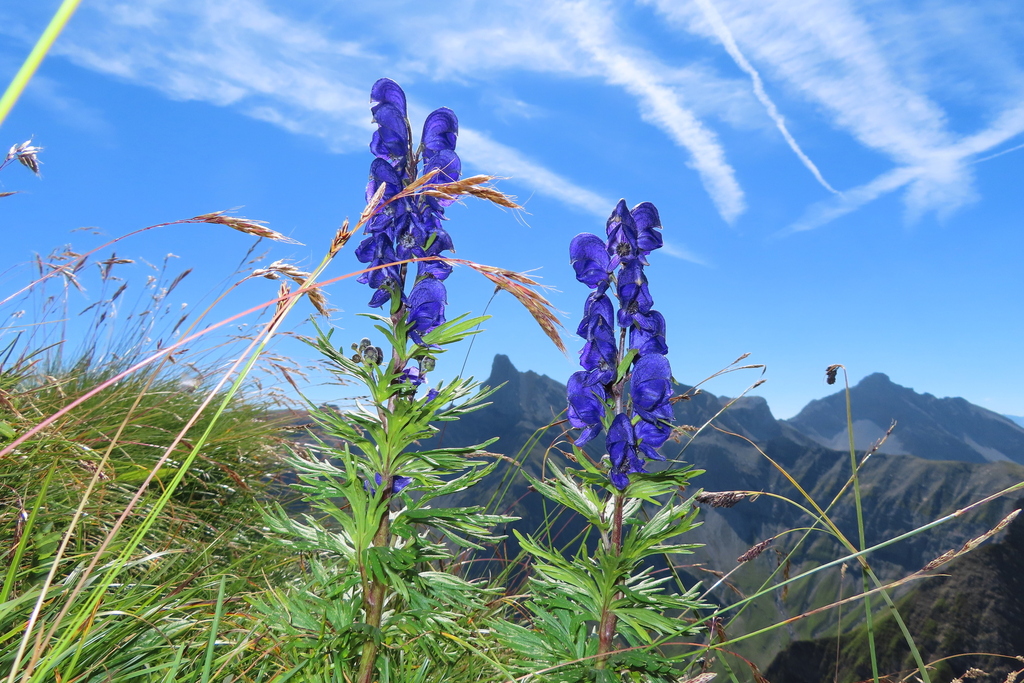
A stately garden perennial with hooded blue-violet flowers, and one of the most poisonous plants in Europe. Aconitine can enter through the skin and causes tingling and numbness, vomiting, and deadly heart rhythms. Greek myth said it grew from the saliva of Cerberus.
Aconitum napellus, monkshood, aconite, Venus' chariot or wolfsbane, is a species of highly toxic flowering plants in the genus Aconitum of the family Ranunculaceae, native and endemic to western and central Europe. A perennial plant, it is herbaceous and grows to 1 m tall, with hairless stems and leaves. The leaves are rounded, 5–10 cm (2.0–3.9 in) diameter, palmately divided into five to seven deeply lobed segments. The flowers are dark purple to bluish-purple, narrow oblong helmet-shaped, 1–2 cm (0.39–0.79 in) tall. Plants native to Asia and North America formerly listed as A. napellus are now regarded as separate species. The plant is extremely poisonous in both ingestion and body contact. It is the most poisonous plant in all of Europe. Wikipedia
What it can do
- iMakes aconitine, which locks sodium channels open in nerves and heart muscle
- iiIts hooded flowers can be opened only by long-tongued bumblebees
- iiiStores toxin-rich tuberous roots that replace themselves each year
- ivAlkaloids can be absorbed through broken skin when handled
At the table
All parts are deadly, especially roots and seeds. Within minutes to an hour: tingling and numbness of the mouth and face spreading to limbs, nausea, vomiting, sweating, weakness, then dangerous ventricular arrhythmias and death. Roots have been mistaken for horseradish or other roots, and leaves for wild greens. Wear gloves when handling; gardeners have been poisoned through the skin. No antidote; treatment is supportive.
In the medicine cabinet
| Tradition | Use |
|---|---|
| 18th–19th-century European medicine | Tincture of aconite as a pain reliever and fever remedy (now abandoned) |
| Traditional Chinese medicine (related species) | Processed roots of Aconitum carmichaelii (fuzi) used for 'cold' conditions; processing reduces toxicity |
Weight of evidence
Traditional. Long historical use; little or no modern clinical evidence.
Active compounds
aconitine, mesaconitine, hypaconitine
Fruit & seed


Fruit
Follicles
Ripens: Late summer–autumn
Clusters of three to five dry pods that split along one side.

Seed
~3–4 mm
Small, wrinkled, dark seeds
- Dispersal
- Shaken from pods by wind
- Germination
- Needs cold stratification; slow
Photographs from Wikimedia Commons under open licences; hover for the photographer, click for the file.
How to grow it
Hardiness (USDA zones)
USDA 3–8. Survives winters down to about -40 °C.
- Light
- Partial shade to full sun
- Water
- Moist
- Soil
- Fertile, moisture-retentive
- Propagation
- Division of tubers; seed
- To harvest
- Ornamental; flowers in 2–3 years from seed
- Climates
- Temperate, Montane, Continental
- 1Always wear gloves when planting, dividing or cutting
- 2Plant tubers in moist, rich soil in partial shade
- 3Keep away from vegetable beds and places children or pets play
- 4Label clearly; never plant near horseradish or other edible roots
Can it grow where you are?
Where it lives
Recorded sightings
—
geo-referenced records in GBIF, from museums, herbaria and field observers.
Native range
Mountains of western and central Europe
Drag the globe to turn it. Dots are where records exist, not a range map; darker means more records.
In the old herbals & bestiaries
Woodcuts and engravings matched from the Source Library’s scanned books by name. Plates marked “relative” show a close kin rather than this exact species. Click a plate to read the page it came from, with translation.

Introductio Generalis in Rem Herbariam
Augustus Quirinus Rivinus · 1690 · p.539

Commentaries on the Six Books of Dioscorides on Medical Matter
Pietro Andrea Mattioli · 1563 · p.644

Commentaries on the Six Books of Pedanius Dioscorides on Medical Matter
Pietro Andrea Mattioli · 1565 · p.1266

Six Groups of the History of Plants
Rembert Dodoens · 1583 · p.460

The Dutch Herbarium or Herbal
Petrus Nylandt · 1670 · p.261

History of Rare Plants Observed in Pannonia
Carolus Clusius · 1583 · p.412

History of Rare Plants Observed in Pannonia
Carolus Clusius · 1583 · p.409

Introductio Generalis in Rem Herbariam
Augustus Quirinus Rivinus · 1690 · p.535

Rariorum Plantarum Historia (with Fungorum Historia)
Carolus Clusius · 1601 · p.477

Rare Asiatic Plants, Vol. 1
Nathaniel Wallich · 1830 · p.92
In the stacks
Searching the stacks…
Every page naming Aconitum napellus in the Biodiversity Heritage Library →
Marginalia
Ovid's Metamorphoses tells how aconite sprang from the foam of Cerberus when Hercules dragged him from the underworld. The name 'wolfsbane' comes from its use in baits and arrow poisons for wolves.
Curiosity
The 'monk's hood' is a sepal, not a petal; the true petals are reduced to two hidden, nectar-holding spurs inside it.
Kinship



Photographs: iNaturalist contributors under the licences shown. Records: GBIF.org. Historical plates: Source Library (CC BY-SA 4.0; originals public domain). Summary text: Nature Library editors and Wikipedia (CC BY-SA). Medicinal and edibility notes are historical and educational, not advice. iNaturalist taxon 131201.