 NL·0038
Herbarium of the Nature Library
- Name
- Ananas comosus
- Family
- Bromeliaceae
- Native to
- Southern Brazil and Paraguay (Paraná–Paraguay basin); domesticated by Indigenous South Americans and spread pantropically
- Habitat
- Tropical savanna and scrub, Plantations
Pineapple
Ananas comosus
Also calledNanas (Tupi-Guarani, 'excellent fruit') · Ananas (Hindi/Arabic/French) · Piña (Spanish) · Bōluó / Fènglí (Chinese) · Nanasi (Swahili) · Abacaxi (Brazilian Portuguese)
A spiny terrestrial bromeliad from South America whose 'fruit' is a fusion of 100–200 individual berries around a central stalk. Its CAM photosynthesis lets it open its pores only at night, making it extraordinarily water-efficient.
The pineapple is a tropical plant with an edible fruit; it is the most economically significant plant in the family Bromeliaceae. Wikipedia
What it can do
- iCAM photosynthesis: takes in CO₂ at night to save water
- iiFruit forms from up to 200 fused flowers, each 'eye' a separate berry
- iiiHummingbirds pollinate wild plants; cultivated plants are self-incompatible, so fruit is seedless
- ivLeaves yield piña fibre, woven into fine sheer cloth in the Philippines
At the table
Eatenfruit (fresh, cooked, juiced, fermented as tepache)
Ripe fruit is eaten. Bromelain makes the mouth tingle or sore when large amounts are eaten raw. Very unripe fruit is irritating and purgative.
In the medicine cabinet
| Tradition | Use |
|---|---|
| Indigenous South American medicine | Fruit applied to wounds and taken for digestive troubles |
| Modern medicine | Bromelain-based enzyme (NexoBrid) approved in Europe and the US for removing burn eschar |
Weight of evidence
Strong. An approved drug, or consistent results in well-run clinical trials.
Active compounds
bromelain, vitamin C, manganese
Fruit & seed


Fruit
Sorosis (multiple fruit)
Ripens: Year-round in the tropics; can be forced
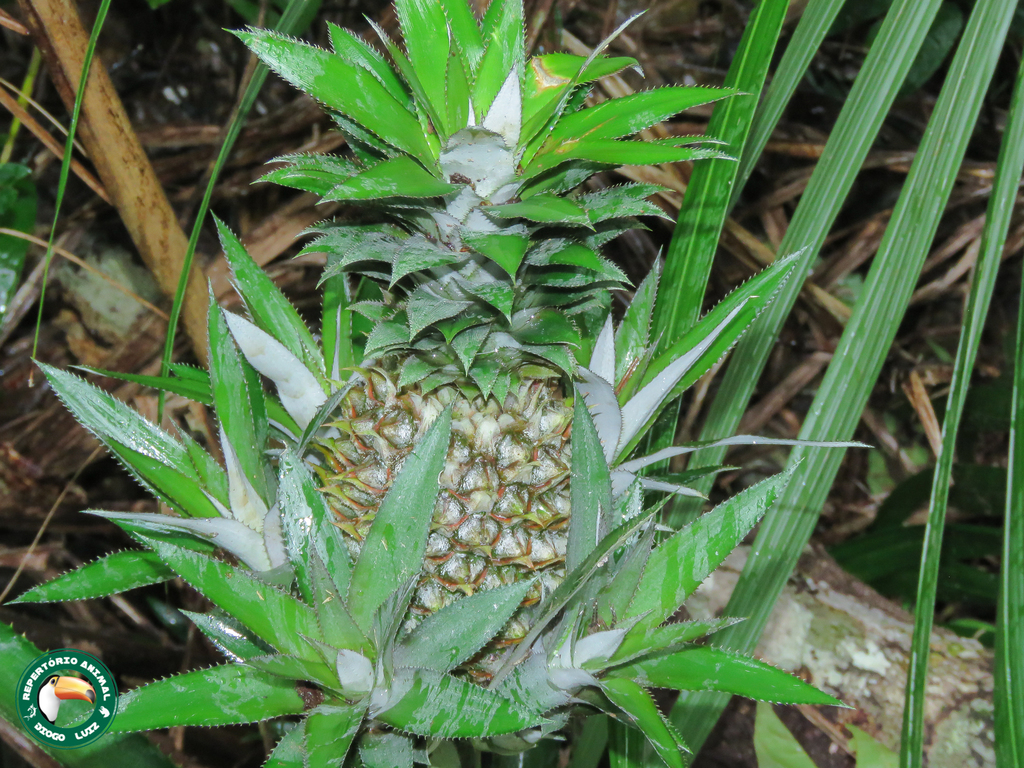
Oval fruit 15–30 cm, covered in hexagonal scales ('eyes'), green ripening to golden-orange, topped with a crown of spiny leaves; juicy yellow flesh around a fibrous core.

Seed
3–5 mm
Usually absent in cultivated fruit; when cross-pollinated, small hard seeds appear just under the skin — dark brown to black, 3–5 mm, angular-oval
- Dispersal
- Animals (wild forms); vegetatively by humans
- Germination
- Seed rarely used; crowns, slips and suckers root easily
Photographs from Wikimedia Commons under open licences; hover for the photographer, click for the file.
How to grow it
Hardiness (USDA zones)
USDA 10–12 (11–12 outdoors year-round; also grown in pots indoors). Survives winters down to about -1 °C.
- Light
- Full sun
- Water
- Low–moderate
- Soil
- Sandy, acidic (pH 4.5–6.5), very well-drained
- Propagation
- Crowns, slips (shoots below the fruit) or suckers
- To harvest
- 18–24 months from a crown; 12–18 months from suckers
- Climates
- Tropical, Warm subtropical
- 1Twist the leafy crown off a ripe pineapple, strip the bottom 3 cm of leaves and let it dry for 2–3 days.
- 2Plant it 5 cm deep in sandy, acidic mix in full sun; water lightly, also into the leaf cup.
- 3Feed lightly every 2 months; keep frost-free and above 15 °C.
- 4To force flowering on a mature plant (12+ months), enclose it in a bag with a ripe apple for a few days, as the ethylene triggers blooming.
- 5Harvest when the fruit smells sweet at the base and the eyes flatten and turn golden; the plant then produces suckers for the next crop.
Can it grow where you are?
Where it lives
Recorded sightings
—
geo-referenced records in GBIF, from museums, herbaria and field observers.
Native range
Southern Brazil and Paraguay (Paraná–Paraguay basin); domesticated by Indigenous South Americans and spread pantropically
Drag the globe to turn it. Dots are where records exist, not a range map; darker means more records.
In the old herbals & bestiaries
Woodcuts and engravings matched from the Source Library’s scanned books by name. Plates marked “relative” show a close kin rather than this exact species. Click a plate to read the page it came from, with translation.

Jan Moninckx; Maria Moninckx — Moninckx Atlas, vol. 1 (1686)
Jan Moninckx; Maria Moninckx · 1687 · p.40

Metamorphosis Insectorum Surinamensium
Maria Sibylla Merian · 1705 · p.15

Histoire d'un voyage faict en la terre du Bresil
Jean de Léry · 1578 · p.176

Kircher: China Illustrata (1667)
Athanasius Kircher · 1667 · p.257

Metamorphosis Insectorum Surinamensium
Maria Sibylla Merian · 1705 · p.12

Maria Sibylla Merian — Dissertatio de generatione et metamorphosibus insectorum Surinamensium (1719)
Maria Sibylla Merian · 1719 · p.23

Kircher: China Illustrata (1667)
Athanasius Kircher · 1667 · p.256

The Embassy of the Dutch East India Company to the Tartar Cham
Johan Nieuhof · 1665 · p.447

Christoph Jakob Trew — Uitgezochte planten (1771)
Christoph Jakob Trew · 1771 · p.98

Tractado de las Drogas y Medicinas de las Indias Orientales
Cristóvão da Costa · 1578 · p.380
In the stacks
Searching the stacks…
Every page naming Ananas comosus in the Biodiversity Heritage Library →
Marginalia
Columbus encountered the pineapple on Guadeloupe in 1493, and it became an emblem of luxury in 17th–18th century Europe, where wealthy hosts rented pineapples as table centrepieces. The Dunmore Pineapple in Scotland is a 1761 garden folly shaped like the fruit.
Curiosity
Pineapple's bromelain digests proteins so well that fresh pineapple stops gelatin from setting.
Kinship



Photographs: iNaturalist contributors under the licences shown. Records: GBIF.org. Historical plates: Source Library (CC BY-SA 4.0; originals public domain). Summary text: Nature Library editors and Wikipedia (CC BY-SA). Medicinal and edibility notes are historical and educational, not advice. iNaturalist taxon 122965.