 NL·0270
Herbarium of the Nature Library
- Name
- Argiope bruennichi
- Family
- Araneidae
- Native to
- Europe, North Africa and temperate Asia to Japan; expanding northward
- Habitat
- Temperate grassland, Meadows, Wetland edge, Road verges
Wasp spider
Argiope bruennichi
Also calledWespenspinne (German) · Argiope frelon (French) · Araña tigre (Spanish) · Nagakoganegumo (Japanese) · Héngwén jīnzhū (Chinese)
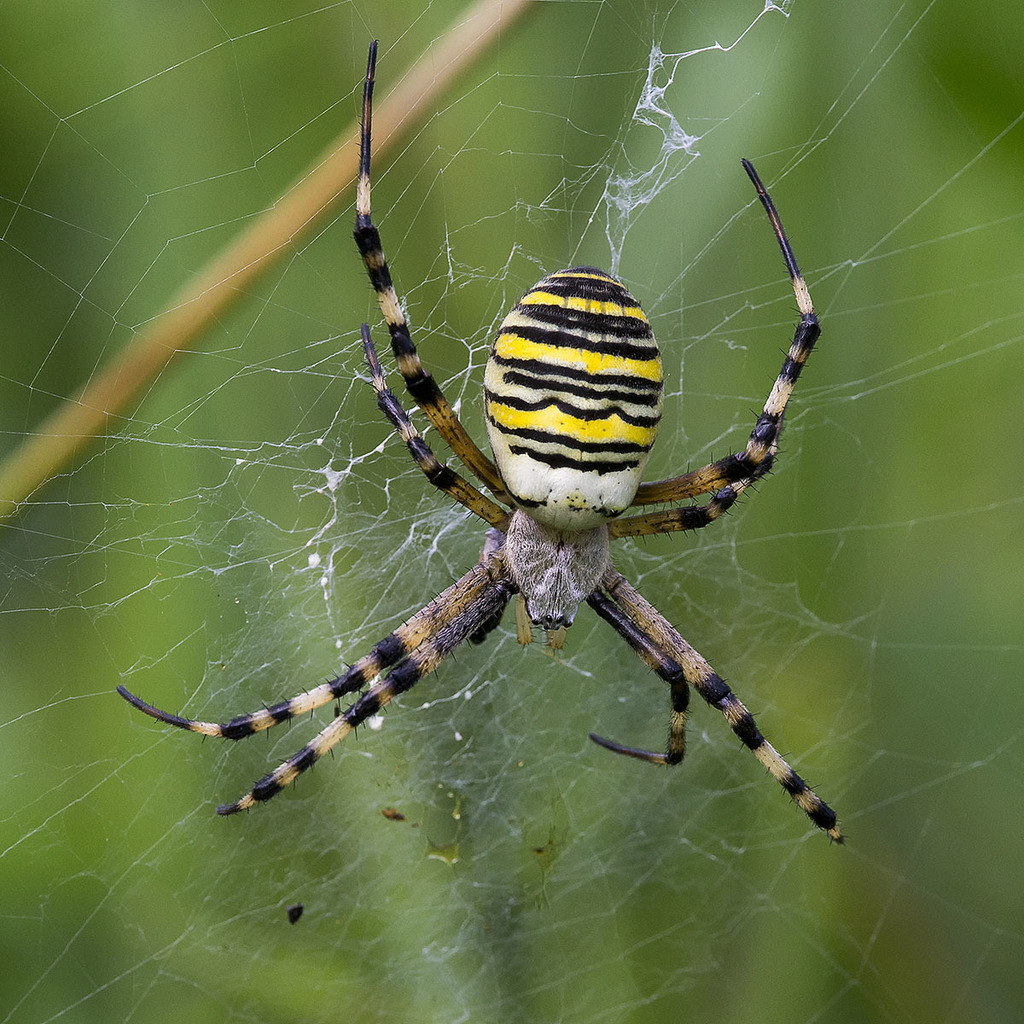
A large orb-weaving spider striped like a wasp in yellow, black and white, that decorates its web with a bold zig-zag band of silk. It has spread rapidly northward across Europe in recent decades.
Argiope bruennichi, commonly known as the wasp spider, is a species of orb-weaver spider found across Central and Northern Europe, several regions of Asia and Africa and the Azores. Like many other members of the same genus Argiope, this species has distinctive yellow, white and black markings on its abdomen. Wikipedia
What it can do
- iBuilds a zig-zag silk band (stabilimentum) whose function is debated, possibly deterring birds or attracting prey
- iiSpiderlings disperse by 'ballooning' on silk threads carried by the wind
- iiiMales often mate with females just after their final moult, when females are least dangerous
In the field
Field marks
- aFemale abdomen striped yellow, black and white like a wasp
- bSilvery-haired cephalothorax
- cBanded legs held in an X shape at the hub of the web
- dOrb web low in grass with a vertical zig-zag silk band
- Not to be confused with
- Lobed argiope (Argiope lobata) of southern Europe has a silvery, scalloped abdomen. The North American banded garden spider (A. trifasciata) has thinner stripes. Garden spiders (Araneus) lack the bold stripes.
- Where to see it
- Rough grassland and coastal meadows across Europe; now common in southern England.
- When
- Adults Jul–Oct
Life & habits
- Diet
- Grasshoppers, crickets, flies, bees and other flying or jumping insects
- Habitat
- Tall grass in sunny meadows, heath, dunes and verges
- Size
- Females about 1.4–1.7 cm body length (up to about 2.5 cm); males about 0.5 cm
- Lifespan
- About one year
Males are frequently cannibalised by females during mating, and often leave part of their palp in the female as a mating plug.
Where it lives
Recorded sightings
—
geo-referenced records in GBIF, from museums, herbaria and field observers.
Native range
Europe, North Africa and temperate Asia to Japan; expanding northward
Drag the globe to turn it. Dots are where records exist, not a range map; darker means more records.
In the old herbals & bestiaries
No plate in the Source Library names this exact species, so these show its closest relatives as the old naturalists drew them: same genus, or the same kind of animal. Click a plate to read the page it came from, with translation.

Jan Jonston — Naeukeurige beschryving van de natuur der viervoetige dieren (1660)
Relative · Jan Jonston · 1660 · p.467

Commentaries on the Six Books of Pedanius Dioscorides on Medical Matter
Relative · Pietro Andrea Mattioli · 1565 · p.487

History of Animals, Book II: On Oviparous Quadrupeds
Relative · Conrad Gessner · 1586 · p.573

Georg Wolfgang Knorr — Deliciae naturae selectae (1771)
Relative · Georg Wolfgang Knorr · 1771 · p.98

Books on Marine Fishes
Relative · Guillaume Rondelet · 1554 · p.596

Commentaries on the Six Books of Dioscorides
Relative · Pietro Andrea Mattioli · 1560 · p.341

Commentaries on the Six Books of Dioscorides
Relative · Pietro Andrea Mattioli · 1560 · p.304

Commentaries on the Six Books of Dioscorides on Medical Matter
Relative · Pietro Andrea Mattioli · 1563 · p.289

History of Animals, Book II: On Oviparous Quadrupeds
Relative · Conrad Gessner · 1586 · p.572

Compendium of Materia Medica
Relative · 李時珍 · 1596 · p.129
In the stacks
Searching the stacks…
Every page naming Argiope bruennichi in the Biodiversity Heritage Library →
Marginalia
Giovanni Scopoli named it in 1772 after the Danish zoologist Morten Thrane Brünnich. Its arrival in Britain was first noted in the early 20th century, and its range expansion is now followed as a sign of climate change.
Curiosity
Its egg sac is a brown, paper-like urn hung among grass stems, in which the young overwinter before emerging in spring.
Kinship





Photographs: iNaturalist contributors under the licences shown. Records: GBIF.org. Historical plates: Source Library (CC BY-SA 4.0; originals public domain). Summary text: Nature Library editors and Wikipedia (CC BY-SA). Medicinal and edibility notes are historical and educational, not advice. iNaturalist taxon 50867.