 NL·0782
Herbarium of the Nature Library
- Name
- Bitis gabonica
- Family
- Viperidae
- Native to
- Central and East Africa, south to Zambia, Mozambique and northeastern South Africa (the West African Gaboon viper is now treated as a separate species, Bitis rhinoceros)
- Habitat
- Tropical rainforest, Forest edge, Woodland
Gaboon viper
Bitis gabonica
Also calledEast African Gaboon viper · Butterfly adder · Kifutu (Swahili)
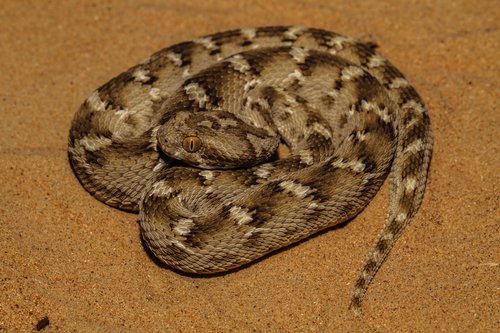
A heavy, slow-moving viper whose geometric pattern of purple, buff and brown disappears among the dead leaves of the African forest floor. It has the longest fangs of any snake and produces more venom than almost any other.
The Gaboon viper, also called the Gaboon adder, is a large and highly venomous species of viper found in the rainforests and savannas of sub-Saharan Africa. It is the largest member of the genus Bitis. Like all other vipers, it is venomous, and it has the longest fangs of any venomous snake – up to 2 inches (5.1 cm) in length – and the highest venom yield of any snake. No subspecies are recognized. Wikipedia
What it can do
- iFangs can exceed 5 cm, the longest of any snake
- iiProduces some of the largest venom yields of any snake
- iiiIts geometric pattern is so effective as camouflage that it can be stepped over without being seen
- ivStrikes and holds on to prey rather than releasing it
In the field
Field marks
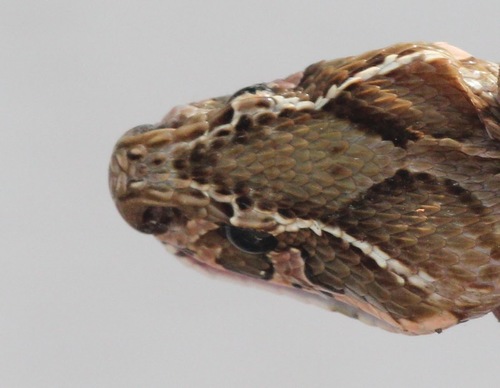
- aVery broad, flat, triangular cream-white head with a thin dark central line and dark triangles behind the eyes
- bA pair of small horn-like scales between the nostrils
- cBack patterned with pale rectangles, hourglasses and purple-brown triangles
- dHugely thick body and short tail
- Not to be confused with
- The rhinoceros viper (Bitis nasicornis) has two or three pairs of large nose horns and a blue, green and crimson pattern. The puff adder (B. arietans) has pale chevrons on a yellowish-brown back. The West African Gaboon viper (B. rhinoceros) has a dark triangle below each eye and larger nose horns. No harmless snake in its range has its build and head shape.
- Where to see it
- Rarely seen in the wild; forests of Uganda, Kenya's Kakamega forest, coastal forest in Mozambique and northern KwaZulu-Natal
- When
- Resident; mostly nocturnal
Life & habits
- Diet
- Rodents, hares, small antelope, ground birds, frogs
- Habitat
- Rainforest floor, forest edges, cocoa and coffee plantations
- Size
- Usually 1.2–1.5 m; can reach ~1.8 m
Famously placid: it lies still, relying on camouflage, and gives a loud warning hiss before biting. Bites are rare but cause massive swelling, tissue death and bleeding. Keep the limb still, do not apply a tight bandage, and get the person to hospital for antivenom.
Where it lives
Recorded sightings
—
geo-referenced records in GBIF, from museums, herbaria and field observers.
Native range
Central and East Africa, south to Zambia, Mozambique and northeastern South Africa (the West African Gaboon viper is now treated as a separate species, Bitis rhinoceros)
Drag the globe to turn it. Dots are where records exist, not a range map; darker means more records.
In the old herbals & bestiaries
No plate in the Source Library names this exact species, so these show its closest relatives as the old naturalists drew them: same genus, or the same kind of animal. Click a plate to read the page it came from, with translation.

Ulyssis Aldrovandi ... serpentum et draconum historiae libri duo
Relative · Ambrosini, Bartolommeo · 1640 · p.180

Ulyssis Aldrovandi ... serpentum et draconum historiae libri duo
Relative · Ambrosini, Bartolommeo · 1640 · p.126

Compendium of Materia Medica: Illustrated Volume, Middle of the Lower Part
Relative · 李時珍 · 1596 · p.50

Manuscript containing illustrations of strange beasts and men, women and children. (Italian MS 63)
Relative · Anonymous · 1700 · p.109

History of Animals, Book II: On Oviparous Quadrupeds
Relative · Conrad Gessner · 1586 · p.219

Serpentum et Draconum Historiae
Relative · Ulisse Aldrovandi · 1640 · p.187

Serpentum et Draconum Historiae
Relative · Ulisse Aldrovandi · 1640 · p.192

History of Serpents and Dragons
Relative · Ulisse Aldrovandi · 1640 · p.126

History of Serpents and Dragons
Relative · Ulisse Aldrovandi · 1640 · p.179

The Pagan World and the Origin of its Gods
Relative · Herold, Johann · 1554 · p.857
In the stacks
Searching the stacks…
Every page naming Bitis gabonica in the Biodiversity Heritage Library →
Marginalia
The species name refers to Gabon, then a French colony, where the specimens used for its 1854 description were said to have been collected. The IUCN now lists it as Vulnerable, with habitat loss and collection for bushmeat and the pet trade among the threats.
Curiosity
Despite its fearsome armament, bites are rare: it is so reluctant to move or strike that most bites happen when someone steps on one.
Kinship




Photographs: iNaturalist contributors under the licences shown. Records: GBIF.org. Historical plates: Source Library (CC BY-SA 4.0; originals public domain). Summary text: Nature Library editors and Wikipedia (CC BY-SA). Medicinal and edibility notes are historical and educational, not advice. iNaturalist taxon 30853.