 NL·0785
Herbarium of the Nature Library
- Name
- Daboia russelii
- Family
- Viperidae
- Native to
- Pakistan, India, Nepal, Bangladesh and Sri Lanka (the eastern Russell's viper, Daboia siamensis, replaces it from Myanmar eastwards)
- Habitat
- Grassland, Farmland, Scrub
Russell's viper
Daboia russelii
Also calledDaboia (Hindi) · Kanadi viriyan (Tamil) · Chandrabora (Bengali) · Tic polonga (Sinhala) · Ghonas (Marathi)
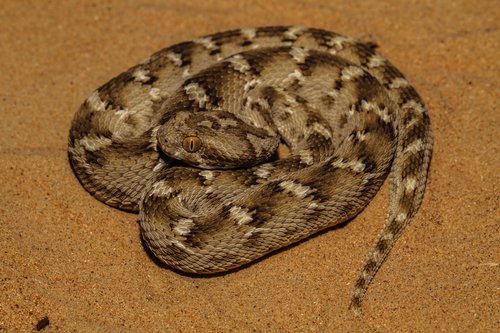
A thick-bodied viper of South Asia's grasslands and farmland, marked with three chains of dark, pale-edged ovals. It is thought to cause more snakebite deaths in South Asia than any other snake, because it is common in farmland where people work barefoot.
Russell's viper is a species of highly venomous snake in the family Viperidae. The species is native to South Asia. It was described in 1797 by George Shaw and Frederick Polydore Nodder. It is named after Patrick Russell. Known for its extremely painful bite, it is considered one of the "Big Four" venomous snake species in the region. Wikipedia
What it can do
- iIts venom turns the blood's clotting system against itself, using up clotting factors so the victim bleeds uncontrollably
- iiHisses so loudly and so long that it is often heard before it is seen
- iiiBears live young, often 20–40 in a litter
- ivVenom can damage the kidneys, and sometimes the pituitary gland
In the field
Field marks
- aTan to brown body with three rows of dark-brown ovals edged in black then white; the middle row runs together along the back
- bLarge flat triangular head with a pale V or X mark and dark stripes behind the eye
- cHeavy body, short tail, rough keeled scales
- dBig nostrils and vertical pupils; no heat pits
- Not to be confused with
- Confused with the harmless common sand boa (Eryx conicus), which has a short blunt tail, tiny eyes, and irregular blotches rather than neat rows of ringed ovals. Also confused with the Indian rock python (Python molurus), which has a pale arrowhead on its head, heat pits along the lips and smooth scales. The Russell's viper's large triangular head, keeled scales and very loud hiss give it away.
- Where to see it
- Rice fields, dry grassland and rocky scrub across India and Sri Lanka; for example, the Deccan plateau and the dry zone of Sri Lanka
- When
- Resident; most bites happen during harvest and planting seasons
Life & habits
- Diet
- Rodents especially; also lizards, frogs and birds
- Habitat
- Open grassland, scrub, rice and sugarcane fields; avoids dense forest
- Size
- Usually ~1–1.2 m; up to ~1.7 m
It lies coiled and still, and when disturbed it hisses hard and strikes with great force. Bites cause severe pain and swelling, bleeding from the gums and wounds, and kidney failure. Treatment is antivenom in hospital, and the 20-minute whole-blood clotting test is used to guide it. Keep the limb still and do not use tight bandages or tourniquets on viper bites.
Where it lives
Recorded sightings
—
geo-referenced records in GBIF, from museums, herbaria and field observers.
Native range
Pakistan, India, Nepal, Bangladesh and Sri Lanka (the eastern Russell's viper, Daboia siamensis, replaces it from Myanmar eastwards)
Drag the globe to turn it. Dots are where records exist, not a range map; darker means more records.
In the old herbals & bestiaries
No plate in the Source Library names this exact species, so these show its closest relatives as the old naturalists drew them: same genus, or the same kind of animal. Click a plate to read the page it came from, with translation.

Ulyssis Aldrovandi ... serpentum et draconum historiae libri duo
Relative · Ambrosini, Bartolommeo · 1640 · p.180

Ulyssis Aldrovandi ... serpentum et draconum historiae libri duo
Relative · Ambrosini, Bartolommeo · 1640 · p.126

Compendium of Materia Medica: Illustrated Volume, Middle of the Lower Part
Relative · 李時珍 · 1596 · p.50

Manuscript containing illustrations of strange beasts and men, women and children. (Italian MS 63)
Relative · Anonymous · 1700 · p.109

History of Animals, Book II: On Oviparous Quadrupeds
Relative · Conrad Gessner · 1586 · p.219

Serpentum et Draconum Historiae
Relative · Ulisse Aldrovandi · 1640 · p.187

Serpentum et Draconum Historiae
Relative · Ulisse Aldrovandi · 1640 · p.192

History of Serpents and Dragons
Relative · Ulisse Aldrovandi · 1640 · p.126

History of Serpents and Dragons
Relative · Ulisse Aldrovandi · 1640 · p.179

The Pagan World and the Origin of its Gods
Relative · Herold, Johann · 1554 · p.857
In the stacks
Searching the stacks…
Every page naming Daboia russelii in the Biodiversity Heritage Library →
Marginalia
The species is named after the Scottish surgeon-naturalist Patrick Russell, who described the snakes of the Coromandel Coast in 'An Account of Indian Serpents' (1796). In Sri Lanka it is the tic polonga, a name long feared in rural folklore.
Curiosity
A Russell's viper venom test called the dilute Russell's viper venom time (dRVVT) is used in blood laboratories worldwide to test for lupus anticoagulant.
Kinship



Photographs: iNaturalist contributors under the licences shown. Records: GBIF.org. Historical plates: Source Library (CC BY-SA 4.0; originals public domain). Summary text: Nature Library editors and Wikipedia (CC BY-SA). Medicinal and edibility notes are historical and educational, not advice. iNaturalist taxon 30687.