 NL·0783
Herbarium of the Nature Library
- Name
- Bothrops asper
- Family
- Viperidae
- Native to
- Southern Mexico through Central America to northwestern South America (Colombia, Ecuador and northwestern Venezuela)
- Habitat
- Tropical rainforest, Plantations, Riverbanks
Terciopelo (fer-de-lance)
Bothrops asper
Also calledFer-de-lance · Barba amarilla (Spanish, 'yellow beard') · Equis (Spanish) · Mapepire balsain (Trinidad) · Nauyaca (Mexico)
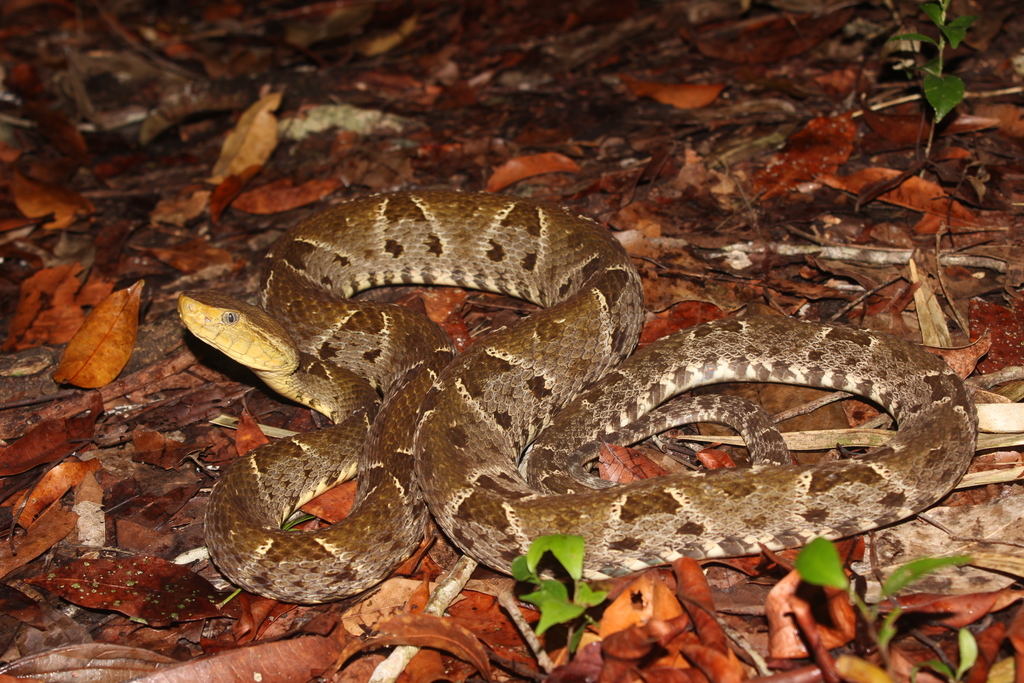
The pit viper behind most serious snakebites in Central America. It is common on farms and plantations, and females bear large litters. Strictly speaking, 'fer-de-lance' is the Martinique species Bothrops lanceolatus, but the name is widely used for this snake.
The terciopelo is a species of pit viper found from north-east Mexico to northern South America. At low to moderate elevations, its habitat ranges from northeastern Mexico to Colombian and Ecuadorian Andes, as well as Venezuela. With a mass of up to 6 kilograms (13 lb), and a maximal length of 2.5 metres (8.2 ft), the terciopelo is among the largest vipers. It is light to dark brown in color, often with yellowish, zig-zag patterning on either side of its body. Dubbed "the ultimate pit-viper" for its defensiveness, large size, fangs and potent venom yield, it has a fearsome reputation, responsible for the most envenomated snakebites within its range, largely due to its proximity to humans, livestock and pets. Nonetheless, like all venomous snakes, the terciopelo actively avoids contact with humans and other larger animals, with bites generally only occurring when the snake is cornered, pursued, or threatened. No subspecies are currently recognized. Wikipedia
What it can do
- iVenom causes severe swelling, blistering, tissue death and bleeding
- iiFemales give birth to large litters, often 20–40 and sometimes many more
- iiiHeat-sensing pits find warm prey at night
- ivThrives in banana and coffee plantations, where its rat prey is common
In the field
Field marks
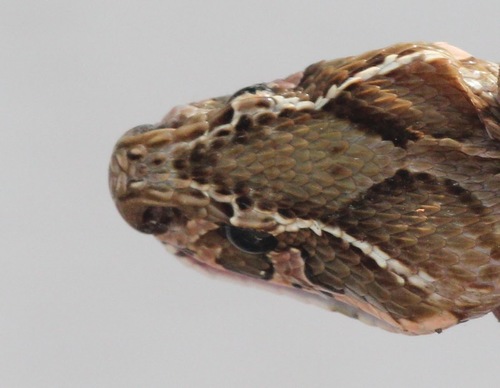
- aLarge, flat, arrowhead-shaped head with a sharp edge along the top of the snout
- bBack pattern of dark triangles with pale edges, which meet along the spine to form X shapes
- cYellow or cream chin and throat (hence 'barba amarilla')
- dHeat pit between eye and nostril; vertical pupils
- Not to be confused with
- The harmless false fer-de-lance (Xenodon rabdocephalus) mimics its colours and flattens its head when threatened, but it has round pupils, no heat pits and smooth scales. Cat-eyed snakes (Leptodeira) have vertical pupils but are slender, with small heads and blotches rather than X-marks. In its range, any large, flat-headed snake with triangles along the side should be treated as a terciopelo.
- Where to see it
- Lowland forests of Costa Rica (La Selva, Tortuguero, Osa Peninsula), Panama, and Chocó in Colombia; often seen on night walks
- When
- Resident; most active on wet nights; births are common at the start of the rainy season
Life & habits
- Diet
- Rodents and opossums; juveniles eat frogs and lizards, luring them by twitching a pale tail tip
- Habitat
- Lowland wet forest, forest edges, plantations and pastures, often near streams
- Size
- Usually 1.2–1.8 m; females much larger than males, up to ~2.5 m
Mostly nocturnal; it can be nervous and quick to strike when stepped near. Bites need hospital treatment with polyvalent antivenom, such as the ICP antivenom from Costa Rica. Keep the limb still and do not apply tourniquets, cut or suck the wound.
Where it lives
Recorded sightings
—
geo-referenced records in GBIF, from museums, herbaria and field observers.
Native range
Southern Mexico through Central America to northwestern South America (Colombia, Ecuador and northwestern Venezuela)
Drag the globe to turn it. Dots are where records exist, not a range map; darker means more records.
In the stacks
Searching the stacks…
Every page naming Bothrops asper in the Biodiversity Heritage Library →
Marginalia
Costa Rica's Instituto Clodomiro Picado, founded in 1970 and named after the Costa Rican scientist who studied snakebite in the early 20th century, produces antivenom against this species that is used across Central America and beyond.
Curiosity
Newborn terciopelos already carry fully working venom and fangs.
Kinship



Photographs: iNaturalist contributors under the licences shown. Records: GBIF.org. Historical plates: Source Library (CC BY-SA 4.0; originals public domain). Summary text: Nature Library editors and Wikipedia (CC BY-SA). Medicinal and edibility notes are historical and educational, not advice. iNaturalist taxon 30798.