 NL·0786
Herbarium of the Nature Library
- Name
- Echis carinatus
- Family
- Viperidae
- Native to
- India and Sri Lanka west through Pakistan, Afghanistan and Iran to parts of the Arabian Peninsula
- Habitat
- Desert, Scrub, Rocky dry plains, Farmland
Saw-scaled viper
Echis carinatus
Also calledIndian saw-scaled viper · Phoorsa (Hindi/Marathi) · Surutai viriyan (Tamil) · Vali polonga (Sinhala) · Afi'a (Arabic, for Echis generally)
The smallest of the Big Four, rarely longer than a forearm, but irritable, common, and armed with a strong venom that stops blood clotting. It warns intruders with a sizzling rasp made by rubbing its saw-edged side scales together.
Echis carinatus, known as the Sindh saw-scaled viper, saw-scaled viper, Indian saw-scaled viper, little Indian viper, and by other common names, is a viper species found in parts of the Middle East and Central Asia, and especially the Indian subcontinent. It is the smallest member of the "big four" Indian snakes that are responsible for causing the most snakebite cases and deaths, due to various factors including their frequent occurrence in highly populated regions, and their inconspicuous nature. Like all vipers, the species is venomous. Two subspecies are currently recognized, including the nominate subspecies described here. Wikipedia
What it can do
- iMakes a hissing rasp (stridulation) by rubbing serrated, keeled flank scales as it loops its body into C-shaped coils
- iiVenom can cause bleeding and clotting failure that lasts for days
- iiiSurvives in hot, dry places where few other vipers can
In the field
Field marks
- aSmall, stout viper with a short tail
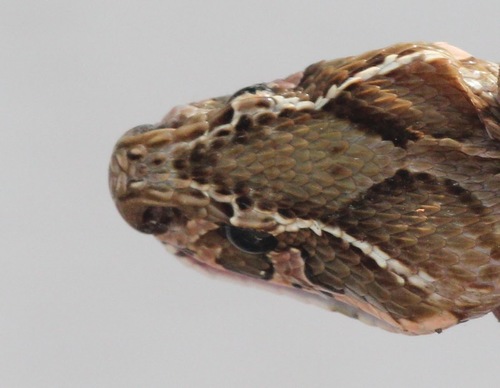
- bPale wavy white line along each flank, with a row of pale-edged dark saddles above it
- cPale cross, trident or bird's-foot mark on top of the pear-shaped head
- dVery rough, keeled scales; large eyes with vertical pupils
- Not to be confused with
- In Arabia and Africa, harmless egg-eating snakes (Dasypeltis) copy its coiling, rasping display. Egg-eaters have a small rounded head barely wider than the neck and lack the pale head cross. In India, juvenile Russell's vipers have rows of ringed ovals, not wavy flank lines. A small, rough-scaled snake rasping in dry scrub should be treated as a saw-scaled viper and left alone.
- Where to see it
- Common in the dry plains of the Deccan and Rajasthan, the Ratnagiri coast and Sri Lanka's dry zone; often found under stones and in field bunds
- When
- Resident; most active and most often met on warm nights after rain
Life & habits
- Diet
- Rodents, lizards, frogs, scorpions, centipedes and insects
- Habitat
- Dry rocky or sandy plains, laterite scrub, bunds of fields
- Size
- Usually 30–60 cm; rarely ~80 cm
Coils in a figure of eight and rasps loudly, then strikes quickly and sometimes again. Bites cause local swelling and bleeding problems, which can appear late. Anyone bitten needs hospital observation, clotting tests and antivenom. Keep the limb still, avoid tourniquets and do not cut the wound.
Where it lives
Recorded sightings
—
geo-referenced records in GBIF, from museums, herbaria and field observers.
Native range
India and Sri Lanka west through Pakistan, Afghanistan and Iran to parts of the Arabian Peninsula
Drag the globe to turn it. Dots are where records exist, not a range map; darker means more records.
In the old herbals & bestiaries
No plate in the Source Library names this exact species, so these show its closest relatives as the old naturalists drew them: same genus, or the same kind of animal. Click a plate to read the page it came from, with translation.

Ulyssis Aldrovandi ... serpentum et draconum historiae libri duo
Relative · Ambrosini, Bartolommeo · 1640 · p.180

Ulyssis Aldrovandi ... serpentum et draconum historiae libri duo
Relative · Ambrosini, Bartolommeo · 1640 · p.126

Compendium of Materia Medica: Illustrated Volume, Middle of the Lower Part
Relative · 李時珍 · 1596 · p.50

Manuscript containing illustrations of strange beasts and men, women and children. (Italian MS 63)
Relative · Anonymous · 1700 · p.109

History of Animals, Book II: On Oviparous Quadrupeds
Relative · Conrad Gessner · 1586 · p.219

Serpentum et Draconum Historiae
Relative · Ulisse Aldrovandi · 1640 · p.187

Serpentum et Draconum Historiae
Relative · Ulisse Aldrovandi · 1640 · p.192

History of Serpents and Dragons
Relative · Ulisse Aldrovandi · 1640 · p.126

History of Serpents and Dragons
Relative · Ulisse Aldrovandi · 1640 · p.179

The Pagan World and the Origin of its Gods
Relative · Herold, Johann · 1554 · p.857
In the stacks
Searching the stacks…
Every page naming Echis carinatus in the Biodiversity Heritage Library →
Marginalia
The Irula Snake Catchers' Industrial Cooperative in Tamil Nadu, founded in 1978 with herpetologist Romulus Whitaker, milks saw-scaled vipers and the rest of the Big Four and supplies much of the venom used to make India's polyvalent antivenom.
Curiosity
In parts of Africa and Asia, Echis vipers are among the snakes that cause the most snakebite deaths, and some experts think they kill more people than any other group.
Kinship



Fact-checked: 2 corrections made to this sheet. Photographs: iNaturalist contributors under the licences shown. Records: GBIF.org. Historical plates: Source Library (CC BY-SA 4.0; originals public domain). Summary text: Nature Library editors and Wikipedia (CC BY-SA). Medicinal and edibility notes are historical and educational, not advice. iNaturalist taxon 31079.