 NL·0195
Herbarium of the Nature Library
- Name
- Calvatia gigantea
- Family
- Lycoperdaceae
- Native to
- Temperate Northern Hemisphere: Europe and North America, also parts of Asia
- Habitat
- Temperate grassland, Meadows, Woodland edges, Gardens
Giant puffball
Calvatia gigantea
Also calledRiesenbovist (German) · Vesse-de-loup géante (French) · Pedo de lobo gigante (Spanish)
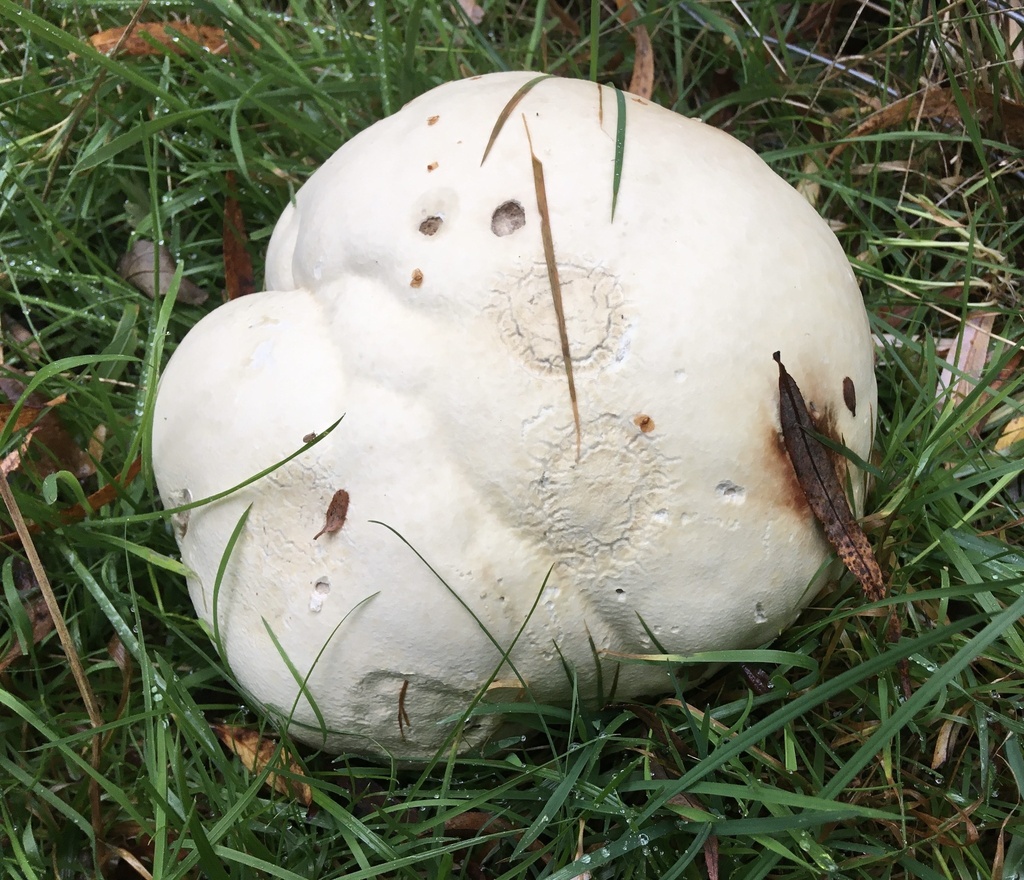
A white football (or larger) in a summer meadow, made of a brainless, gill-less sphere of spore-making tissue. One puffball can produce trillions of spores. Sliced while pure white inside, it fries like a mushroom steak.
Calvatia gigantea, commonly known in English as the giant puffball, is a puffball mushroom found in meadows, fields, and deciduous forests in late summer and autumn. It is found in temperate areas throughout the world. It is edible when young. Wikipedia
What it can do
- iCan reach 20–80 cm across, and occasionally more
- iiA single large fruiting body produces several trillion spores
- iiiIts outer skin cracks away when mature, letting wind and rain release the olive-brown spore powder
- ivGrows in rich, nitrogen-heavy soil such as pasture and hedgerows
At the table
Eatenyoung fruiting body, pure white throughout (cooked)
Edible only when young, with firm, pure-white interior like marshmallow, and cooked. Discard any with yellow, olive or brown flesh. Deadly lookalikes: the egg-stage buttons of Amanita species, including the death cap and destroying angels. Always slice top to bottom: any outline of a cap, gills or stem means it is not a puffball. Also avoid earthballs (Scleroderma), which have a thick rind and purple-black interior and are poisonous.
In the medicine cabinet
| Tradition | Use |
|---|---|
| European and North American Indigenous folk medicine | Dried spore mass or slices placed on wounds and nosebleeds to stop bleeding |
Weight of evidence
Traditional. Long historical use; little or no modern clinical evidence.
Active compounds
calvacin (an antitumour protein studied in the 1960s)
Fruiting body & spores
Spores
Spore mass olive-brown; spores globose, minutely warty, about 3.5–5.5 µm
- Dispersal
- Wind and rain as the outer skin cracks open
Where it lives
Recorded sightings
—
geo-referenced records in GBIF, from museums, herbaria and field observers.
Native range
Temperate Northern Hemisphere: Europe and North America, also parts of Asia
Drag the globe to turn it. Dots are where records exist, not a range map; darker means more records.
In the old herbals & bestiaries
No plate in the Source Library names this exact species, so these show its closest relatives as the old naturalists drew them: same genus, or the same kind of plant. Click a plate to read the page it came from, with translation.

Histoire des Champignons de la France, Vol 2
Relative · Pierre Bulliard · 1791 · p.263

Illustrations of Fungi which Grow in Bavaria and the Palatinate around Ratisbon, Vols 1–2
Relative · Jacob Christian Schaeffer; C.H. Persoon (ed.) · 1800 · p.412

Illustrations of Fungi which Grow in Bavaria and the Palatinate around Ratisbon, Vols 1–2
Relative · Jacob Christian Schaeffer; C.H. Persoon (ed.) · 1800 · p.414

Illustrations of Fungi which Grow in Bavaria and the Palatinate around Ratisbon, Vols 3–4
Relative · Jacob Christian Schaeffer; C.H. Persoon (ed.) · 1800 · p.212

Illustrations of Fungi which Grow in Bavaria and the Palatinate around Ratisbon, Vols 3–4
Relative · Jacob Christian Schaeffer; C.H. Persoon (ed.) · 1800 · p.277

Six Groups of the History of Plants
Relative · Rembert Dodoens · 1583 · p.497

Rariorum Plantarum Historia (with Fungorum Historia)
Relative · Carolus Clusius · 1601 · p.670

Rariorum Plantarum Historia (with Fungorum Historia)
Relative · Carolus Clusius · 1601 · p.670

Elements of Botany
Relative · Joseph Pitton de Tournefort · 1719 · p.82

Histoire des Champignons de la France, Vol 2
Relative · Pierre Bulliard · 1791 · p.285
In the stacks
Searching the stacks…
Every page naming Calvatia gigantea in the Biodiversity Heritage Library →
Marginalia
European herdsmen and North American Indigenous peoples used dried puffballs as tinder, as wound dressings and to stupefy bees when collecting honey.
Curiosity
Lycoperdon, the old genus name for puffballs, means 'wolf fart', after the dusty puff of spores.
Kinship


Photographs: iNaturalist contributors under the licences shown. Records: GBIF.org. Historical plates: Source Library (CC BY-SA 4.0; originals public domain). Summary text: Nature Library editors and Wikipedia (CC BY-SA). Medicinal and edibility notes are historical and educational, not advice. iNaturalist taxon 57692.