 NL·0757
Herbarium of the Nature Library
- Name
- Calypte anna
- Family
- Trochilidae
- Native to
- Western North America from British Columbia to Baja California and Arizona
- Habitat
- Chaparral, Gardens, Coastal scrub, Oak woodland
On eBird ↗
Anna's Hummingbird
Live sightings near you, the range map, bar charts of when it is seen, and Macaulay Library photos and recordings.
Anna's hummingbird
Calypte anna
Also calledColibrí de Anna (Spanish) · Colibri d'Anna (French)
A rose-headed hummingbird of the Pacific coast whose courtship dive is, relative to body length, among the fastest known movements of any vertebrate. At the bottom of the dive its tail feathers sing.
Anna's hummingbird is a North American species of hummingbird named after Anna Masséna, Duchess of Rivoli. Wikipedia
What it can do
- iDisplay dive reaches ~385 body lengths per second (Clark 2009)
- iiOuter tail feathers flutter to make a loud chirp at the bottom of the dive
- iiiWithstands around 9 g of acceleration pulling out of the dive
- ivStays through winter in the north, aided by garden feeders and exotic plants
In the field
Field marks
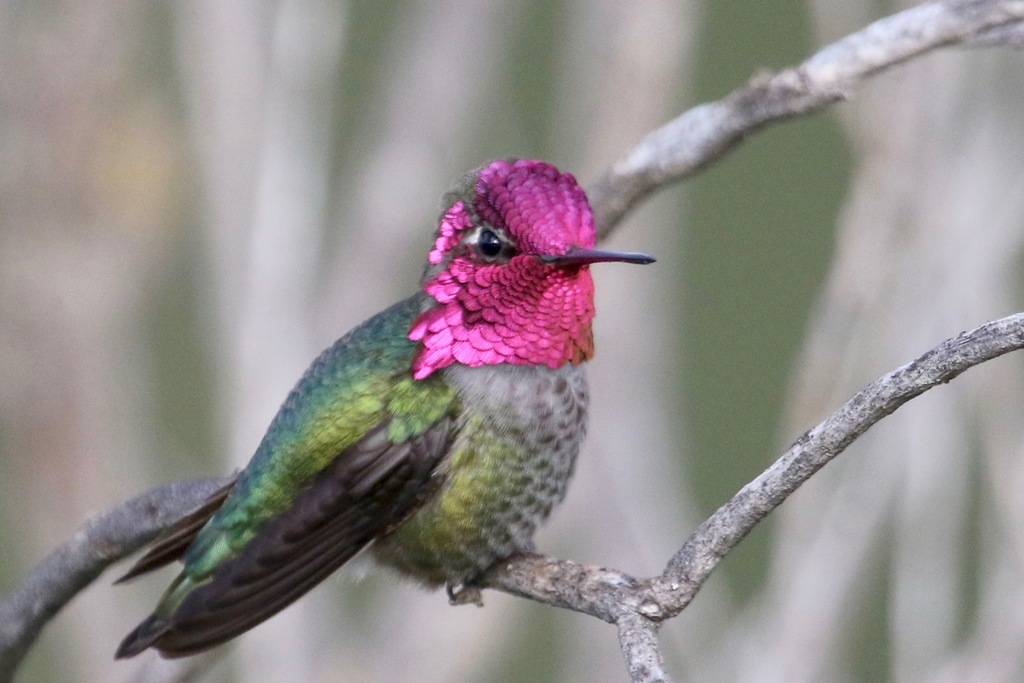
- aMedium-sized hummingbird, green above, greyish below
- bMale has an iridescent rose-pink crown and throat
- cFemale often shows a small central patch of pink on the throat
- dShort straight bill
- Voice
- Male gives a scratchy, buzzy song from a perch; display dive ends in a loud chirp made by the tail feathers
- Not to be confused with
- Costa's hummingbird is smaller with a purple crown and a throat patch that flares down the sides. Rufous and Allen's are orange.
- Where to see it
- Gardens, parks and chaparral along the Pacific Coast from Vancouver to Baja California
- When
- Resident; breeds in winter and spring
Listen
Looking for field recordings…
Life & habits
- Diet
- Nectar, insects and tree sap from sapsucker wells
- Habitat
- Gardens, parks, chaparral and open woodland
- Size
- 10 cm; ~4–5 g
- Lifespan
- Up to about 8 years
A male climbs up to 40 m and plunges in a J-shaped dive past a female, ending in a sharp tail-feather chirp.
Where it lives
Recorded sightings
—
geo-referenced records in GBIF, from museums, herbaria and field observers.
Native range
Western North America from British Columbia to Baja California and Arizona
Drag the globe to turn it. Dots are where records exist, not a range map; darker means more records.
In the old herbals & bestiaries
No plate in the Source Library names this exact species, so these show its closest relatives as the old naturalists drew them: same genus, or the same kind of animal. Click a plate to read the page it came from, with translation.

Maria Sibylla Merian — Dissertatio de generatione et metamorphosibus insectorum Surinamensium (1719)
Relative · Maria Sibylla Merian · 1719 · p.71

Tudela Codex
Relative · Anonymous Nahua tlacuilo · n.d. · p.184

Treasury of Medical Matters of New Spain
Relative · Francisco Hernández · 1651 · p.754

De Indiae utriusque re naturali et medica
Relative · Willem Piso · 1658 · p.348

De Indiae utriusque re naturali et medica
Relative · Willem Piso · 1658 · p.349

The Natural History of Carolina, Florida and the Bahama Islands, Vol. 1
Relative · Mark Catesby · 1777 · p.212

Jean Baptiste Audebert — Histoire naturelle des colibris (1802)
Relative · Jean Baptiste Audebert · 1802 · p.264

Jean Baptiste Audebert — Histoire naturelle des colibris (1802)
Relative · Jean Baptiste Audebert · 1802 · p.154

Jean Baptiste Audebert — Histoire naturelle des grimpereaux et des oiseaux de paradis (1802)
Relative · Jean Baptiste Audebert · 1802 · p.26

Thesaurus of Medical Things of New Spain, or History of Mexican Plants, Animals, and Minerals
Relative · Francisco Hernández; Nardo Antonio Recchi (ed.) · 1651 · p.742
In the stacks
Searching the stacks…
Every page naming Calypte anna in the Biodiversity Heritage Library →
Marginalia
It is named after Anna Masséna, Duchess of Rivoli, a 19th-century French collector of hummingbird specimens.
Curiosity
Its range has expanded northward to Vancouver and beyond since the mid-20th century.
Kinship
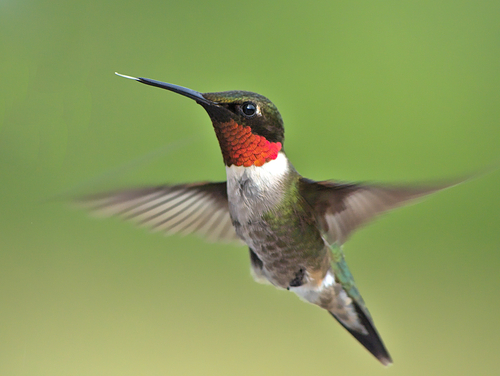
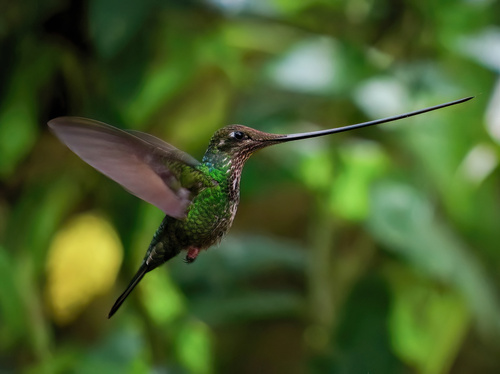
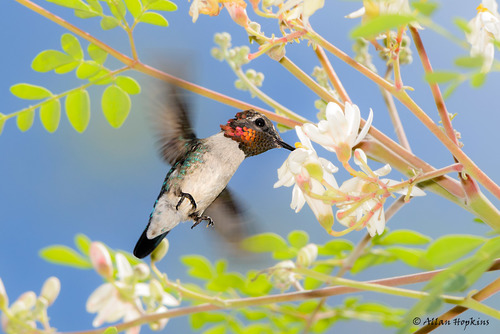



Photographs: iNaturalist contributors under the licences shown. Records: GBIF.org. Historical plates: Source Library (CC BY-SA 4.0; originals public domain). Summary text: Nature Library editors and Wikipedia (CC BY-SA). Medicinal and edibility notes are historical and educational, not advice. iNaturalist taxon 6317.