 NL·0758
Herbarium of the Nature Library
- Name
- Ensifera ensifera
- Family
- Trochilidae
- Native to
- Andes from western Venezuela and Colombia through Ecuador and Peru to Bolivia, mostly 1,700–3,500 m
- Habitat
- Montane cloud forest, Páramo edge, Montane shrubland
On eBird ↗
Sword-billed Hummingbird
Live sightings near you, the range map, bar charts of when it is seen, and Macaulay Library photos and recordings.
Sword-billed hummingbird
Ensifera ensifera
Also calledColibrí pico espada (Spanish) · Picoespada (Spanish) · Colibri porte-épée (French)
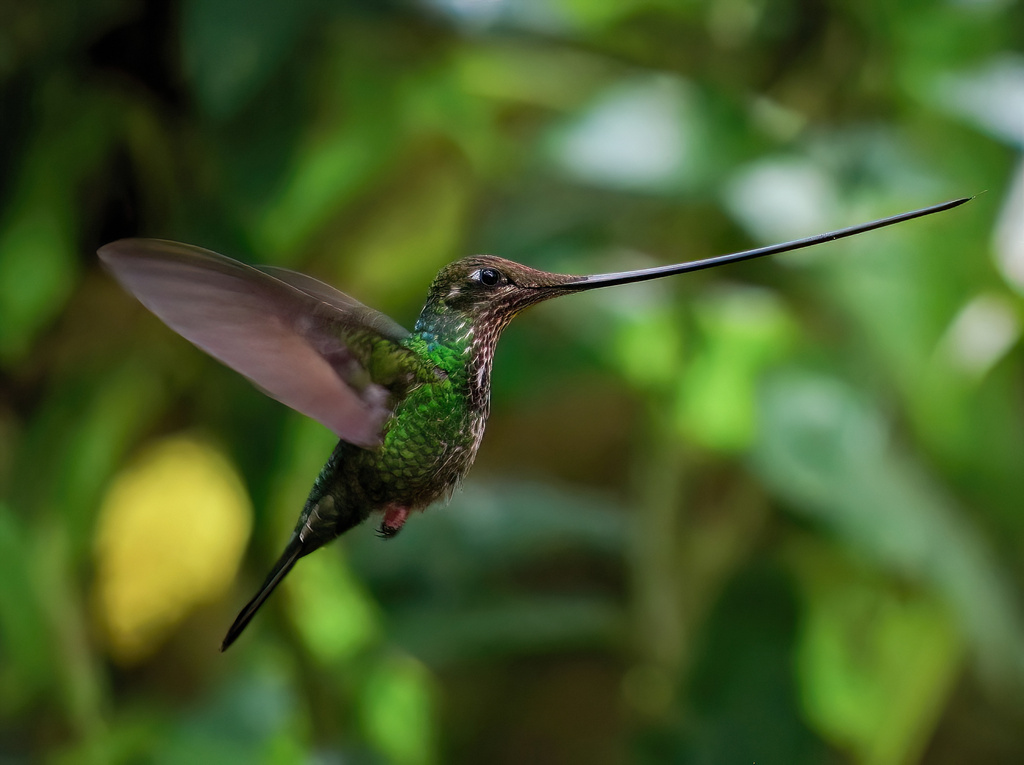
The only bird whose bill is longer than its body, excluding the tail. It reaches nectar at the bottom of long-tubed Andean flowers that no other hummingbird can use.
The sword-billed hummingbird, also known as the swordbill, is a neotropical species of hummingbird from the Andean regions of South America. It is the only member in the genus Ensifera. Among the largest species of hummingbird, it is characterized by its unusually long bill, being the only bird to have a beak longer than the rest of its body, excluding the tail. It uses its bill to drink nectar from flowers with long corollas and has coevolved with the species Passiflora mixta. While most hummingbirds preen using their bills, the sword-billed hummingbird uses its feet to scratch and preen due to its bill being so long. Wikipedia
What it can do
- iBill about 9–11 cm long, longer than the bird's head and body
- iiMain pollinator of long-tubed flowers such as Passiflora mixta and angel's trumpets (Brugmansia)
- iiiPerches with its bill pointed steeply upward to balance the weight
- ivGrooms with its feet because it cannot reach its feathers with its bill
In the field
Field marks
- aExtremely long, straight, slightly upturned bill
- bBronze-green body; male with coppery head
- cForked, greenish-bronze tail
- dSmall white spot behind the eye
- Voice
- A low, rattling 'trrr' and buzzy chips; no complex song.
- Not to be confused with
- No other hummingbird has a bill nearly as long. Great Sapphirewing and incas share its habitat but have short or medium bills.
- Where to see it
- Feeders and flowering edges at Yanacocha Reserve and Guango Lodge (Ecuador), Abra Málaga and Wayqecha (Peru).
- When
- Resident year-round
Listen
Looking for field recordings…
Life & habits
- Diet
- Nectar from long tubular flowers; small insects caught in flight
- Habitat
- Humid montane forest edge and shrubby clearings
- Size
- About 13–17 cm excluding bill; 12–15 g
It catches insects on the wing with its mouth open wide, keeping the long bill out of the way.
Where it lives
Recorded sightings
—
geo-referenced records in GBIF, from museums, herbaria and field observers.
Native range
Andes from western Venezuela and Colombia through Ecuador and Peru to Bolivia, mostly 1,700–3,500 m
Drag the globe to turn it. Dots are where records exist, not a range map; darker means more records.
In the old herbals & bestiaries
No plate in the Source Library names this exact species, so these show its closest relatives as the old naturalists drew them: same genus, or the same kind of animal. Click a plate to read the page it came from, with translation.

Maria Sibylla Merian — Dissertatio de generatione et metamorphosibus insectorum Surinamensium (1719)
Relative · Maria Sibylla Merian · 1719 · p.71

Tudela Codex
Relative · Anonymous Nahua tlacuilo · n.d. · p.184

Treasury of Medical Matters of New Spain
Relative · Francisco Hernández · 1651 · p.754

De Indiae utriusque re naturali et medica
Relative · Willem Piso · 1658 · p.348

De Indiae utriusque re naturali et medica
Relative · Willem Piso · 1658 · p.349

The Natural History of Carolina, Florida and the Bahama Islands, Vol. 1
Relative · Mark Catesby · 1777 · p.212

Jean Baptiste Audebert — Histoire naturelle des colibris (1802)
Relative · Jean Baptiste Audebert · 1802 · p.264

Jean Baptiste Audebert — Histoire naturelle des colibris (1802)
Relative · Jean Baptiste Audebert · 1802 · p.154

Jean Baptiste Audebert — Histoire naturelle des grimpereaux et des oiseaux de paradis (1802)
Relative · Jean Baptiste Audebert · 1802 · p.26

Thesaurus of Medical Things of New Spain, or History of Mexican Plants, Animals, and Minerals
Relative · Francisco Hernández; Nardo Antonio Recchi (ed.) · 1651 · p.742
In the stacks
Searching the stacks…
Every page naming Ensifera ensifera in the Biodiversity Heritage Library →
Marginalia
Curiosity
It co-evolved with Passiflora mixta, whose floral tube is long enough that only the sword-bill can reach its nectar.
Kinship
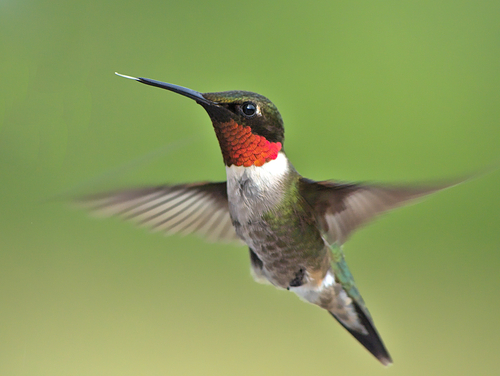
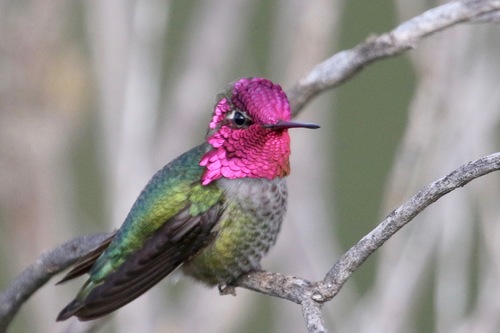
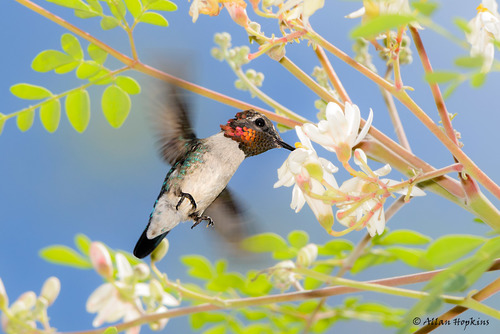



Photographs: iNaturalist contributors under the licences shown. Records: GBIF.org. Historical plates: Source Library (CC BY-SA 4.0; originals public domain). Summary text: Nature Library editors and Wikipedia (CC BY-SA). Medicinal and edibility notes are historical and educational, not advice. iNaturalist taxon 6458.