 NL·0569
Herbarium of the Nature Library
- Name
- Hapalochlaena lunulata
- Family
- Octopodidae
- Native to
- Tropical western Pacific and eastern Indian Ocean: northern Australia, Indonesia, the Philippines, New Guinea, the Solomon Islands and Vanuatu, north to southern Japan
- Habitat
- Coral reef, Rubble and sand flats, Tide pools
Greater blue-ringed octopus
Hapalochlaena lunulata
Also calledHyōmon-dako (Japanese, blue-ringed octopuses) · Gurita cincin biru (Indonesian) · Pieuvre à anneaux bleus (French)
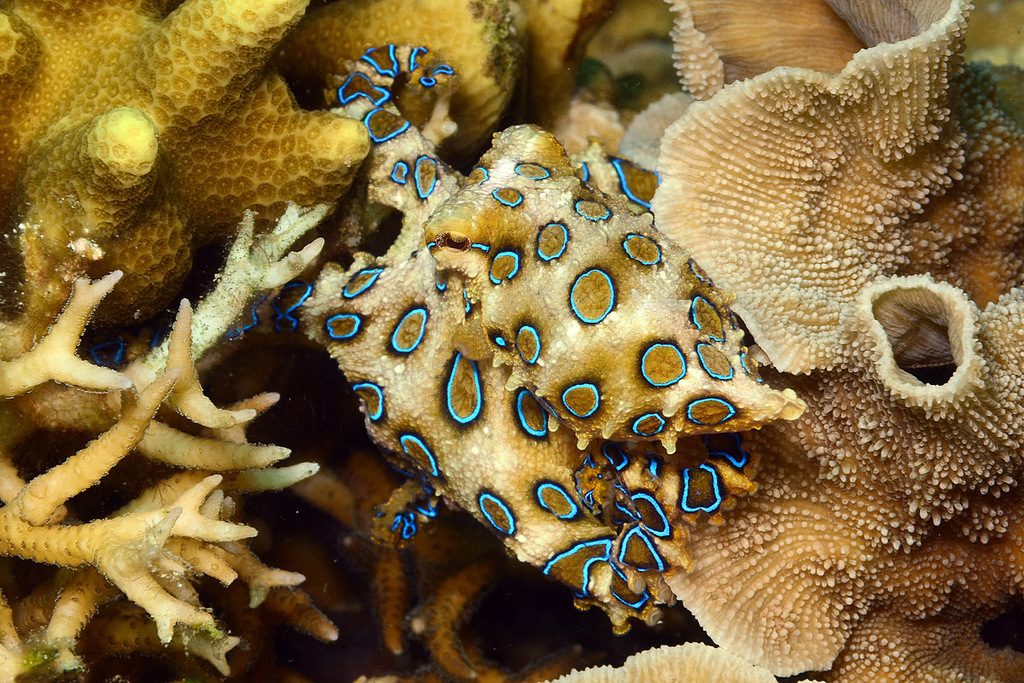
A golf-ball-sized octopus that flashes vivid blue rings when alarmed. Its saliva carries tetrodotoxin, a nerve poison that can paralyse and kill an adult human within minutes to hours, and there is no antivenom.
The greater blue-ringed octopus is one of four species of extremely venomous blue-ringed octopuses belonging to the family Octopodidae. This particular species of blue-ringed octopus is known as one of the most toxic marine animals in the world. Wikipedia
What it can do
- iSaliva carries tetrodotoxin produced by symbiotic bacteria
- iiFlashes about 60 blue rings in a fraction of a second, using muscles that expose reflecting layers
- iiiBite is often painless, so victims may not notice it
- ivCan change from drab brown to warning colours instantly
In the field
Field marks
- aTiny octopus, yellowish-brown at rest
- bLarge, iridescent blue rings outlined in black, larger than in other blue-ringed species
- cRings flash brightly when the animal is disturbed
- dOften found in empty shells or bottles
- Not to be confused with
- Southern blue-ringed octopus (Hapalochlaena maculosa) of southern Australia is smaller with smaller rings. Blue-lined octopus (H. fasciata) has blue lines on the body rather than rings. Treat any blue-ringed octopus as deadly.
- Where to see it
- Muck-diving sites such as Lembeh Strait (Indonesia) and Anilao (Philippines); never handle.
- When
- Year-round
Life & habits
- Diet
- Small crabs, shrimps and fish, subdued by injecting venomous saliva
- Habitat
- Shallow reefs, rubble, tide pools and seagrass, often hiding in shells and crevices
- Size
- Arm span about 10 cm
- Lifespan
- About 1–2 years
Normally camouflaged in brown and yellow, it displays pulsing blue rings when provoked, a warning to predators.
Where it lives
Recorded sightings
—
geo-referenced records in GBIF, from museums, herbaria and field observers.
Native range
Tropical western Pacific and eastern Indian Ocean: northern Australia, Indonesia, the Philippines, New Guinea, the Solomon Islands and Vanuatu, north to southern Japan
Drag the globe to turn it. Dots are where records exist, not a range map; darker means more records.
In the old herbals & bestiaries
No plate in the Source Library names this exact species, so these show its closest relatives as the old naturalists drew them: same genus, or the same kind of animal. Click a plate to read the page it came from, with translation.

The Hieroglyphics
Relative · Horapollo · 1551 · p.247

Hokusai Manga (北斎漫画), Vol. 1
Relative · Katsushika Hokusai · 1814 · p.23

The Hieroglyphics
Relative · Horapollo · 1551 · p.246

History of Animals, Book II: On Oviparous Quadrupeds
Relative · Conrad Gessner · 1586 · p.558

Books on Marine Fishes
Relative · Guillaume Rondelet · 1554 · p.537

The Pagan World and the Origin of its Gods
Relative · Herold, Johann · 1554 · p.870

History of Animals, Book II: On Oviparous Quadrupeds
Relative · Conrad Gessner · 1586 · p.559

Hōrou Apollōnos Neilōou Hieroglyphika eklekta = : Hori Apollinis selecta hieroglyphica, sive sacrae notae Aegyptiorum, & insculptae imagines
Relative · Horapollo · 1597 · p.246

Hōrou Apollōnos Neilōou Hieroglyphika eklekta = : Hori Apollinis selecta hieroglyphica, sive sacrae notae Aegyptiorum, & insculptae imagines
Relative · Horapollo · 1597 · p.247

The Pagan World and the Origin of its Gods
Relative · Herold, Johann · 1554 · p.870
In the stacks
Searching the stacks…
Every page naming Hapalochlaena lunulata in the Biodiversity Heritage Library →
Marginalia
Blue-ringed octopus bites killed swimmers in Australia in the 1950s and 1960s, and the animal became a pop-culture emblem in the James Bond film Octopussy (1983).
Curiosity
Victims stay conscious while paralysed; people have survived when bystanders gave artificial respiration until the toxin wore off.
Kinship





Fact-checked: 1 correction made to this sheet. Photographs: iNaturalist contributors under the licences shown. Records: GBIF.org. Historical plates: Source Library (CC BY-SA 4.0; originals public domain). Summary text: Nature Library editors and Wikipedia (CC BY-SA). Medicinal and edibility notes are historical and educational, not advice. iNaturalist taxon 199917.