 NL·0570
Herbarium of the Nature Library
- Name
- Octopus vulgaris
- Family
- Octopodidae
- Native to
- Mediterranean Sea and eastern Atlantic; similar species elsewhere were long included under this name
- Habitat
- Rocky reef, Seagrass meadow, Coastal waters
Common octopus
Octopus vulgaris
Also calledPulpo (Spanish) · Polvo (Portuguese) · Chtapódi χταπόδι (Greek) · Ukhṭubūṭ (Arabic) · Ahtapot (Turkish) · Tako (Japanese) · Zhāngyú 章鱼 (Chinese)
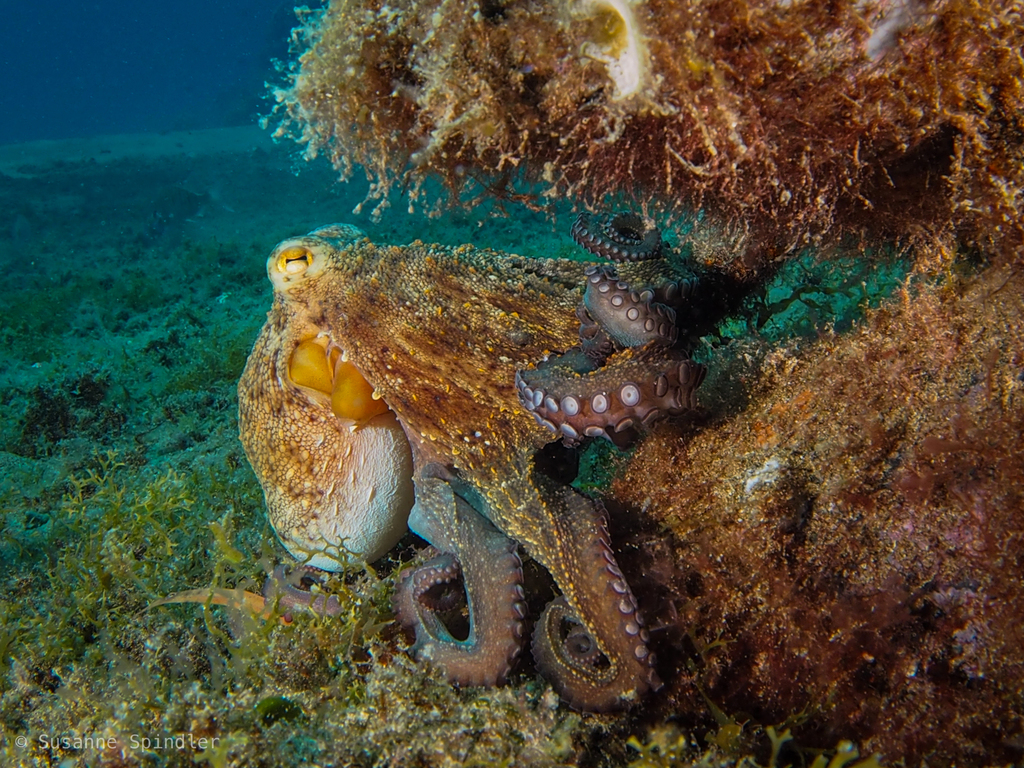
A clever, short-lived mollusc of the Mediterranean and eastern Atlantic, with three hearts, blue blood and most of its neurons in its arms. It changes colour and skin texture in an instant to vanish against rock or sand.
The common octopus is a mollusk belonging to the class Cephalopoda. Octopus vulgaris is one of the most studied of all the octopus species, and also one of the most intelligent. It ranges from the eastern Atlantic, extends from the Mediterranean Sea, Black sea and the southern coast of England, to the southern coast of South Africa. It also occurs off the Azores, Canary Islands, and Cape Verde Islands. The species is also common in the Western Atlantic. Wikipedia
What it can do
- iChanges colour, pattern and skin texture within a fraction of a second using chromatophores and papillae
- iiArms, holding about two-thirds of its neurons, can taste, touch and act semi-independently
- iiiSolves puzzles, unscrews jars and learns by watching another octopus
- ivSqueezes through any gap larger than its hard beak
- vSquirts ink clouds and jets away by water propulsion
In the field
Field marks
- aSoft body with eight arms
- bRapid colour and texture change
- cLives in dens with shell piles outside
- dLarge, golden eyes
- Not to be confused with
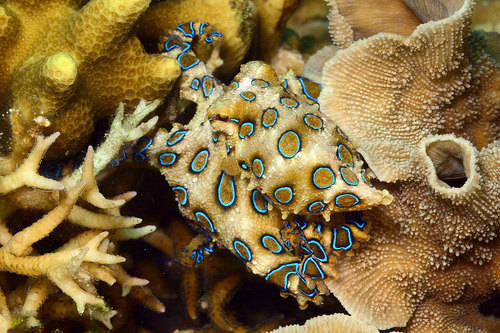
- Several similar octopuses elsewhere were long called 'common octopus'.
- Where to see it
- Rocky shores of the Mediterranean and eastern Atlantic
- When
- Resident
Life & habits
- Diet
- Carnivore: crabs, clams, snails, fish
- Habitat
- Rocky coasts, reefs and seagrass from shallows to ~200 m
- Size
- Mantle up to ~25 cm; arm span to ~1 m; usually 3–10 kg
- Lifespan
- 1–2 years
A female guards and cleans her eggs in a den for weeks without eating, and dies soon after they hatch.
Where it lives
Recorded sightings
—
geo-referenced records in GBIF, from museums, herbaria and field observers.
Native range
Mediterranean Sea and eastern Atlantic; similar species elsewhere were long included under this name
Drag the globe to turn it. Dots are where records exist, not a range map; darker means more records.
In the old herbals & bestiaries
Woodcuts and engravings matched from the Source Library’s scanned books by name. Plates marked “relative” show a close kin rather than this exact species. Click a plate to read the page it came from, with translation.


In the stacks
Searching the stacks…
Every page naming Octopus vulgaris in the Biodiversity Heritage Library →
Marginalia
Octopuses sprawl across Minoan 'Marine Style' jars from Crete (c. 1500 BCE), and Aristotle's History of Animals describes their mating and colour change. Pliny tells of an octopus at Carteia in Spain that raided a fish-salting works by night.
Curiosity
Its blood is blue because it carries oxygen with copper-based haemocyanin instead of iron-based haemoglobin.
Kinship




Photographs: iNaturalist contributors under the licences shown. Records: GBIF.org. Historical plates: Source Library (CC BY-SA 4.0; originals public domain). Summary text: Nature Library editors and Wikipedia (CC BY-SA). Medicinal and edibility notes are historical and educational, not advice. iNaturalist taxon 49315.