 NL·0048
Herbarium of the Nature Library
- Name
- Ipomoea batatas
- Family
- Convolvulaceae
- Native to
- Tropical Central and northern South America; grown throughout the tropics and warm-temperate regions
- Habitat
- Tropical lowlands, Farmland and gardens
Sweet potato
Ipomoea batatas
Also calledKūmara (Māori/Polynesian) · Kamote (Tagalog, from Nahuatl camohtli) · Shakarkand (Hindi/Urdu) · Batata doce (Portuguese) · Camote / Boniato (Spanish) · Gānshǔ / Fānshǔ (Chinese) · Satsumaimo (Japanese) · Kiazi kitamu (Swahili)
A trailing morning-glory relative from tropical America with sweet, starchy storage roots. Sweet potatoes reached Polynesia centuries before Columbus — widely taken as evidence of pre-Columbian contact between Polynesians and South Americans.
The sweet potato or sweetpotato is a dicotyledonous plant in the morning glory family, Convolvulaceae. Its sizeable, starchy, sweet-tasting, tuberous roots are used as a root vegetable, which is a staple food in parts of the world. Cultivars of the sweet potato have been bred to bear tubers with flesh and skin of various colors. Moreover, the young shoots and leaves are eaten as greens with nutritional composition comparable to spinach. The sweet potato and the potato are only distantly related, both being in the order Solanales. Although darker sweet potatoes are often known as yams in parts of North America, they are even more distant from actual yams, which are monocots in the order Dioscoreales. Wikipedia
What it can do
- iNatural GM crop: its genome carries genes inserted by Agrobacterium thousands of years ago
- iiVines root at nodes, so a single plant can cover several square metres
- iiiOrange-fleshed types are very rich in β-carotene, used in Africa to fight vitamin A deficiency
- ivProduces food in poor soils and survives typhoons that flatten grain crops
At the table
Eatenstorage roots (cooked) · leaves and shoot tips (cooked, widely eaten in Africa and Asia)
Roots and leaves are eaten cooked. Roots attacked by weevils or mould can contain toxic furanoterpenoids (e.g. ipomeamarone); cut away bitter, blemished parts.
In the medicine cabinet
| Tradition | Use |
|---|---|
| Traditional Chinese Medicine | Roots to strengthen the spleen and ease constipation |
| Japanese / Brazilian folk medicine | White-skinned sweet potato ('caiapo') extract taken for diabetes, with small trials |
| Public health nutrition (Africa) | Orange-fleshed sweet potato promoted to prevent vitamin A deficiency (World Food Prize 2016) |
Weight of evidence
Moderate. Some clinical trials with promising but limited or mixed results.
Active compounds
β-carotene, anthocyanins (purple types), sporamin, chlorogenic acid
Fruit & seed

Fruit
Capsule
Ripens: Rarely set in cultivation
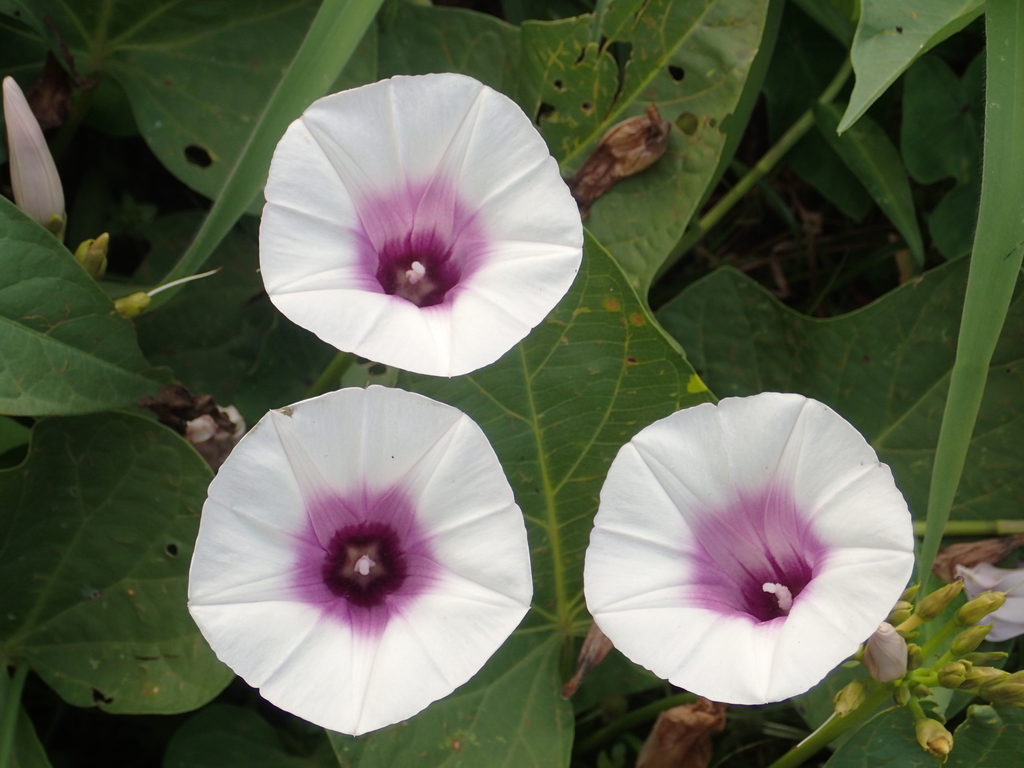
Small, round, dry capsule about 5–8 mm, holding 1–4 seeds; flowers are lavender-to-white morning-glory trumpets.

Seed
3–4 mm
Hard, angular to rounded, dark-brown to black seeds about 3–4 mm, with a very tough coat
- Dispersal
- Gravity; vegetatively by humans; possibly ocean drift and birds
- Germination
- Breeding only: scarify (nick or acid) and sow at 25–30 °C. Gardeners use slips
Photographs from Wikimedia Commons under open licences; hover for the photographer, click for the file.
How to grow it
Hardiness (USDA zones)
Annual warm-season crop (USDA 4–11 with 90–150 frost-free days); perennial in tropics. Survives winters down to about -34 °C.
- Light
- Full sun
- Water
- Moderate; drought-tolerant once established
- Soil
- Loose, sandy loam, well-drained, pH 5.5–6.5; avoid rich nitrogen soils (all leaves, few roots)
- Propagation
- Slips (rooted sprouts) or vine cuttings
- To harvest
- 90–150 days
- Climates
- Tropical, Subtropical, Warm temperate summer
- 1Grow slips by half-submerging a sweet potato in water or burying it in damp sand in a warm place; snap off sprouts at 15–20 cm and root them in water.
- 2After frost, when soil is above 18 °C, plant slips 30–40 cm apart in raised ridges, burying them to the top leaves.
- 3Water until established; avoid heavy nitrogen feeding.
- 4Lift vines periodically so they don't root everywhere, and pick some tips for cooking.
- 5Dig carefully before frost, when roots are a good size; cure in a warm (around 30 °C), humid place for 7–10 days to sweeten and heal skins, then store at 13–15 °C.
Can it grow where you are?
Where it lives
Recorded sightings
—
geo-referenced records in GBIF, from museums, herbaria and field observers.
Native range
Tropical Central and northern South America; grown throughout the tropics and warm-temperate regions
Drag the globe to turn it. Dots are where records exist, not a range map; darker means more records.
In the old herbals & bestiaries
Woodcuts and engravings matched from the Source Library’s scanned books by name. Plates marked “relative” show a close kin rather than this exact species. Click a plate to read the page it came from, with translation.

Metamorphosis Insectorum Surinamensium
Maria Sibylla Merian · 1705 · p.132

History of Rare Plants
Carolus Clusius · 1601 · p.454

Rariorum Plantarum Historia (with Fungorum Historia)
Carolus Clusius · 1601 · p.460

Treasury of Medical Matters of New Spain
Francisco Hernández · 1651 · p.346

De Indiae utriusque re naturali et medica
Willem Piso · 1658 · p.284

Illustrated Compendium of Materia Medica (Vol. 6)
吳其濬 · 1848 · p.5

Stirpium adversaria nova
Matthias de Lobel · 1571 · p.341

Herbarium Portatile, Oder Behendes Kräuter- und Gewächs-Buch: Darinn nicht allein 1363. so wol Einheimische als Außländndische Kräuter mit Lateinisch und Deutscher Benennung abgebildet, sondern auch die meisten, so in der Medicin gebräuchlich, kürtzlich erkläret werden
Panckow, Thomas · 1656 · p.372

The Book of Household Management
Mrs Isabella Beeton · 1861 · p.656

Rariorum Plantarum Historia (with Fungorum Historia)
Carolus Clusius · 1601 · p.460
In the stacks
Searching the stacks…
Every page naming Ipomoea batatas in the Biodiversity Heritage Library →
Marginalia
Kūmara reached Polynesia by about 1000–1100 CE, and Māori grew it in New Zealand with elaborate rituals to the god Rongo. In Japan, the Edo scholar Aoki Konyō promoted the sweet potato as famine insurance in the 1730s, earning the nickname 'Kansho Sensei' (Master Sweet Potato).
Curiosity
The Polynesian word 'kūmara' closely resembles the Quechua 'kumar' — often cited as a clue that Polynesians reached South America, though linguists still debate the link.
Kinship



Fact-checked: 3 corrections made to this sheet. Photographs: iNaturalist contributors under the licences shown. Records: GBIF.org. Historical plates: Source Library (CC BY-SA 4.0; originals public domain). Summary text: Nature Library editors and Wikipedia (CC BY-SA). Medicinal and edibility notes are historical and educational, not advice. iNaturalist taxon 62941.