 NL·0074
Herbarium of the Nature Library
- Name
- Pelargonium sidoides
- Family
- Geraniaceae
- Native to
- Highveld grasslands of South Africa and Lesotho
- Habitat
- Montane grassland, Highveld
South African geranium (Umckaloabo)
Pelargonium sidoides
Also calledUmckaloabo (trade name, from Zulu, roughly 'heavy cough') · Kalwerbossie (Afrikaans) · Khoara e nyenyane (Sesotho) · Kapland-Pelargonie (German)
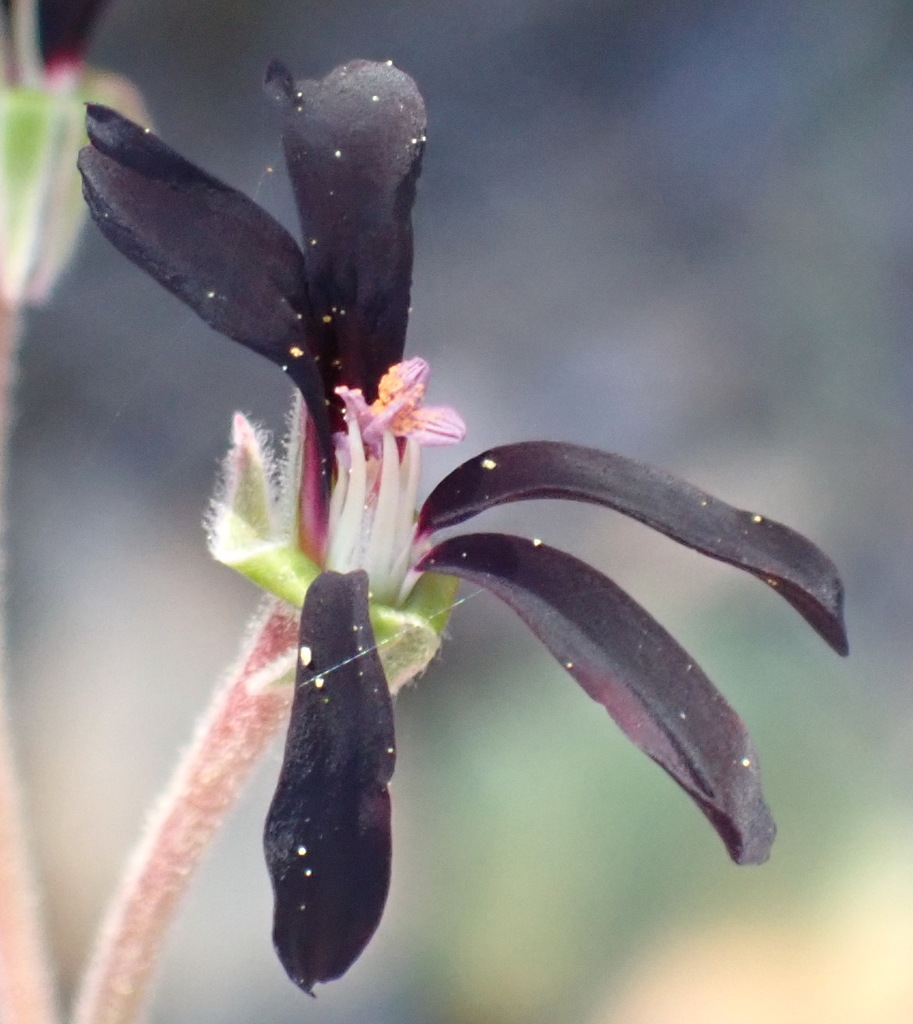
A low, silvery-leaved grassland pelargonium with tiny, almost black-purple flowers and a thick red tuber. A Victorian Englishman's 'tuberculosis cure' from that tuber became Germany's best-selling herbal cold remedy.
Pelargonium sidoides is a plant native to South Africa, Eswatini, and Lesotho. Its common names include African geranium and South African geranium. Wikipedia
What it can do
- iTuber contains highly oxygenated coumarins such as umckalin and prodelphinidins with antimicrobial and immune-modulating activity
- iiThick tubers survive frost, drought and grassland fires and resprout
- iiiFlowers almost year-round in mild climates
At the table
Not a food. The tuber is used as decoction or extract.
In the medicine cabinet
| Tradition | Use |
|---|---|
| Southern African traditional medicine (Sesotho, Zulu, Xhosa) | Tuber decoction for coughs, chest infections, diarrhoea and dysentery, and for colic in calves |
| European phytotherapy | Root extract EPs 7630 for acute bronchitis, sinusitis and the common cold |
Weight of evidence
Moderate. Some clinical trials with promising but limited or mixed results.
Active compounds
umckalin, 5,6,7-trimethoxycoumarin, prodelphinidins, gallic acid, scopoletin
Fruit & seed
Fruit
Schizocarp
Ripens: Spring–autumn
Beaked fruit splitting into five one-seeded segments with spirally twisting tails.
Seed
~4–5 mm (plus tail)
Small seeds with a feathery, corkscrew tail
- Dispersal
- Wind; the tail twists with humidity and drills the seed into soil
- Germination
- 1–3 weeks at 18–22 °C
How to grow it
Hardiness (USDA zones)
USDA 8–11. Survives winters down to about -12 °C.
- Light
- Full sun
- Water
- Low–moderate
- Soil
- Well-drained, gritty loam
- Propagation
- Seed, cuttings or tuber division
- To harvest
- Tubers at 2–3 years
- Climates
- Subtropical, Mediterranean, Temperate (with protection)
- 1Sow seed in gritty compost in spring
- 2Plant out in full sun with sharp drainage, or grow in pots
- 3Water in summer and keep drier in winter
- 4Lift tubers in autumn of year 2–3, replanting the crowns
Can it grow where you are?
Where it lives
Recorded sightings
—
geo-referenced records in GBIF, from museums, herbaria and field observers.
Native range
Highveld grasslands of South Africa and Lesotho
Drag the globe to turn it. Dots are where records exist, not a range map; darker means more records.
In the old herbals & bestiaries
No plate in the Source Library names this exact species, so these show its closest relatives as the old naturalists drew them: same genus, or the same kind of plant. Click a plate to read the page it came from, with translation.

In the stacks
Searching the stacks…
Every page naming Pelargonium sidoides in the Biodiversity Heritage Library →
Marginalia
In 1897 Englishman Charles Henry Stevens travelled to South Africa for his tuberculosis. He said a Basotho healer cured him with the root, and in Britain he sold it as 'Stevens' Consumption Cure'.
Curiosity
Its seed tail twists and untwists with changes in humidity, working the seed into the ground like a corkscrew.
Kinship




Fact-checked: 2 corrections made to this sheet. Photographs: iNaturalist contributors under the licences shown. Records: GBIF.org. Historical plates: Source Library (CC BY-SA 4.0; originals public domain). Summary text: Nature Library editors and Wikipedia (CC BY-SA). Medicinal and edibility notes are historical and educational, not advice. iNaturalist taxon 568517.