 NL·0623
Herbarium of the Nature Library
- Name
- Phyllium philippinicum
- Family
- Phylliidae
- Native to
- Philippines
- Habitat
- Tropical forest
Philippine leaf insect
Phyllium philippinicum
Also calledWandelndes Blatt (German, leaf insects generally) · Phyllie (French) · Insecto hoja (Spanish)
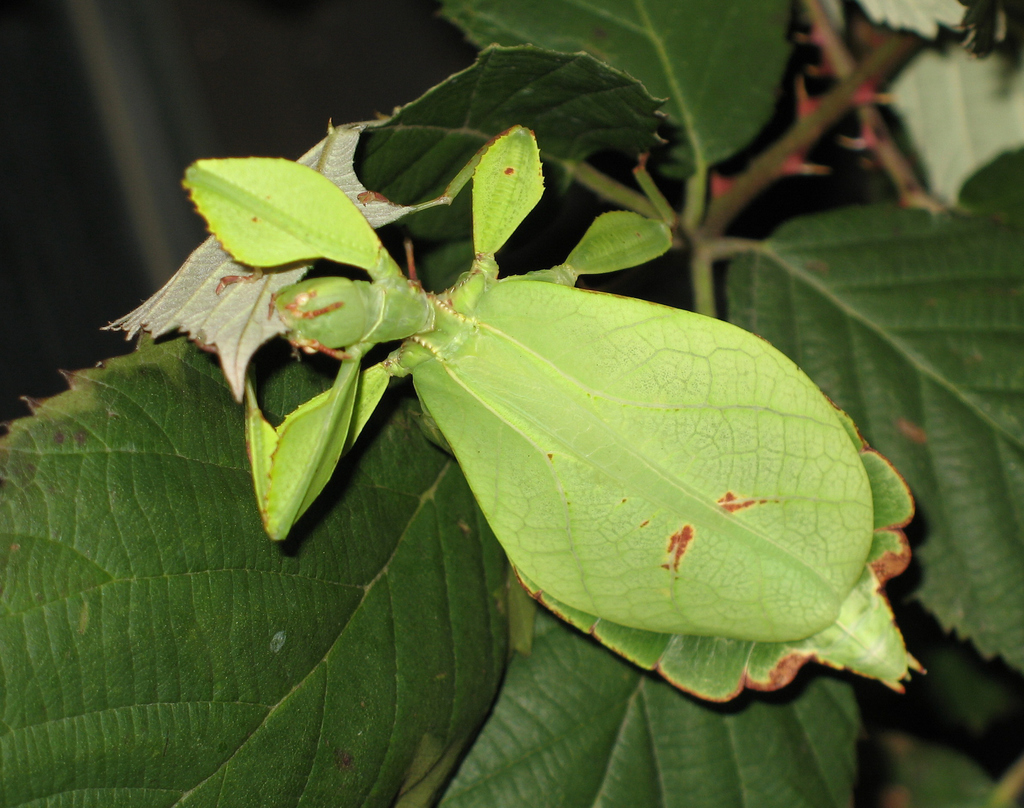
A flattened, bright-green stick-insect relative that is almost indistinguishable from a leaf, complete with 'veins' and brown 'bite marks'. It even sways gently as if moved by a breeze.
Phyllium philippinicum is a species of leaf insect in the family Phylliidae. It is endemic to the Philippines. Wikipedia
What it can do
- iBody and legs are flattened into leaf-like lobes with vein patterns
- iiRocks from side to side while walking, imitating a leaf in wind
- iiiFemales can reproduce without males (parthenogenesis)
- ivEggs look like plant seeds
In the field
Field marks
- aBroad, flat, leaf-shaped green body, sometimes with brown or yellow patches
- bLeaf-like flaps on the legs
- cFemale forewings marked with a pattern resembling a leaf's midrib and veins
- dMales narrower, with long antennae and functional hindwings
- Not to be confused with
- Many Phyllium species are near-identical and are separated by egg shape, the leg lobes and range. In the wild its main 'lookalike' is a leaf.
- Where to see it
- Philippine forests; one of the most commonly kept leaf insects in captivity.
Listen
Looking for field recordings…
Life & habits
- Diet
- Leaves of tropical trees and shrubs; in captivity bramble, oak and guava
- Habitat
- Leafy forest canopy and understorey
- Size
- Females about 8–9 cm; males smaller (about 5–6 cm) and slimmer
- Lifespan
- Adults several months; about a year in total
Females are flightless and rely on stillness and disguise; slimmer males have full wings and fly to find females.
Where it lives
Recorded sightings
—
geo-referenced records in GBIF, from museums, herbaria and field observers.
Native range
Philippines
Drag the globe to turn it. Dots are where records exist, not a range map; darker means more records.
In the old herbals & bestiaries
No plate in the Source Library names this exact species, so these show its closest relatives as the old naturalists drew them: same genus, or the same kind of animal. Click a plate to read the page it came from, with translation.

The natural history of Carolina, Florida, and the Bahama Islands : containing two hundred a...
Relative · Catesby, Mark, bioloog, kunstenaar · 1743 · p.371

The natural history of Carolina, Florida, and the Bahama Islands : containing two hundred a...
Relative · Catesby, Mark, bioloog, kunstenaar · 1743 · p.395

Micrographia nova: sive nova & curiosa variorum minutorum corporum singularis cujusdam & noviter
Relative · Griendel, Johann Franz · 1687 · p.50

Micrographia nova: sive nova & curiosa variorum minutorum corporum singularis cujusdam & noviter
Relative · Griendel, Johann Franz · 1687 · p.28

Ornithology
Relative · Ulisse Aldrovandi · 1599 · p.223

Sancai Tuhui (Vol. 92)
Relative · 王圻, 王思義 · 1609 · p.73

Secrets of Nature Discovered
Relative · Antony van Leeuwenhoek · 1695 · p.406

Secrets of Nature Discovered
Relative · Antony van Leeuwenhoek · 1695 · p.615

Garden of Health
Relative · Jacob Meydenbach · 1491 · p.707

Ornithologiae: de avibus historiae libri XII
Relative · Ulisse Aldrovandi · 1599 · p.788
In the stacks
Searching the stacks…
Every page naming Phyllium philippinicum in the Biodiversity Heritage Library →
Marginalia
Leaf insects astonished early European naturalists; Linnaeus named the first known species Gryllus siccifolius, the 'dry-leaf cricket', in 1758.
Curiosity
Newly hatched nymphs are reddish-brown and look like ants or dead leaf fragments; they turn green only after their first meals of leaves.
Kinship





Fact-checked: 1 correction made to this sheet. Photographs: iNaturalist contributors under the licences shown. Records: GBIF.org. Historical plates: Source Library (CC BY-SA 4.0; originals public domain). Summary text: Nature Library editors and Wikipedia (CC BY-SA). Medicinal and edibility notes are historical and educational, not advice. iNaturalist taxon 744264.