 NL·0156
Herbarium of the Nature Library
- Name
- Verbascum thapsus
- Family
- Scrophulariaceae
- Native to
- Europe, North Africa and Asia; naturalised and invasive in North America, Australia and elsewhere
- Habitat
- Disturbed ground, Dry grassland, Rocky slopes
Great mullein
Verbascum thapsus
Also calledKönigskerze (German, 'king's candle') · Gordolobo (Spanish) · Bouillon-blanc (French) · Máo ruǐ huā 毛蕊花 (Chinese) · Flannel leaf / Hag's taper (English) · Aaron's rod (English)
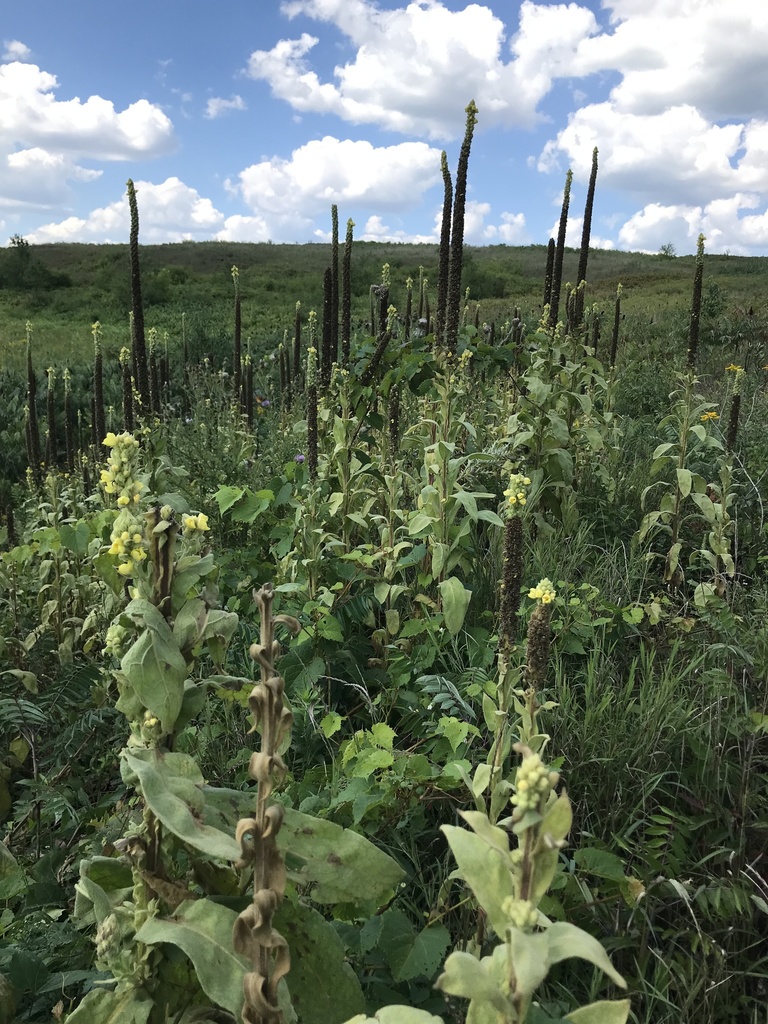
A biennial that spends its first year as a rosette of leaves as soft as felt, then sends up a 2 m spike of sulphur-yellow flowers. Its dried stalks, dipped in tallow, were once burned as torches.
Verbascum thapsus, the great mullein, greater mullein or common mullein, is a species of mullein native to Europe, northern Africa, and Asia, and introduced in the Americas, Australia and New Zealand. Wikipedia
What it can do
- iDense branched hairs shield the leaves from sun, drought and grazing
- iiSeeds stay viable in soil for many decades
- iiiColonises bare, burned or disturbed ground quickly
- ivA single plant can bear over 100,000 seeds
At the table
Leaves and flowers are used for tea only, and the irritating hairs must be strained out through fine cloth. Seeds contain saponins and have been used as fish poison; do not eat them.
In the medicine cabinet
| Tradition | Use |
|---|---|
| European folk medicine | Flower and leaf tea for coughs, bronchitis and sore throat; flower oil dropped into the ear for earache |
| Indigenous American | Adopted after introduction by nations including the Navajo, Cherokee and Iroquois, who smoked or brewed the leaves for coughs and asthma |
Weight of evidence
Traditional. Long historical use; little or no modern clinical evidence.
Active compounds
verbascoside (acteoside), aucubin, catalpol, saponins, mucilage, flavonoids
Fruit & seed

Fruit
Capsule
Ripens: Late summer–autumn
Woolly, egg-shaped two-valved capsule with many seeds.


Seed
~0.8 mm
Tiny, pitted, brown seeds
- Dispersal
- Shaken out by wind and passing animals; long-lived seed bank
- Germination
- Needs light; 1–3 weeks at 15–20 °C
Photographs from Wikimedia Commons under open licences; hover for the photographer, click for the file.
How to grow it
Hardiness (USDA zones)
USDA 3–9. Survives winters down to about -40 °C.
- Light
- Full sun
- Water
- Low
- Soil
- Dry, sandy or stony, well-drained
- Propagation
- Seed
- To harvest
- Leaves year 1; flowers year 2
- Climates
- Temperate, Mediterranean, Continental
- 1Check local status first, as it is invasive in some regions
- 2Surface-sow in spring or autumn
- 3Harvest leaves from first-year rosettes and flowers daily in year 2
- 4Cut spikes before seed sets to prevent spread
Can it grow where you are?
Where it lives
Recorded sightings
—
geo-referenced records in GBIF, from museums, herbaria and field observers.
Native range
Europe, North Africa and Asia; naturalised and invasive in North America, Australia and elsewhere
Drag the globe to turn it. Dots are where records exist, not a range map; darker means more records.
In the old herbals & bestiaries
Woodcuts and engravings matched from the Source Library’s scanned books by name. Plates marked “relative” show a close kin rather than this exact species. Click a plate to read the page it came from, with translation.

The Book of Health: The Art of Distillation
Brunschwig, Hieronymus · 1505 · p.257

Commentaries on the Six Books of Dioscorides on Medical Matter
Pietro Andrea Mattioli · 1563 · p.665

Notable Commentaries on the History of Plants
Leonhart Fuchs · 1542 · p.883

Notable Commentaries on the History of Plants
Leonhart Fuchs · 1549 · p.879

Commentaries on the Six Books of Dioscorides on Medical Matter
Pietro Andrea Mattioli · 1563 · p.664

Ortus sanitatis
1491 · p.466

Commentaries on the Six Books of Pedanius Dioscorides on Medical Matter
Pietro Andrea Mattioli · 1565 · p.1318

Commentaries on the Six Books of Pedanius Dioscorides on Medical Matter
Pietro Andrea Mattioli · 1565 · p.1320

Ortus sanitatis
1491 · p.448

Garden of Health (Hortus Sanitatis)
Jacob Meydenbach · 1491 · p.378
In the stacks
Searching the stacks…
Every page naming Verbascum thapsus in the Biodiversity Heritage Library →
Marginalia
Dried mullein stalks dipped in tallow were burned as torches ('hag's tapers'), and the woolly leaves were used as lamp wicks and as linings for shoes. Dioscorides recommended phlomos for coughs and eye complaints.
Curiosity
In W. J. Beal's buried-seed experiment, begun in Michigan in 1879, seeds of the related moth mullein still germinated after 120 years.
Kinship



Photographs: iNaturalist contributors under the licences shown. Records: GBIF.org. Historical plates: Source Library (CC BY-SA 4.0; originals public domain). Summary text: Nature Library editors and Wikipedia (CC BY-SA). Medicinal and edibility notes are historical and educational, not advice. iNaturalist taxon 59029.